
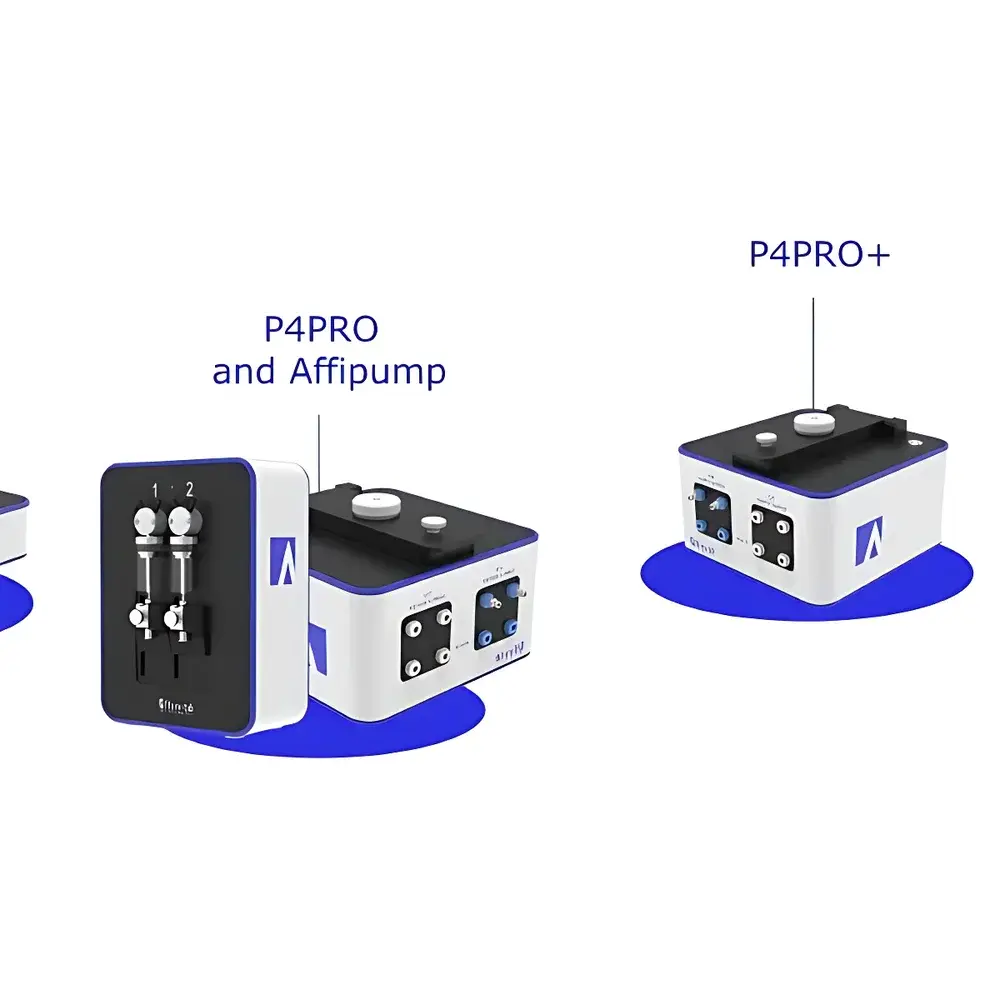
Affinité P4SPR Portable Surface Plasmon Resonance Molecular Interaction Analyzer
| Brand | Affinité |
|---|---|
| Origin | Canada |
| Model | P4SPR, P4PRO |
| Instrument Type | Surface Plasmon Resonance (SPR) |
| Channel Configuration | 4-channel (3 sample + 1 reference) |
| Detection Range | >88 Da |
| Sample Volume | 100 µL |
| Injection Volume | 10–200 µL |
| Analysis Time | 10 min |
| Temperature Control | Ambient |
| Light Source | Multicolor LED (550–750 nm) |
| Detector | High-uniformity gold thin-film sensor |
| Refractive Index Range | 1.333–1.390 RIU |
| Association Rate (kₐ) | 10³–10⁹ M⁻¹s⁻¹ |
| Dissociation Rate (k_d) | 10⁻⁶–10⁻¹ s⁻¹ |
| Affinity Range | pM–mM |
| Dimensions | ≤175 × 155 × 55 mm |
| Weight | <1.3 kg |
Overview
The Affinité P4SPR is a portable, benchtop-grade surface plasmon resonance (SPR) molecular interaction analyzer engineered for label-free, real-time quantification of biomolecular binding events. Based on the physical principle of evanescent wave coupling at a gold-dielectric interface, the P4SPR detects minute changes in local refractive index induced by mass accumulation on the sensor surface—enabling direct measurement of association and dissociation kinetics without fluorescent or enzymatic labeling. Its compact architecture integrates a multicolor LED light source (550–750 nm), high-uniformity gold-coated SPR chips, and precision photodetection to deliver reproducible angular or wavelength-shift measurements across four independent flow channels. Designed for operational flexibility, the system functions reliably at ambient temperature with no active thermal regulation—making it suitable for both controlled laboratory environments and field-deployable applications including environmental screening, point-of-need diagnostics, and process monitoring.
Key Features
- Four-channel SPR detection (3 sample + 1 reference) with real-time background subtraction for enhanced signal fidelity
- Label-free, real-time monitoring of binding kinetics (ka, kd) and equilibrium affinity (KD) across a dynamic range from pM to mM
- Minimal sample consumption: injection volumes adjustable between 10–200 µL; typical assay volume per cycle: 100 µL
- Compact footprint (≤175 × 155 × 55 mm) and lightweight design (<1.3 kg) enabling transport between labs, cleanrooms, or outdoor sampling sites
- Robust optical architecture utilizing wavelength-scanned multicolor LED illumination and high-stability gold thin-film sensors
- Flexible fluidics: supports manual syringe injection or integration with external peristaltic pumps—no valves, tubing wear, or maintenance-intensive microfluidics
- Validated performance in complex matrices including whole blood, milk, cell lysates, and environmental water samples without prior purification
- Patented sensor surface chemistries (US 8680233, US 8860943, US 898235) enabling low non-specific binding and tunable immobilization strategies
Sample Compatibility & Compliance
The P4SPR demonstrates broad compatibility with diverse analyte classes: small molecules (<88 Da), peptides, proteins, antibodies, nucleic acids, glycans, lipids, nanoparticles, viruses, whole cells, and microbial pathogens. Its refractive index operating window (1.333–1.390 RIU) accommodates undiluted biological fluids and turbid environmental samples. While not certified for clinical diagnostic use under FDA 510(k) or IVD directives, the instrument supports GLP-compliant data acquisition workflows through timestamped, audit-trail-enabled software logging. Raw output files are compatible with third-party analysis platforms—including TraceDrawer, Origin, MATLAB, and Excel—facilitating traceable kinetic modeling and statistical validation per ISO/IEC 17025 guidelines. Instrument calibration and sensor chip lot traceability align with common academic and industrial QC protocols for SPR-based assays.
Software & Data Management
Data acquisition and preliminary analysis are executed via a LabVIEW-based control interface optimized for intuitive operation and minimal training overhead. The software records full sensorgrams at user-defined temporal resolution, stores metadata (injection time, flow rate, buffer composition), and exports ASCII-formatted time-series data for downstream processing. All datasets include embedded timestamps and hardware identification codes, supporting version-controlled archiving and regulatory review. Export formats preserve native signal units (resonance units, RU) and enable conversion to mass density using standard calibration curves. No cloud dependency or proprietary binary formats are employed—ensuring long-term data accessibility and interoperability with institutional data management systems.
Applications
- Real-time characterization of antibody-antigen binding kinetics for therapeutic development and epitope binning
- Rapid screening of peptide–receptor interactions in GPCR and kinase target validation studies
- Environmental monitoring of pesticide residues, explosives (e.g., RDX), hormones (e.g., testosterone), and pharmaceutical contaminants in aqueous matrices
- Point-of-collection detection of pathogen-associated molecular patterns (PAMPs) in food safety and agricultural surveillance
- Quantitative analysis of protein–DNA/RNA interactions in transcription factor studies and CRISPR guide RNA off-target profiling
- Immunoassay development for cancer biomarker detection in minimally processed clinical lysates (e.g., HER2 in breast cancer cell extracts)
- Field-deployable pharmacokinetic monitoring of therapeutic proteins (e.g., asparaginase) during oncology treatment regimens
FAQ
Is the P4SPR compliant with FDA 21 CFR Part 11 for electronic records?
No—the P4SPR is intended for research use only (RUO) and does not implement electronic signature, role-based access control, or audit trail encryption required for Part 11 compliance.
Can the instrument operate outside a laboratory environment?
Yes—its passive thermal design, battery-compatible power input (12 V DC), and shock-resistant housing support deployment in mobile labs, greenhouses, wastewater treatment facilities, and remote field stations.
What sensor chip types are supported?
Affinité provides pre-functionalized Au chips with carboxymethyl dextran, streptavidin, Ni-NTA, and custom self-assembled monolayer (SAM) surfaces; users may also perform in-house thiol-based immobilization.
Does the system require regular recalibration?
No—gold film stability and LED spectral consistency ensure baseline drift <0.5 RU/hour; routine verification uses a reference glycerol series or known IgG–protein A interaction.
How is data integrity ensured during multi-user operation?
Each experiment file embeds operator ID, instrument serial number, sensor chip lot code, and UTC timestamp—enabling full chain-of-custody documentation without additional middleware.




