
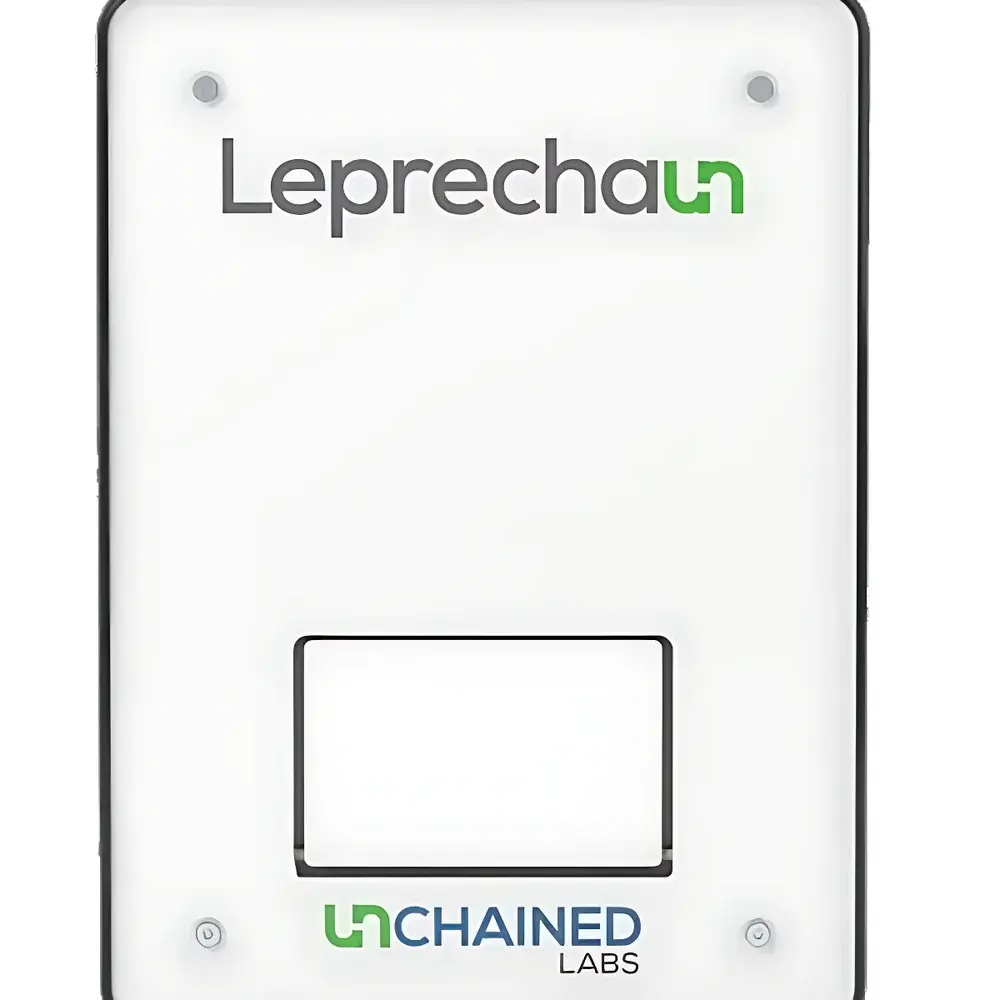
Unchained Labs Leprechaun Single-Particle Immuno-Structural Analyzer for Lentiviral and Extracellular Vesicle Characterization
| Brand | Unchained Labs |
|---|---|
| Origin | USA |
| Model | Leprechaun |
| Application | Single-particle immuno-structural analysis of lentiviral vectors and extracellular vesicles (e.g., exosomes) |
| Detection Principle | Fluorescence-based single-particle imaging coupled with antibody- and probe-mediated orthogonal labeling |
| Sensitivity | ≥1 × 10⁷ particles/mL |
| Particle Sizing Range | ~30–200 nm (diameter) |
| Capture Flexibility | Compatible with anti-VSV-G, anti-gp70, or user-provided custom capture antibodies |
| Nucleic Acid Detection | RNA-specific fluorescent probes (e.g., Quasar 670-labeled oligos) |
| Structural Discrimination | Simultaneous detection of capsid protein (e.g., p24), envelope glycoprotein (e.g., VSV-G), and genomic RNA |
| Aggregation Assessment | Quantitative resolution of monodisperse virions vs. dimers, trimers, and higher-order aggregates |
| Regulatory Alignment | Designed to support process development under ICH Q5A(R2), USP <1043>, and FDA CMC guidance for gene therapy products |
Overview
The Unchained Labs Leprechaun is a purpose-built, fluorescence-enabled single-particle analyzer engineered for the biophysical characterization of lentiviral vectors (LVs) and extracellular vesicles (EVs), including exosomes. Unlike bulk ensemble methods—such as ELISA, qPCR, or nanoparticle tracking analysis (NTA)—the Leprechaun operates on a true single-particle basis, resolving individual virions and vesicles in suspension without averaging or inference. Its core measurement principle integrates high-sensitivity widefield fluorescence microscopy with precisely calibrated fluidics and automated image acquisition. Each particle is interrogated simultaneously across multiple spectral channels: one for capture antibody signal (e.g., anti-VSV-G conjugated to Alexa Fluor 488), one for capsid protein label (e.g., anti-p24 labeled with AF647), and one for RNA-specific hybridization probe signal (e.g., Quasar 670–labeled oligonucleotides targeting the LV genome). This orthogonal, three-parameter readout enables unambiguous classification of functional integrity states—including “intact” (capsid⁺/RNA⁺), “empty” (capsid⁺/RNA⁻), “naked RNA” (capsid⁻/RNA⁺), and “degraded/non-assembled” (capsid⁻/RNA⁻)—as well as detection and quantification of aggregation events across defined size thresholds.
Key Features
- Single-particle resolution at concentrations as low as 1 × 10⁷ particles/mL, eliminating dilution bias and enabling direct analysis of crude harvests and purified formulations.
- Modular immuno-capture platform compatible with commercial anti-VSV-G, anti-gp70, or customer-supplied custom antibodies immobilized on functionalized glass surfaces.
- Simultaneous triple-channel fluorescence detection optimized for standard filter sets (488 nm, 647 nm, 670 nm), supporting multiplexed structural phenotyping without sequential staining.
- Automated particle sizing and morphology analysis using diffraction-limited spot intensity profiles and centroid-based diameter estimation (30–200 nm range).
- Integrated aggregation scoring algorithm that classifies particles as monomeric, dimeric, trimeric, or higher-order clusters based on inter-particle distance and co-localization confidence.
- Robust thermal and mechanical stability—designed for continuous operation in GMP-aligned cleanroom environments (ISO Class 7 compatible).
Sample Compatibility & Compliance
The Leprechaun accepts clarified supernatants, ultracentrifugation pellets resuspended in physiological buffers (e.g., PBS + 0.1% BSA), and chromatography-fractionated LV preparations without requirement for concentration or purification. It is validated for use with third-generation self-inactivating (SIN) lentiviral constructs, pseudotyped variants (VSV-G, RD114, GALV), and non-viral extracellular vesicles isolated via SEC, ultrafiltration, or density gradient centrifugation. From a regulatory perspective, the system supports data integrity requirements per 21 CFR Part 11 when operated with Unchained Labs’ compliant software suite (including electronic signatures, audit trails, and user access controls). Its output metrics align with ICH Q5A(R2) recommendations for vector characterization and USP <1043> guidelines for ancillary viral vectors used in cell and gene therapy manufacturing.
Software & Data Management
Acquisition and analysis are managed through Unchained Labs’ proprietary Leprechaun Software v3.x, a Windows-based application built on .NET Framework with SQLite-backed local database architecture. The software provides real-time visualization of particle events, batch-level QC dashboards, and export of structured CSV/Excel reports containing per-particle metadata (intensity values, spatial coordinates, classification labels, size estimates). All raw image stacks and processed tables are timestamped and cryptographically hashed to ensure traceability. Audit trail functionality logs every user action—including parameter changes, reanalysis events, and report generation—with immutable timestamps and operator IDs. Data export formats comply with CDISC SDTM standards for integration into enterprise LIMS or QMS platforms.
Applications
- Process development: Monitoring capsid:RNA stoichiometry across upstream harvest timepoints and downstream purification steps (e.g., anion exchange, affinity chromatography).
- Lot release testing: Quantifying % intact particles as a critical quality attribute (CQA) correlated with transduction efficiency in target cells.
- Stability assessment: Tracking aggregation onset and empty particle accumulation during frozen storage or thermal stress studies.
- Comparability studies: Demonstrating equivalence between manufacturing scale-up batches or post-process changes (e.g., new plasmid backbone or packaging cell line).
- Exosome characterization: Differentiating EV subpopulations by surface marker expression (e.g., CD63, CD81) and cargo loading (miRNA, lncRNA) using analogous dual-labeling strategies.
FAQ
Can the Leprechaun distinguish between lentiviral particles and non-infectious defective interfering particles (DIPs)?
Yes—by combining capsid protein signal intensity, RNA probe hybridization efficiency, and particle size distribution, the system identifies DIPs as small, RNA-rich but capsid-deficient particles, distinct from full-length LVs and empty capsids.
Is sample preparation standardized, or does it require optimization per construct?
Capture antibody selection and incubation time must be empirically optimized for each pseudotype and surface glycoprotein; however, the core workflow (blocking, binding, washing, labeling, imaging) remains consistent across applications.
Does the system support GMP documentation packages for regulatory submissions?
Unchained Labs provides IQ/OQ documentation templates, 21 CFR Part 11 validation support packages, and change control records upon request—intended for use by qualified internal QA teams or third-party validation consultants.
How does Leprechaun data correlate with functional titer assays (e.g., TU/mL measured by flow cytometry)?
Published correlation studies show R² > 0.92 between % intact particles (capsid⁺/RNA⁺) and transducing units/mL across multiple LV lots and cell lines, confirming its utility as a predictive physicochemical surrogate for infectivity.
Can the instrument be integrated into automated liquid handling workflows?
Yes—the Leprechaun features RS-232 and Ethernet interfaces for external triggering and status polling; it has been successfully interfaced with Hamilton STAR and Tecan Fluent systems for walk-away sample loading in high-throughput process characterization labs.
Related Products



