
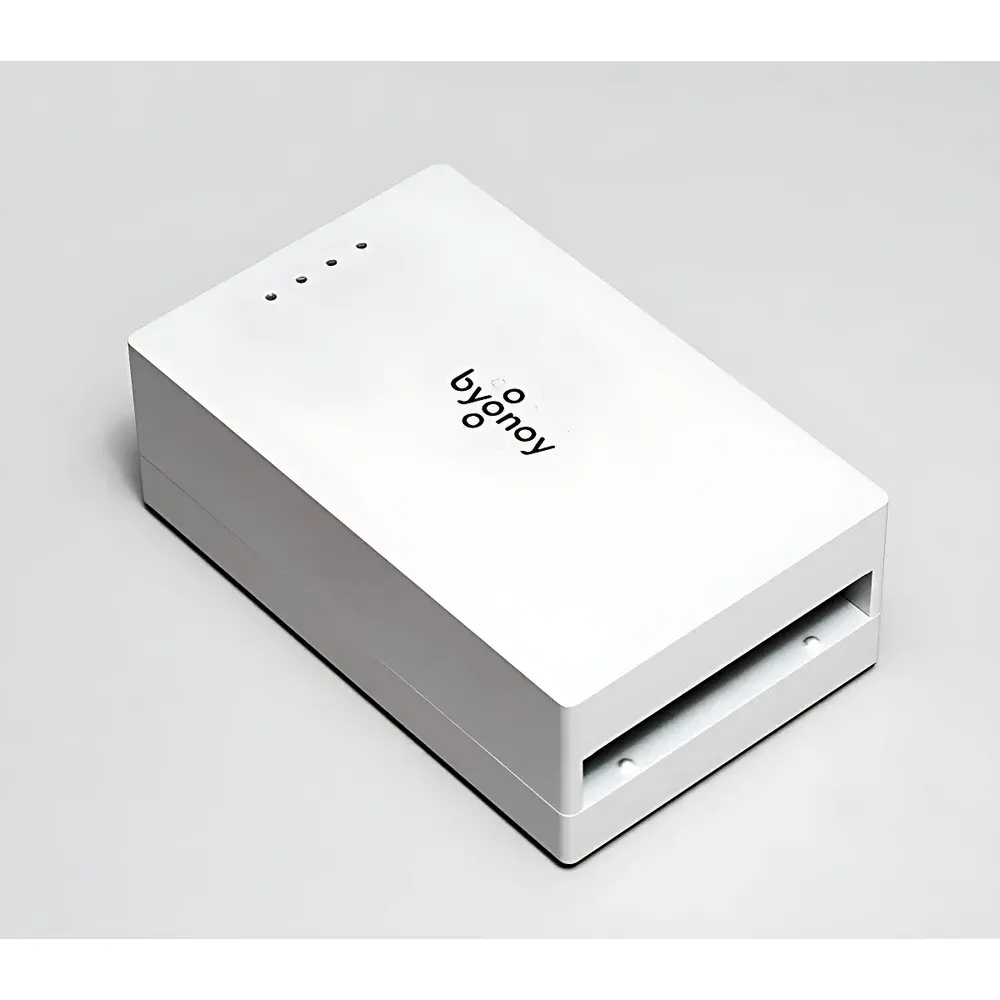
Byonoy Absorbance 96 Compact Solid-State Microplate Reader
| Brand | Byonoy |
|---|---|
| Origin | Germany |
| Model | Absorbance 96 |
| Automation Level | Fully Automated |
| Measurement Modes | Endpoint & Kinetic |
| Wavelength Options | 405, 450, 492, 620 nm / 405, 450, 540, 630 nm / 492, 562, 605, 650 nm |
| Optical Density Range | 0.0–4.0 OD |
| Linearity (at 405 nm) | ≤1.5% (0–2 OD), ≤3.0% (2–3 OD) |
| (≥450 nm) | ≤1.0% (0–2 OD), ≤1.5% (2–3 OD) |
| Accuracy | 405 nm: ≤1.5% + 0.010 OD (0–2 OD), ≤3.0% + 0.010 OD (2–3 OD) |
| ≥450 nm | ≤1.0% + 0.010 OD (0–2 OD), ≤1.5% + 0.010 OD (2–3 OD) |
| Detection Speed | ≤5 seconds per wavelength (single-read mode) |
| Detector Architecture | 96-channel solid-state photodiode array |
| Curve Fitting Algorithms | Point-to-point, Linear Regression, Four-Parameter Logistic (4PL), Five-Parameter Logistic (5PL) |
Overview
The Byonoy Absorbance 96 is a fully automated, compact solid-state microplate reader engineered for high-throughput absorbance measurements in life science laboratories. Unlike conventional scanning-based plate readers that rely on moving optical components and sequential well interrogation, the Absorbance 96 employs a fixed 96-channel photodiode array—each channel aligned directly to one well of a standard 96-well microplate. This architecture eliminates mechanical motion, reducing wear, thermal drift, and measurement variability. The instrument operates on the principle of single-wavelength or dual-wavelength absorbance photometry, compliant with Beer–Lambert law fundamentals, and delivers quantitative optical density (OD) values across a broad spectral range (400–1000 nm). Its ultra-compact footprint (9.6 × 15.4 × 5.5 cm) and plug-and-play USB connectivity make it suitable for benchtop deployment in core facilities, QC labs, teaching laboratories, and field-deployable diagnostic settings where space, reliability, and reproducibility are critical.
Key Features
- Solid-State 96-Channel Detection: No moving parts—no motorized filter wheels, no scanning mirrors, no carriage movement. Each photodiode is permanently calibrated and optically isolated, ensuring consistent inter-well sensitivity and eliminating positional bias.
- Sub-5-Second Read Time: Full-plate acquisition completed in ≤5 seconds per selected wavelength, enabling rapid kinetic profiling without time-lag artifacts between wells.
- Modular Filter Compatibility: Interchangeable interference filters support user-defined wavelength combinations—including standardized ELISA bands (405, 450, 492, 620 nm) and extended options (e.g., 540, 562, 605, 630, 650 nm)—all within the 400–1000 nm operational window.
- Traceable Photometric Performance: Linearity and accuracy specifications meet ISO 15197:2013 and CLSI EP6-A guidelines for clinical absorbance instrumentation. Calibration traceability is maintained via factory-certified reference standards and optional user-performed verification with NIST-traceable neutral density filters.
- Cross-Platform Software Integration: Native drivers and API support for Windows (7/10/11) and macOS (12–14), with export formats including CSV, Excel (.xlsx), and structured JSON for LIMS and ELN interoperability.
Sample Compatibility & Compliance
The Absorbance 96 is validated for use with standard ANSI/SBS-compliant 96-well polystyrene, polypropylene, and UV-transparent microplates—including low-volume and black-walled plates for reduced crosstalk. It supports both clear-bottom and opaque-bottom formats without hardware modification. The system complies with IEC 61010-1 (Safety Requirements for Electrical Equipment for Measurement, Control, and Laboratory Use) and EMC Directive 2014/30/EU. For regulated environments, audit trail functionality, electronic signature support, and user access control are available through optional firmware modules aligned with FDA 21 CFR Part 11 and EU Annex 11 requirements. Routine operation adheres to GLP principles, and raw data files include embedded metadata (timestamp, operator ID, plate map, filter ID, gain setting) to satisfy ISO/IEC 17025 documentation mandates.
Software & Data Management
The bundled Byonoy Analyze software provides an intuitive graphical interface for protocol setup, real-time monitoring, and post-acquisition analysis. All curve-fitting algorithms—including point-to-point interpolation, linear regression, and asymmetric sigmoidal models (4PL and 5PL)—are implemented using numerically stable Levenberg–Marquardt optimization with convergence diagnostics. Raw absorbance values are stored in HDF5 format, preserving bit-depth fidelity and enabling batch reprocessing with updated calibration coefficients. Export modules support direct integration with laboratory information management systems (LIMS) via RESTful API endpoints and scheduled FTP/SFTP uploads. Version-controlled method templates can be shared across instruments, ensuring analytical consistency across multi-site deployments.
Applications
- ELISA Quantification: Supports chromogenic substrates including TMB (450/620 nm dual-wavelength), OPD (492 nm), ABTS (405 nm), and PNPP (405 nm), with built-in background subtraction and blank correction routines.
- Protein Assays: Validated for Bradford (595 nm), BCA (562 nm), and Lowry (750 nm) protocols using appropriate filter configurations.
- Cell Viability & Proliferation: Enables MTT (570 nm), XTT (450 nm), and resazurin-based assays with kinetic slope analysis for metabolic activity profiling.
- Enzyme Kinetics: Time-resolved absorbance monitoring at user-defined intervals (1–3600 s), with automatic calculation of initial reaction rates (V₀) and Michaelis–Menten parameters when coupled with concentration gradients.
- Microbial Growth Monitoring: OD600 tracking in bacterial cultures using 600–650 nm filters, with configurable alarm thresholds and auto-pause triggers.
FAQ
Is the Absorbance 96 compatible with 384-well plates?
No—it is optimized exclusively for 96-well microplates per ANSI/SBS dimensional standards. Attempting to use higher-density plates will result in incomplete illumination and non-uniform signal capture.
Can I perform dual-wavelength measurements automatically?
Yes—the software supports simultaneous or sequential acquisition at two user-selected wavelengths, with built-in ratio calculation (e.g., 450 nm/620 nm for ELISA) and differential correction.
Does the system require routine recalibration?
The solid-state architecture ensures long-term photometric stability. Annual verification using certified reference standards is recommended; full recalibration is only required after physical impact or environmental exposure beyond specified operating conditions (15–30 °C, <80% RH, non-condensing).
How is data integrity ensured during power interruption?
All active measurements are buffered in non-volatile memory. Upon recovery, the software resumes acquisition from the last completed well and logs the event in the audit trail with timestamp and error code.
Is remote monitoring supported?
Yes—via optional Ethernet module and web-based dashboard (HTTPS-enabled), allowing real-time status viewing, queue management, and secure file retrieval from any authorized network endpoint.




