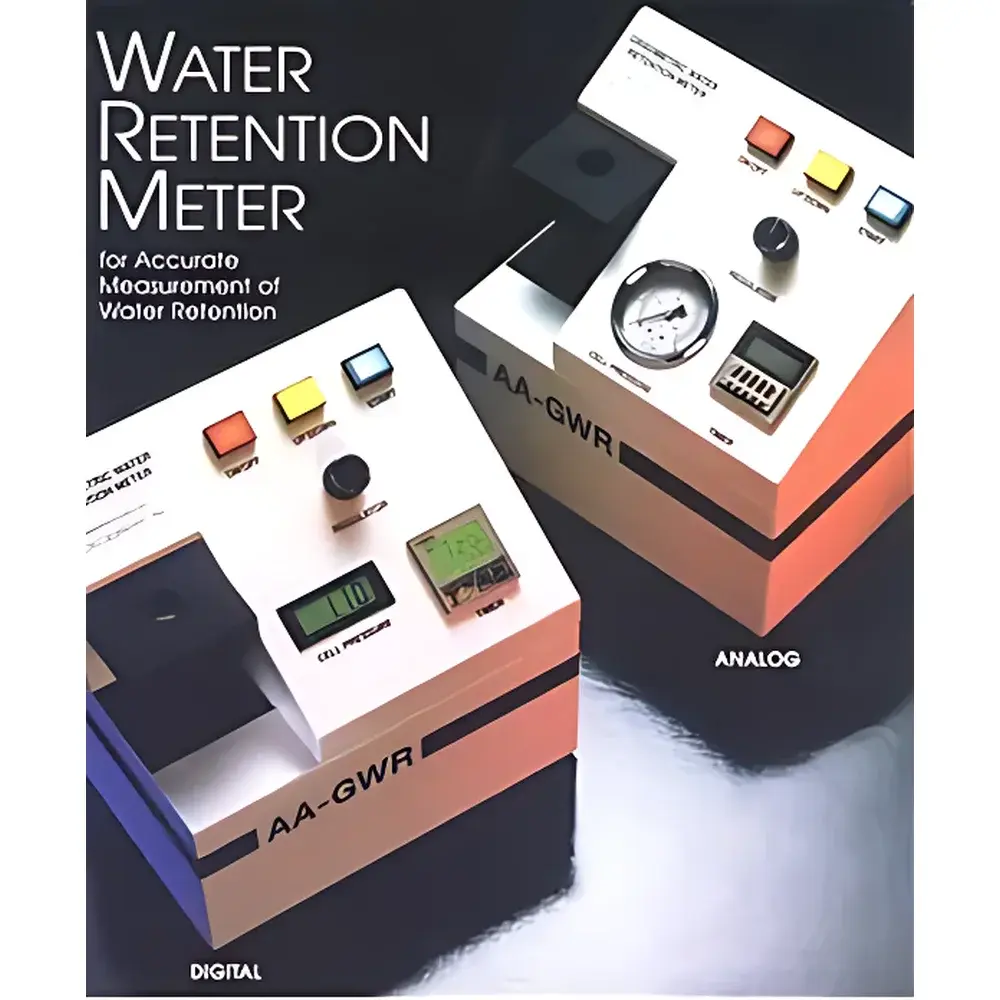
Kaltec AA-GWR250 Paint Water Retention Tester
| Origin | USA |
|---|---|
| Manufacturer Type | Authorized Distributor |
| Origin Category | Imported |
| Model | AA-GWR250 |
| Pricing | Available Upon Request |
| Test Chamber Area | 8.0 cm² |
| Sample Volume | 10 mL |
| Pressure Range | 0–30 psi (0–2.07 bar) |
| Pressure Control Accuracy | ±1% of full scale |
| Input Air Supply | 80–100 psi (5.5–7.0 bar) |
| Power Supply | 220 V AC |
| Timer Range | 0.1–9990 s (LCD digital display) |
| Net Weight | 18 lbs (8.2 kg) |
| Dimensions (H × W × D) | 10 × 10 × 7 in (254 × 254 × 178 mm) |
Overview
The Kaltec AA-GWR250 Paint Water Retention Tester is a precision-engineered instrument designed to quantify the water retention capacity of water-based architectural coatings, mortars, grouts, and cementitious slurries under controlled, reproducible pressure conditions. It operates on the principle of pressure-driven filtration: a defined volume of sample is subjected to a regulated air pressure across a standardized filter medium, and the mass of filtrate collected over time is used to calculate water retention percentage—defined as [(initial water content − filtrate mass) / initial water content] × 100. This method aligns with industry-standard test protocols referenced in ASTM C1326 (Standard Test Method for Water Retention of Hydraulic Cement-Based Mortars) and EN 1015-18 (Methods of Test for Mortar for Masonry — Part 18: Determination of Water Absorption Coefficient by Capillary Suction). The AA-GWR250 employs a closed-loop servo-controlled pneumatic system that continuously monitors chamber pressure via a high-stability piezoresistive sensor and dynamically adjusts two proportional solenoid valves to maintain setpoint accuracy within ±1% of full scale—critical for inter-laboratory comparability and QC repeatability.
Key Features
- Servo-controlled pressure regulation system with real-time feedback loop ensures stable, drift-free pressure application across the full 0–30 psi (0–2.07 bar) range.
- Dual-valve architecture enables rapid pressure ramping and fine-grained stabilization—minimizing overshoot and settling time during transient phases.
- Integrated high-resolution LCD timer (0.1 s resolution, up to 9990 s) synchronized with pressure acquisition for precise endpoint definition.
- Standardized 8.0 cm² test chamber area and 10 mL sample volume comply with ASTM and EN geometrical requirements, eliminating dimensional variability between labs.
- Robust aluminum alloy chassis and sealed electronics provide long-term operational stability in humid, high-dust environments typical of construction materials testing labs.
- Modular filter holder accepts standard 47 mm diameter membrane filters (e.g., cellulose acetate, polyethersulfone), enabling method flexibility per material matrix.
Sample Compatibility & Compliance
The AA-GWR250 is validated for use with water-dispersed systems including acrylic, styrene-acrylic, vinyl acetate, and PVA-based paints; polymer-modified cement mortars; tile adhesives; self-leveling underlayments; and gypsum-based plasters. Its mechanical design conforms to ISO/IEC 17025:2017 general requirements for competence of testing and calibration laboratories. When operated with documented SOPs—including pre-test conditioning (23 °C ± 2 °C, 50% RH ± 5%), calibrated pressure transducers (NIST-traceable), and gravimetrically verified filtrate collection—the instrument supports GLP-compliant data generation. Optional audit trail logging (via external PC interface) facilitates alignment with FDA 21 CFR Part 11 requirements for electronic records in regulated quality control environments.
Software & Data Management
While the AA-GWR250 operates as a standalone benchtop unit with embedded firmware, it features an RS-232 serial port (DB9) for optional integration with third-party data acquisition software. Users may export timestamped pressure and timer values at user-defined intervals (e.g., every 0.5 s) for post-processing in Excel, MATLAB, or LIMS platforms. Kaltec provides a free Windows-compatible configuration utility for firmware updates, pressure calibration offset adjustment, and timer preset storage. All internal firmware adheres to IEC 61508 functional safety principles for embedded control systems, ensuring deterministic response timing and fault detection during pressure actuation.
Applications
- Formulation screening: Quantifying comparative water retention performance of different thickeners (HEC, HPMC, xanthan gum) or redispersible polymer powders.
- Batch release testing: Verifying consistency of water retention across production lots of ready-mix mortars prior to dispatch.
- R&D correlation studies: Correlating GWR results with rheological parameters (e.g., yield stress, low-shear viscosity) measured on rotational rheometers.
- Technical service support: Troubleshooting field issues such as sagging, poor open time, or premature skinning by linking low water retention to formulation instability.
- Standards compliance reporting: Generating test reports compliant with ASTM C1326 Annex A1 or EN 1015-18 Clause 6 for certification submissions.
FAQ
What filter types are recommended for use with the AA-GWR250?
Cellulose acetate (0.45 µm pore size) is recommended for latex paints; polyethersulfone (0.22 µm) is preferred for cementitious slurries to prevent particle clogging. Filter selection must be documented in the test report.
Is the instrument compatible with 110 V power supplies?
No—the AA-GWR250 is configured exclusively for 220 V AC, 50/60 Hz operation. A step-down transformer is required for use in North American 110 V environments.
Can the pressure setpoint be programmed in bar instead of psi?
Yes—the LCD interface displays both units simultaneously; users may enter setpoints in either psi or bar using the dual-unit keypad input mode.
How often does the pressure sensor require recalibration?
Kaltec recommends annual NIST-traceable recalibration; however, daily zero-check using atmospheric reference and quarterly span verification against a deadweight tester are advised for critical QC applications.
Does the AA-GWR250 meet CE marking requirements?
Yes—it complies with EU Machinery Directive 2006/42/EC and Electromagnetic Compatibility Directive 2014/30/EU, and carries the CE mark affixed to the rear panel.