
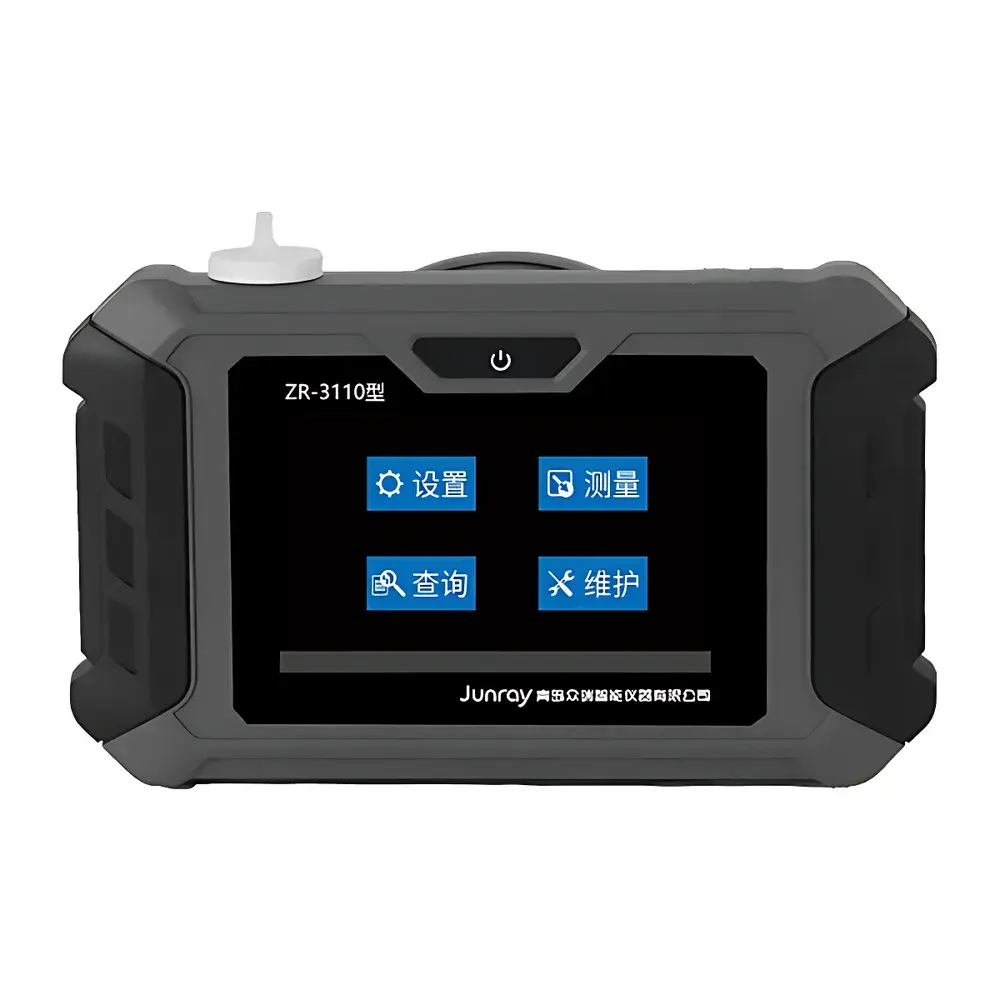
Junray ZR-3110C Portable Multi-Gas Detector
| Brand | Junray |
|---|---|
| Origin | Shandong, China |
| Manufacturer Type | Direct Manufacturer |
| Product Category | Domestic |
| Model | ZR-3110C |
| Detection Target | VOCs (Volatile Organic Compounds) |
| Sensor Technologies | Electrochemical (EC), Catalytic Bead (LEL), Photoionization Detection (PID) |
| Compliance Standards | GB 12358–2006, HJ 872–2017, GBZ 2.1–2019, GB/T 36198–2018, JJF 1172–2007, JJG 915–2008, JJG 635–2011, JJG 551–2003, JJG 695–2003, JJG 693–2011, Q/0214 ZRB008–2017 |
Overview
The Junray ZR-3110C Portable Multi-Gas Detector is an integrated field-deployable instrument engineered for real-time, on-site detection of volatile organic compounds (VOCs) and select toxic/combustible gases in ambient air, soil gas, and industrial process environments. Designed specifically for emergency response, occupational hygiene assessment, and leak detection in petrochemical infrastructure, the ZR-3110C employs a tri-sensor architecture combining electrochemical (EC), catalytic bead (LEL), and photoionization detection (PID) technologies. This hybrid sensing strategy enables simultaneous quantification of target analytes—including CO, H2S, SO2, Cl2, combustible hydrocarbons (0–100% LEL), and broad-spectrum VOCs (1–6000 ppm isobutylene-equivalent)—without cross-interference or signal saturation under transient exposure conditions. The device operates on diffusion-based sampling with optional integrated pump-assisted soil gas extraction, ensuring representative measurement across heterogeneous matrices. Its compact form factor (220 × 95 × 65 mm), IP65-rated enclosure, and 12-hour continuous runtime support extended deployment in confined spaces, outdoor spill zones, and mobile vehicle-mounted monitoring configurations.
Key Features
- Triple-sensor platform: Electrochemical cells for specific toxic gases (CO, H2S, SO2, Cl2), catalytic bead sensor for combustible gas (0–100% LEL), and 10.6 eV UV lamp PID for non-specific VOC screening
- Auto-zeroing and span calibration routines compliant with JJF 1172–2007 and JJG 693–2011 metrological requirements
- Real-time data logging with timestamped records stored internally (≥100,000 data points) and exportable via USB or Bluetooth to PC-based analysis software
- Backlit OLED display with intuitive icon-driven interface supporting dual-unit readouts (ppm/ppb for VOCs; %LEL for combustibles; mg/m³ for toxics)
- Ruggedized housing meeting IP65 ingress protection and MIL-STD-810G shock/vibration specifications for field durability
- Battery-powered operation using rechargeable Li-ion pack (7.4 V, 3200 mAh) with low-power sleep mode and battery-level indicator
Sample Compatibility & Compliance
The ZR-3110C is validated for direct ambient air sampling and indirect soil gas analysis using standardized probe-based extraction per GB/T 36198–2018. It supports passive diffusion sampling for routine area monitoring and active pumped sampling (flow rate: 300–500 mL/min) for low-concentration or high-humidity environments. All sensor modules are factory-calibrated against NIST-traceable reference standards and certified to meet national regulatory performance criteria outlined in GB 12358–2006 (general gas detector technical requirements), HJ 872–2017 (emergency toxic gas monitoring), and GBZ 2.1–2019 (occupational exposure limits). Device firmware includes audit trail functionality for GLP-aligned recordkeeping, and calibration logs retain operator ID, date/time stamp, and standard gas concentration—supporting traceability during internal QA audits or third-party verification.
Software & Data Management
Junray’s proprietary ZR-DataLink software (Windows-compatible) enables configuration, firmware updates, historical data visualization, and report generation in PDF/CSV formats. The software enforces user-level access control (administrator/operator modes) and maintains immutable calibration history per sensor channel. Raw sensor outputs are time-synchronized and annotated with environmental parameters (temperature, relative humidity) captured by onboard micro-sensors. Exported datasets include metadata fields required for regulatory submission under Chinese MEE guidelines and align with international data integrity expectations referenced in ISO/IEC 17025:2017 Clause 7.5. All stored measurements are encrypted at rest and support optional digital signature authentication for chain-of-custody documentation.
Applications
- Emergency response to chemical spills or pipeline ruptures—rapid identification of VOC plumes and co-emitted toxics
- Ongoing occupational exposure assessment in refineries, paint booths, and solvent-handling facilities per GBZ 2.1–2019 compliance protocols
- Pre-commissioning leak detection in storage tanks, flanges, valves, and transfer lines using sniffer-mode PID scanning
- Soil vapor intrusion (SVI) screening at brownfield sites using thermal probe coupling and time-weighted average (TWA) calculation
- Indoor air quality (IAQ) surveys in remediation projects where formaldehyde, benzene, and chlorinated solvents require sub-ppb sensitivity
FAQ
What gases does the ZR-3110C detect simultaneously?
It detects up to four gas types concurrently: one toxic gas (e.g., CO or H2S) via electrochemical sensor, combustible gas (%LEL) via catalytic bead, VOCs (1–6000 ppm isobutylene eq.) via PID, and optionally a second toxic gas depending on sensor configuration.
Is the PID sensor interchangeable and field-replaceable?
Yes—the 10.6 eV UV lamp and ion chamber assembly are modular and can be replaced without recalibration when following Junray’s documented procedure and using certified replacement parts.
Does the instrument support data export for regulatory reporting?
Yes—CSV exports include ISO 8601 timestamps, sensor IDs, raw analog outputs, temperature/humidity compensation flags, and operator annotations required for MEE or provincial environmental bureau submissions.
How often must the electrochemical sensors be calibrated?
Initial calibration is performed pre-shipment. Field users should perform bump tests before each shift and full calibration every 30 days or after exposure to >10× full-scale concentration, per JJG 915–2008 and JJG 551–2003 recommendations.
Can the ZR-3110C be used for soil gas sampling without accessories?
No—soil gas sampling requires the optional ZR-SGK soil gas kit (stainless steel probe, vacuum pump module, and moisture trap), which interfaces directly with the instrument’s auxiliary port and activates automatic flow compensation algorithms.
Related Products







