
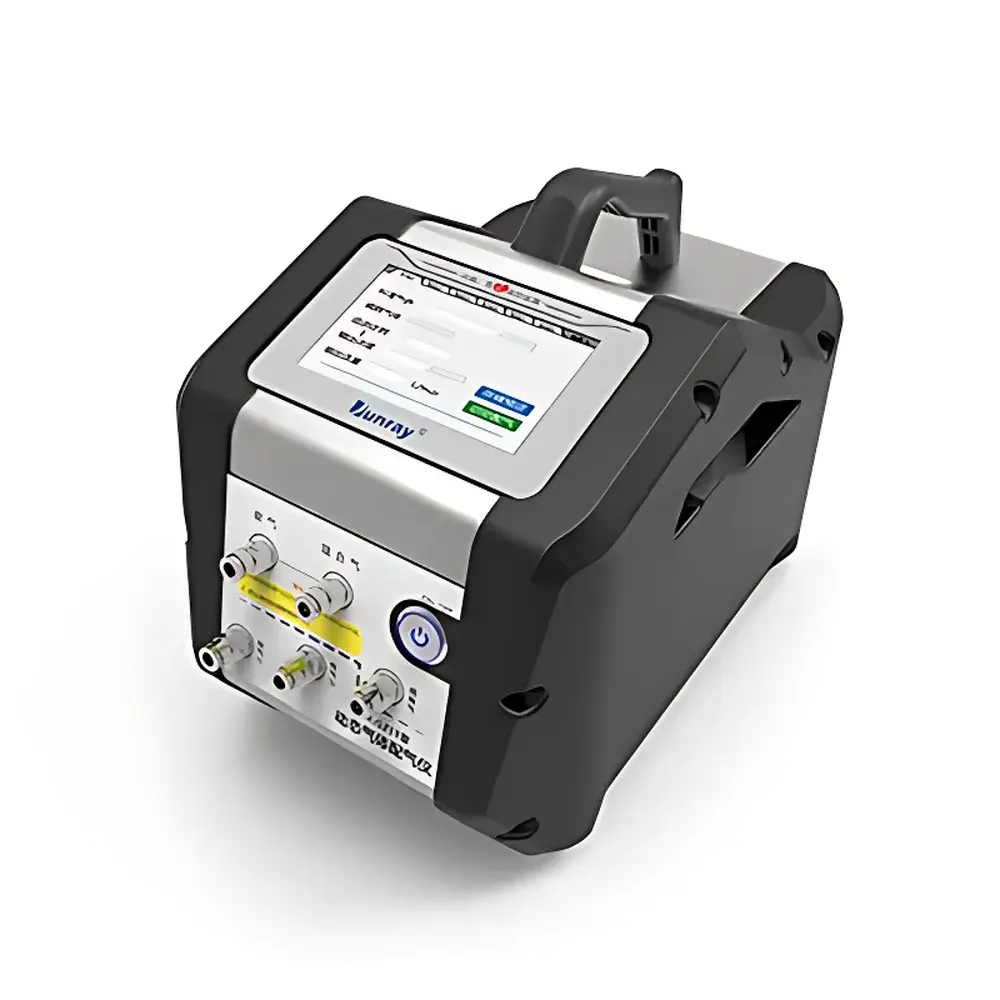
Junray ZR-5211E Dynamic Gas Dilution System
| Brand | Junray |
|---|---|
| Model | ZR-5211E |
| Origin | Shandong, China |
| Manufacturer Type | Original Equipment Manufacturer (OEM) |
| Category | Dynamic Gas Dilutor for Environmental Emission Monitoring |
| Compliance | GB/T 5275.7–2014, HJ 57–2017 |
| Power Supply | AC/DC Dual-mode (100–240 VAC / 24 VDC) |
| Gas Channels | 3 independent mass flow-controlled inlets |
| Display | 7-inch color TFT touchscreen with localized Chinese UI |
| Construction | Corrosion-resistant & low-adsorption gas path materials (e.g., electropolished 316L SS, PFA-lined fittings) |
| Price Range | USD 7,000 – 14,000 (FOB Qingdao) |
Overview
The Junray ZR-5211E Dynamic Gas Dilution System is an OEM-engineered instrument designed for precise, real-time preparation of certified calibration gas mixtures from high-concentration standard gases. It operates on the dynamic volumetric dilution principle—utilizing thermal mass flow controllers (MFCs) to regulate and blend primary gas streams with zero air or nitrogen carrier gas under continuous laminar flow conditions. This method ensures traceable, gravimetrically equivalent concentration outputs without reliance on static cylinder-based blends, thereby eliminating batch-to-batch variability and enabling on-demand generation of multi-point calibration standards across ppmv to %v/v ranges. The system is purpose-built for regulatory compliance in fixed-source emission monitoring, particularly for SO₂ calibration per HJ 57–2017, and aligns with the metrological framework defined in GB/T 5275.7–2014 for dynamic gas mixture preparation using thermal MFCs.
Key Features
- Three independently controlled thermal mass flow channels—each calibrated to ±1% full-scale accuracy with repeatability better than ±0.2% FS—enabling simultaneous delivery of up to three source gases or sequential multi-step dilution protocols.
- Gas pathways constructed from electropolished 316L stainless steel tubing and PFA-lined valves and fittings to minimize surface adsorption, catalytic decomposition, and corrosion—critical for reactive species including SO₂, NOₓ, NH₃, Cl₂, and H₂S.
- Dual-mode power architecture supports both line-powered operation (100–240 VAC, 50/60 Hz) and field-deployable DC input (24 VDC), allowing uninterrupted use during stack testing, mobile lab deployments, or emergency calibration response.
- Integrated 7-inch capacitive touchscreen interface with intuitive Chinese-language menu navigation—supporting real-time flow visualization, stepwise dilution ratio programming, and manual override modes without external PC dependency.
- Ruggedized enclosure rated IP54 for dust and splash resistance, optimized for ambient operating temperatures from 5 °C to 40 °C and relative humidity up to 80% non-condensing—suitable for both laboratory and outdoor stack-side environments.
Sample Compatibility & Compliance
The ZR-5211E accommodates a broad spectrum of calibration gases—including but not limited to SO₂, NO, NO₂, CO, CO₂, O₂, CH₄, and volatile organic compounds (VOCs)—provided they are compatible with its wetted materials and fall within the operational pressure and temperature envelope (up to 300 kPa inlet pressure, ≤50 °C). Its design conforms to the technical requirements of GB/T 5275.7–2014 for dynamic dilution systems used in analytical reference gas generation, and supports method validation for HJ 57–2017 (determination of SO₂ in stationary source exhaust via potentiostatic electrolysis). While not inherently 21 CFR Part 11 compliant, audit-ready operation can be achieved when paired with validated third-party data logging software that implements electronic signatures, change control, and secure audit trails.
Software & Data Management
The embedded firmware provides local storage of up to 1,000 dilution recipes, each timestamped and annotated with operator ID, target concentration, base gas identity, and flow parameters. All configuration changes and runtime events—including MFC diagnostics, alarm triggers, and power mode transitions—are logged internally with UTC timestamps. Export is supported via USB flash drive in CSV format for integration into LIMS or QA/QC reporting workflows. Optional RS-485 Modbus RTU and Ethernet TCP/IP interfaces enable remote monitoring and synchronization with central SCADA or CEMS platforms—facilitating automated calibration scheduling and traceability documentation per ISO/IEC 17025 requirements.
Applications
- Primary and secondary calibration of fixed-source CEMS analyzers (SO₂, NOₓ, CO) in thermal power plants, cement kilns, and waste incinerators.
- Verification and drift correction of portable gas detectors (e.g., electrochemical, NDIR, PID sensors) prior to field deployment.
- Generation of multi-level calibration curves for laboratory-grade gas chromatographs (GC) and Fourier-transform infrared (FTIR) spectrometers.
- Support of method development and inter-laboratory comparison studies requiring metrologically traceable gas standards.
- On-site validation of sensor response linearity and zero/span stability under variable environmental conditions.
FAQ
Does the ZR-5211E support automatic calibration sequence execution?
Yes—the system allows pre-programmed multi-step dilution sequences with timed dwell periods and auto-switching between gas sources, configurable via the touchscreen or exported recipe files.
Is external certification required for traceability to national standards?
While the unit’s MFCs are factory-calibrated against NIST-traceable references, end-users must perform periodic verification using certified reference gases and document results per ISO/IEC 17025 or internal QA procedures.
Can the ZR-5211E be integrated into an existing CEMS validation protocol?
Yes—it meets the functional requirements for dynamic dilution systems outlined in HJ 75–2017 and is routinely deployed alongside CEMS performance evaluation kits for span/zero checks and linearity verification.
What maintenance intervals are recommended for long-term reliability?
MFC recalibration is advised every 12 months; filter elements (inlet particulate and hydrocarbon traps) should be inspected quarterly and replaced based on usage and ambient contamination levels.
Is English-language firmware available?
The standard firmware includes only Chinese-language UI; however, custom English firmware builds are available upon request for international OEM integration or export-dedicated units.
Related Products







