
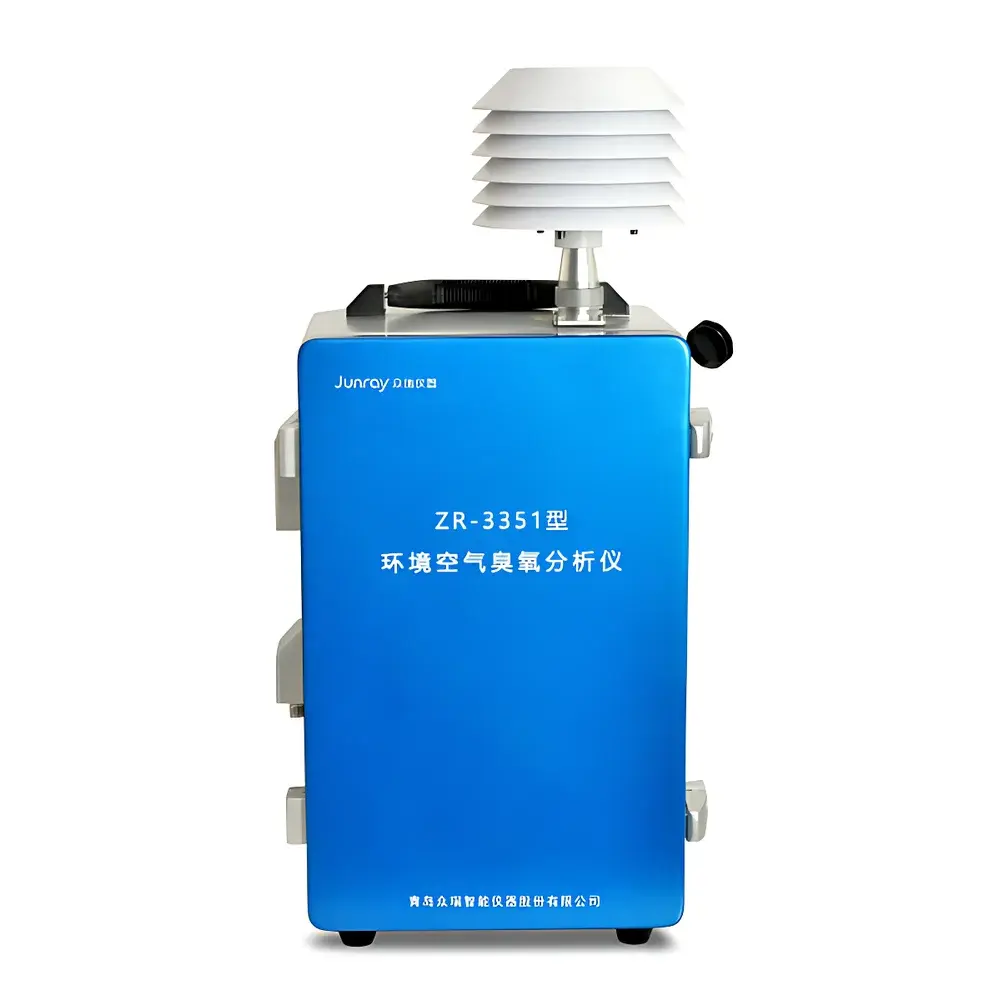
Junray ZR-3351 Portable Environmental Ozone Analyzer
| Brand | Junray |
|---|---|
| Origin | Shandong, China |
| Manufacturer Type | Direct Manufacturer |
| Product Origin | Domestic (China) |
| Model | ZR-3351 |
| Instrument Type | Portable |
| Measurement Range | ≤ 5 nmol/mol |
| Limit of Detection (LOD) | ≤ 1 nmol/mol |
| Response Time | ≤ 20 s |
| Zero Drift | ±2 nmol/mol |
| Resolution | 1 ppb |
Overview
The Junray ZR-3351 Portable Environmental Ozone Analyzer is a field-deployable, UV photometric gas analyzer engineered for continuous, real-time quantification of ground-level ozone (O₃) in ambient air. It operates on the principle of ultraviolet absorption spectroscopy at 254 nm—the characteristic absorption peak of ozone—ensuring high selectivity and minimal interference from common atmospheric constituents such as NO₂, SO₂, and hydrocarbons. This method conforms to the fundamental physical basis specified in HJ 590–2010 and aligns with international best practices for trace-level ozone monitoring. The instrument’s compact, ruggedized enclosure meets IP65-rated ingress protection, enabling reliable operation under rain, dust, and temperature fluctuations typical of unsheltered outdoor deployment. Its integrated high-capacity rechargeable battery supports uninterrupted operation for over 24 hours without external power—a critical capability for remote site surveys, mobile monitoring campaigns, and emergency response scenarios where grid access is unavailable.
Key Features
- UV photometric detection at 254 nm with dual-beam optical path design for enhanced baseline stability and reduced lamp drift effects
- Low detection limit of ≤1 nmol/mol (≈1.99 ppb at 25 °C and 101.3 kPa), supporting compliance with national ambient air quality standards and trend analysis in low-ozone environments
- Fast response time (T₉₀ ≤ 20 s), facilitating dynamic monitoring during rapid ozone concentration changes—e.g., photochemical smog formation or boundary layer mixing events
- Zero drift stability of ±2 nmol/mol over 24 h, validated per HJ 654–2013 requirements for continuous monitoring systems
- Integrated data logging with timestamped records stored internally (≥30 days at 1-min intervals); optional SD card expansion
- Modular design with quick-swap sampling inlet, particulate filter, and moisture trap—field-serviceable without tools or calibration recalibration
Sample Compatibility & Compliance
The ZR-3351 is optimized for undiluted ambient air sampling at standard temperature and pressure (STP). It accepts sample flow rates between 0.5–1.5 L/min and incorporates a heated sampling line option (optional) to suppress condensation in high-humidity conditions. All internal wetted materials are ozone-compatible (e.g., electropolished stainless steel, PTFE, and fused silica optics), minimizing surface adsorption and memory effects. The analyzer complies with multiple Chinese environmental monitoring standards: HJ 590–2010 (ozone measurement methodology), HJ 654–2013 (performance specifications for continuous gaseous pollutant monitors), HJ 193–2013 (installation and acceptance protocols), and HJ 818–2018 (operational quality control procedures). While not certified to EU EN 14625 or US EPA EQOA requirements out-of-the-box, its measurement principle and documented performance characteristics support equivalency assessments for cross-validation studies and inter-laboratory comparison programs.
Software & Data Management
The instrument includes embedded firmware with configurable sampling parameters (integration time, averaging window, alarm thresholds) and real-time diagnostics (lamp intensity, detector signal-to-noise ratio, flow rate deviation). Data export is supported via USB-C interface in CSV format, compatible with standard environmental data management platforms (e.g., EPA AirData, WISP, or custom SQL-based QA/QC databases). Firmware updates are delivered via signed binary files to ensure integrity; all configuration changes and calibration events are logged with user ID, timestamp, and parameter before/after values—supporting audit-ready documentation aligned with GLP principles. Remote monitoring is achievable through optional RS-485 or 4–20 mA analog output modules, enabling integration into SCADA systems used by regional air quality networks.
Applications
- Fixed-site ambient air quality monitoring networks requiring portable backup or supplemental validation units
- Mobile monitoring on vehicles, drones (with vibration-dampened mounting), or backpack platforms for spatial ozone mapping
- Field validation and intercomparison exercises between reference-grade analyzers and lower-cost sensor networks
- Short-term exposure assessment in occupational or community health studies near industrial zones or transportation corridors
- Research applications including photochemical modeling input, boundary layer chemistry investigations, and ozone dry deposition flux estimation when paired with micrometeorological stations
FAQ
What is the recommended calibration frequency for routine monitoring?
Per HJ 818–2018, zero and span calibration should be performed at least once every 7 days; full multi-point linearity verification is required monthly. Internal zero checks using synthetic zero air (N₂ ≥ 99.999%) can be automated hourly.
Does the ZR-3351 require external ozone generators for span calibration?
Yes—span calibration requires a traceable ozone generator calibrated against a NIM-certified primary standard. The instrument accepts 0–10 ppm ozone-in-air spans; built-in ozone scrubber enables automatic zero generation without external gas cylinders.
Can the analyzer operate continuously at sub-zero temperatures?
The operating temperature range is –10 °C to +45 °C. Below 0 °C, optional heated inlet and optical chamber modules are recommended to prevent frost formation and maintain photometric accuracy.
Is the firmware upgrade process compliant with data integrity requirements?
Yes—each firmware version carries a SHA-256 checksum and digital signature. Upgrade logs record firmware version, installation timestamp, and operator ID, satisfying traceability criteria under HJ 818–2018 and general data governance frameworks.
How is humidity interference mitigated during high-moisture sampling?
The standard configuration includes a Nafion™ membrane dryer; optional thermoelectric cooler (TEC)-based condensation trap achieves dew point suppression to –10 °C, reducing water vapor interference below 1% relative error across 10–95% RH.







