
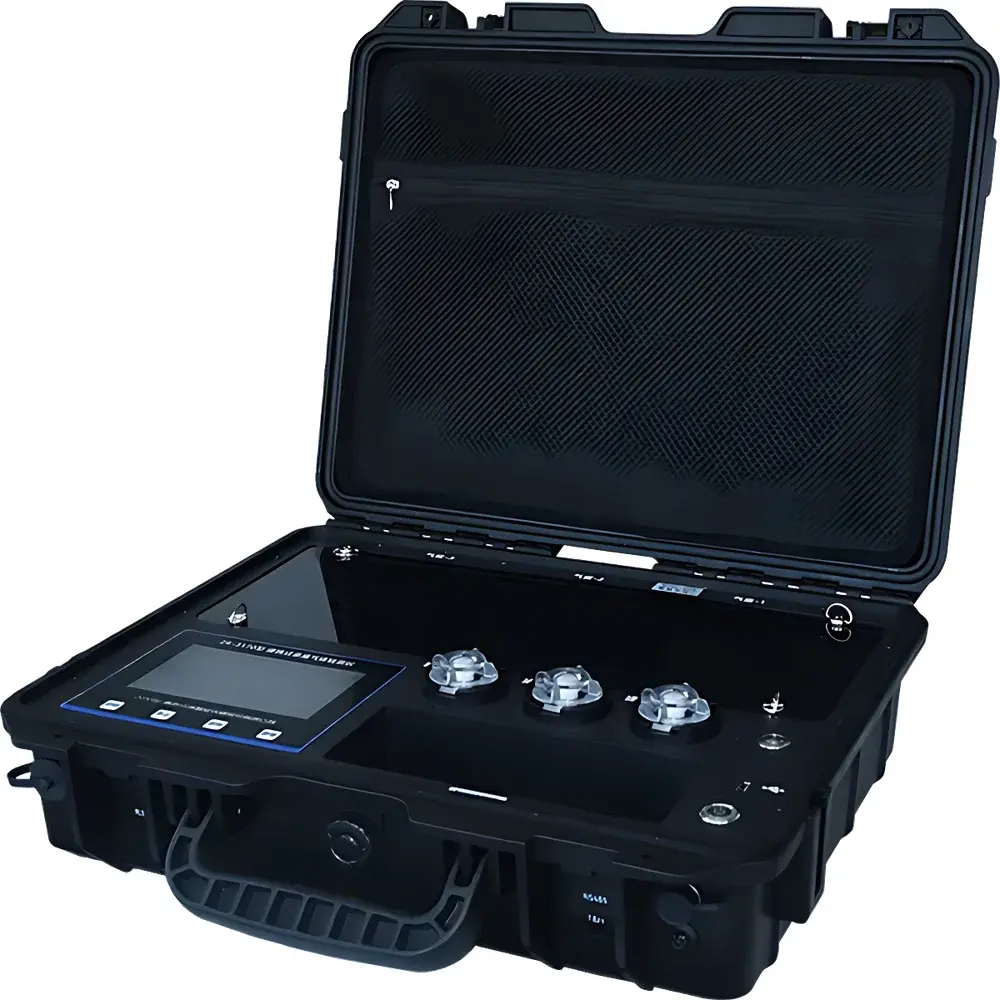
Junray ZR-3170 Portable Odor Gas Detector
| Brand | Junray |
|---|---|
| Origin | Shandong, China |
| Manufacturer Type | Direct Manufacturer |
| Product Category | Domestic (China-made) |
| Model | ZR-3170 |
| Instrument Type | Portable |
| Detection Principles | Electrochemical, Metal Oxide Semiconductor (MOS), Photoionization Detection (PID) |
| Compliance | Meets Chinese National Standards for Environmental Monitoring (e.g., HJ 905–2017, HJ 1222–2021) |
| Application Scope | Field-based odor assessment, emergency response, ambient air quality screening, and source emission investigation |
Overview
The Junray ZR-3170 Portable Odor Gas Detector is an integrated field-deployable instrument engineered for rapid, on-site quantification of malodorous compounds in ambient air and near-source environments. Unlike laboratory-based olfactometry (e.g., dynamic dilution olfactometry per ASTM E679 or EN 13725), the ZR-3170 employs a multi-sensor array architecture combining electrochemical (EC), metal oxide semiconductor (MOS), and photoionization detection (PID) technologies to deliver real-time, compound-class indicative measurements. It is not a human-perception-based odor unit (OUE) analyzer but rather a targeted chemical sensor platform optimized for sulfur-containing compounds (e.g., H2S, CH3SH), nitrogenous species (e.g., NH3, amines), volatile organic compounds (VOCs) with low ionization potentials (e.g., aromatics, aldehydes), and select halogenated organics. Its design prioritizes operational robustness under variable environmental conditions—temperature range: –10 °C to +50 °C; relative humidity: 15–90% RH (non-condensing)—making it suitable for municipal wastewater treatment plants, landfill perimeter monitoring, composting facilities, and industrial fugitive emission surveys.
Key Features
- Multi-principle sensor fusion: Simultaneous EC, MOS, and PID detection channels enable broad-spectrum responsiveness across key odorant chemical families while minimizing single-sensor drift limitations.
- Field-calibration-ready architecture: Supports zero/span verification using certified gas standards (e.g., 10 ppm H2S in N2, 100 ppm isobutylene for PID response check) without requiring bench-top recalibration equipment.
- Integrated environmental compensation: Onboard temperature and humidity sensors feed real-time correction algorithms to stabilize baseline and improve cross-condition reproducibility.
- IP65-rated enclosure: Dust-tight and water-jet resistant housing ensures reliable operation during rain, fog, or high-dust field deployments.
- Battery endurance: Rechargeable Li-ion battery provides ≥8 hours of continuous operation at 1 Hz sampling frequency, with low-power sleep mode extending standby time to 72 hours.
- Real-time data logging: Internal memory stores up to 100,000 timestamped records (date/time, sensor readings, T/RH, GPS coordinates if enabled), compliant with basic GLP traceability requirements.
Sample Compatibility & Compliance
The ZR-3170 is validated for direct aspiration sampling of ambient air and ducted exhaust streams (with optional probe extension kit). It does not require pre-concentration, thermal desorption, or chromatographic separation. Its measurement scope aligns with Chinese national technical specifications for odor pollution monitoring—including HJ 905–2017 “Technical Guidelines for Odor Pollution Monitoring in Ambient Air” and HJ 1222–2021 “Technical Specification for Monitoring of Odorous Pollutants from Stationary Sources.” While not certified to ISO 16000 series or US EPA Method TO-15/TO-17, its sensor outputs may serve as screening-level indicators prior to confirmatory GC-MS or olfactometric analysis. The device meets GB/T 18204.2–2014 for general air quality instrumentation safety and EMC performance.
Software & Data Management
Data export is supported via USB-C interface and Bluetooth 5.0 (BLE) to the proprietary Junray FieldLink mobile application (iOS/Android). The software enables geotagged survey mapping, customizable alarm thresholds (ppb–ppm range), CSV report generation, and synchronization with centralized environmental information systems—including provincial emergency monitoring platforms compliant with China’s “Ecological Environment Big Data Platform” architecture. Audit trails include operator ID, calibration timestamps, firmware version, and sensor health diagnostics. Exported files retain embedded metadata required for internal QA/QC review; however, the system does not implement FDA 21 CFR Part 11 electronic signature functionality.
Applications
- Emergency odor incident response: Rapid identification of dominant odorant classes following complaints or process upsets at wastewater infrastructure.
- Perimeter monitoring: Time-series tracking of odor plume dispersion around landfills, rendering plants, and anaerobic digesters.
- Source attribution support: Correlating real-time sensor trends with meteorological data and facility operational logs to narrow potential emission origins.
- Pre-compliance screening: Preliminary assessment ahead of formal EN 13725 olfactometry or GC–SCD testing for regulatory reporting.
- Community engagement: Transparent, real-time display of ambient odor-related parameters during public consultation sessions.
FAQ
Does the ZR-3170 provide odor concentration in odor units (OUE)?
No. It delivers quantitative or semi-quantitative readings in engineering units (e.g., ppm for H2S, ppb for VOCs) based on sensor-specific calibrations. OUE determination requires human-panel-based dynamic dilution olfactometry.
Can it distinguish between individual VOCs in a mixture?
Not selectively. The PID channel responds broadly to VOCs with ionization potentials below its lamp energy (typically 10.6 eV); speciation requires GC–MS or GC–PID coupling.
Is third-party calibration certification available?
Yes—Junray offers optional NIST-traceable calibration certificates issued by CNAS-accredited laboratories upon request, valid for 12 months under standard storage and usage conditions.
What maintenance intervals are recommended?
Sensor zero checks every 7 days; full span calibration every 30 days; particulate filter replacement every 60 days in dusty environments; annual factory performance verification recommended.
Does it support Modbus or other industrial protocols for SCADA integration?
Not natively. Integration with supervisory systems requires middleware conversion via the FieldLink API or RS-485-to-USB gateway (third-party supplied).
Related Products







