
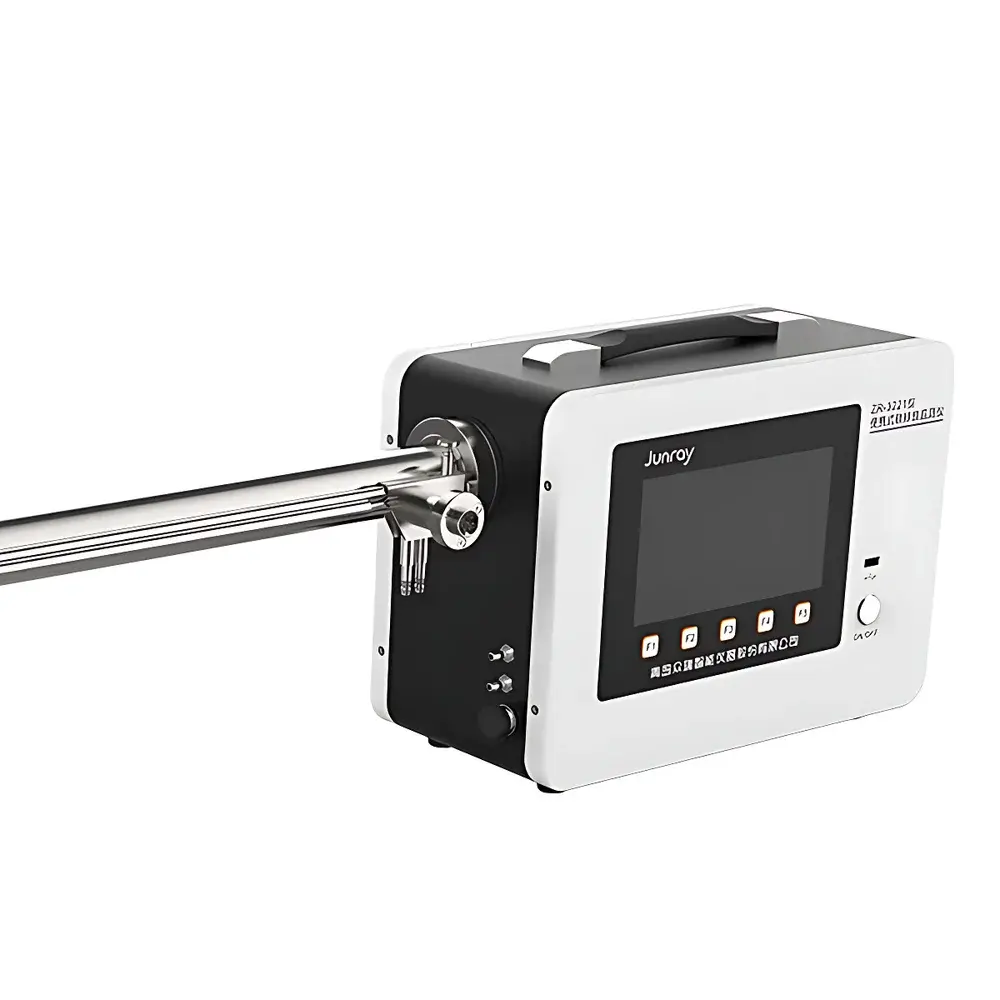
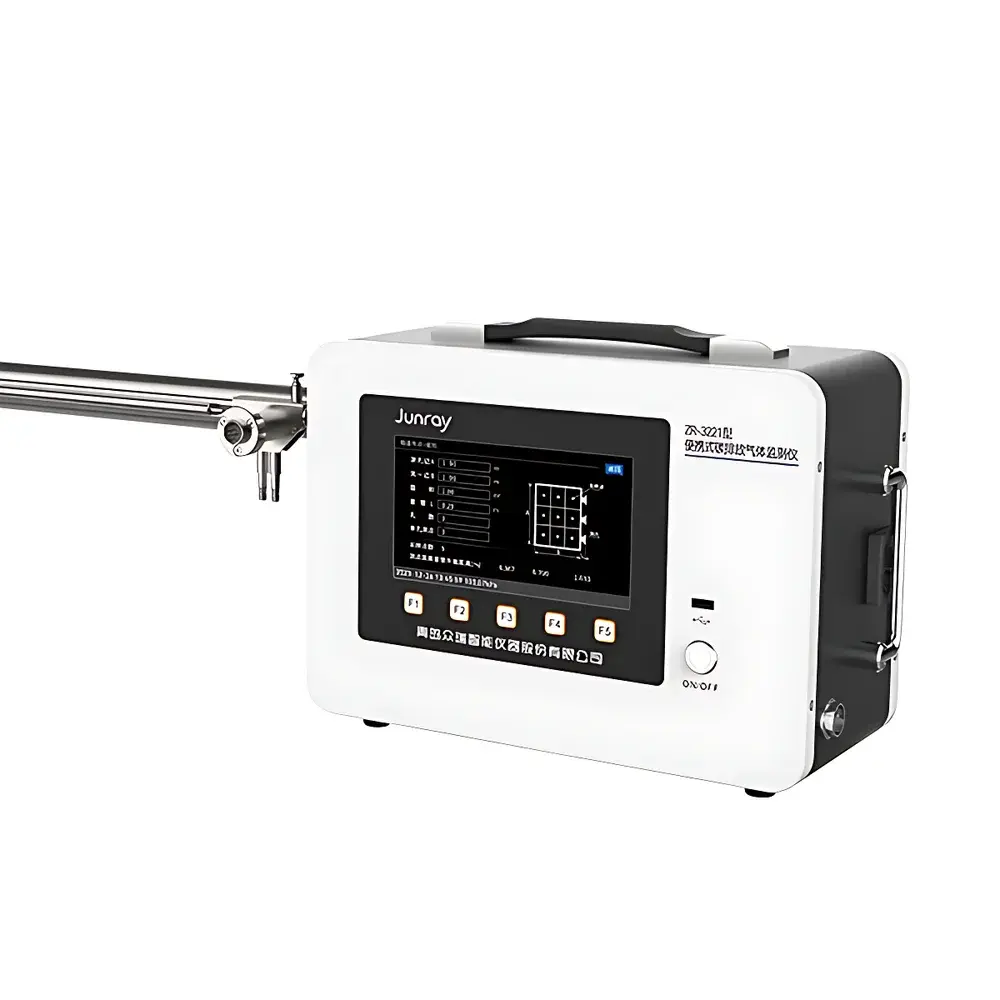
Junray ZR-3221 Portable Multi-Gas Greenhouse Gas Analyzer (CO₂, CH₄, N₂O, SF₆, CO, O₂)
| Brand | Junray |
|---|---|
| Model | ZR-3221 |
| Origin | Shandong, China |
| Manufacturer Type | Original Equipment Manufacturer (OEM) |
| Detection Principle | Non-Dispersive Infrared (NDIR) Absorption for CO₂, CO, CH₄, N₂O |
| Gas Range | CO, CO₂, CH₄, N₂O, O₂ |
| Resolution | 0.01 (unitless, per gas-specific scale) |
| Compliance | HJ 870–2017, HJ/T 44–1999, HJ/T 397–2007, JJG 635–2011, JJG 968–2002, JJG 693–2011 |
| Data Connectivity | Integrated 4G module, Bluetooth 5.0, Wi-Fi 802.11 b/g/n,北斗 (BeiDou) GNSS positioning |
| Power Options | Internal Li-ion battery, AC adapter, external mobile power bank |
| Sample Handling | Heated sampling probe (120–180 °C), integrated Peltier condensate removal with auto-drain蠕动 pump, heated sample line, particulate filter, humidity monitoring & bypass protection |
| Software Features | Audit-trail-enabled logging (operation history, calibration records, maintenance events), GLP-compliant data encryption (AES-256), anti-tamper hardware design, tamper-evident report generation with cryptographic QR code |
| Units | mg/m³ and μmol/mol (ppm/ppb-equivalent) selectable per gas |
| GWP Integration | Preloaded IPCC AR6 global warming potential coefficients for real-time CO₂-equivalent emission calculation |
| Operating Interface | 7-inch capacitive color touchscreen (low-temperature functional), physical shortcut keys, optional handheld remote controller |
Overview
The Junray ZR-3221 is a field-deployable, multi-component greenhouse gas (GHG) analyzer engineered for regulatory-grade measurement of CO₂, CH₄, N₂O, SF₆, CO, and O₂ in flue gas and ambient emission streams from stationary sources. It operates on the physical principle of non-dispersive infrared (NDIR) absorption spectroscopy — where each target gas exhibits unique vibrational absorption bands in the mid-infrared region (e.g., CO₂ at 4.26 µm, CH₄ at 3.31 µm, N₂O at 4.54 µm, SF₆ at 10.55 µm). Dual-beam optical architecture with thermopile detection ensures high signal stability and immunity to source drift. O₂ concentration is determined via electrochemical cell technology meeting ISO 12032 requirements for accuracy and response fidelity. The instrument integrates real-time stack parameter acquisition — including flue gas temperature (up to 200 °C), volumetric flow velocity (via pitot-static or thermal anemometry), and moisture content — enabling full stoichiometric conversion to mass-based emission rates (g/s, kg/h) per national and international reporting frameworks.
Key Features
- Triple-mode operation: automatic timed sampling, manual point measurement, and continuous monitoring — configurable via intuitive GUI or remote hand controller.
- Heated sampling system: 120–180 °C adjustable probe temperature with full-line heating to prevent condensation and adsorptive loss of polar gases (e.g., N₂O, CO).
- Onboard Peltier-based condensate management: integrated thermoelectric cooler with automatic drainage via precision peristaltic pump, eliminating manual intervention during extended deployments.
- Cross-interference mitigation: multivariate curve-fitting algorithm calibrated against certified reference gas mixtures to resolve spectral overlap between CO₂/CH₄/N₂O/SF₆ in complex matrices.
- Dual-range NDIR channels: auto-ranging optics for CO, CO₂, CH₄, and N₂O ensure optimal signal-to-noise ratio across low-background (e.g., ambient air) and high-concentration (e.g., biogas, cement kiln) applications.
- Hardware-level data integrity: AES-256 encrypted internal flash storage, tamper-proof mechanical housing, and cryptographic QR-code generation for printed reports compliant with CNAS and CMA audit requirements.
- Regulatory-ready connectivity: embedded 4G LTE modem with TLS 1.2 secure transmission, BeiDou GNSS time synchronization, and MQTT/HTTP(S) protocol support for integration into provincial and national environmental monitoring platforms (e.g., China’s National Emission Monitoring System, NEMS).
Sample Compatibility & Compliance
The ZR-3221 is validated for use with hot, humid, and particulate-laden flue gases from coal-fired boilers, waste incinerators, cement clinker kilns, and landfill gas collection systems. Its heated sampling train meets HJ/T 397–2007 requirements for isokinetic sampling and moisture management. All gas measurements comply with Chinese EPA method standards: CO₂ per HJ 870–2017 (NDIR), CO per HJ/T 44–1999 (NDIR), and O₂ per HJ 75–2017 (electrochemical). The analyzer holds China Metrology Accreditation (CPA) certification (approval number: 2022F1234567), confirming conformity to JJG 635–2011 and JJG 968–2002 metrological verification protocols. Firmware supports traceable calibration using NIST-traceable standard gases and implements full audit trail logging required under GLP and ISO/IEC 17025 laboratory quality systems.
Software & Data Management
The embedded Linux-based firmware provides comprehensive data governance functionality. All operational events — including zero/span calibrations, sensor diagnostics, battery status, humidity-triggered bypass activation, and firmware updates — are timestamped, digitally signed, and stored in a write-once-read-many (WORM) partition. Calibration records include gas lot numbers, expiration dates, and operator ID. Reports generated on-device or exported via USB/Wi-Fi include cryptographic hash values and machine-readable QR codes for third-party verification. Remote platform integration supports role-based access control (RBAC), automated alarm thresholds (e.g., exceedance of GB 13223–2011 limits), and batch export in CSV, XML, and PDF/A-2 formats compatible with enterprise environmental information systems (EIS).
Applications
- Continuous emissions monitoring (CEMS) validation and QA/QC audits for thermal power plants and industrial boilers.
- GHG inventory development per GHG Protocol Scope 1 guidelines and national carbon accounting frameworks.
- Landfill gas composition profiling and flare efficiency assessment (CH₄ destruction efficiency calculation).
- Biogas upgrading process optimization through real-time CO₂/CH₄ ratio tracking.
- Research-grade flux measurements in eddy covariance towers when paired with dynamic dilution modules.
- Environmental inspection and enforcement activities by provincial ecological environment bureaus.
FAQ
Does the ZR-3221 meet international calibration traceability requirements?
Yes — all factory calibrations are performed using NIST-traceable standard gases certified to ISO 6141, with uncertainty budgets documented per ISO/IEC 17025 Annex A.
Can the instrument operate unattended for 72+ hours?
With fully charged internal Li-ion battery (12,000 mAh) and optimized duty cycling, continuous operation exceeds 16 hours; external power options enable indefinite deployment.
Is SF₆ quantification validated per IEC 62271-100?
While not a high-voltage equipment tester, its NDIR channel for SF₆ is calibrated against certified mixtures per ISO 14687 and validated for atmospheric and stack concentration ranges relevant to leakage detection and emissions reporting.
How is data security enforced during wireless transmission?
All 4G/Wi-Fi communications use TLS 1.2 encryption with certificate pinning; device authentication employs X.509 client certificates issued by the provincial environmental cloud platform.
What maintenance intervals are recommended for field use?
Filter replacement every 100 operating hours; full optical path cleaning and electrochemical O₂ sensor replacement every 6 months or 2,000 hours — logged automatically and flagged in the maintenance dashboard.
Related Products







