
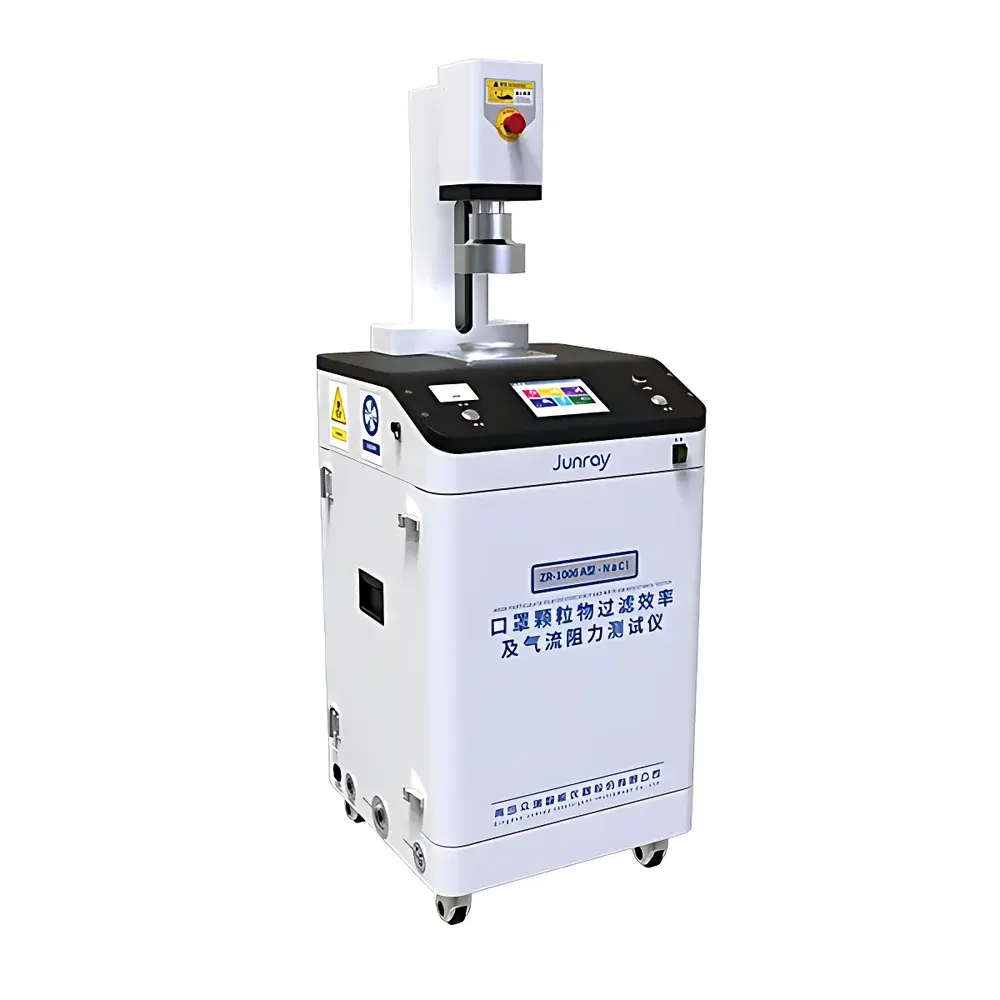
Junray ZR-1006A/B Aerosol Filtration Efficiency and Airflow Resistance Tester
| Brand | Junray |
|---|---|
| Origin | Shandong, China |
| Manufacturer Type | Direct Manufacturer |
| Regional Classification | Domestic (China) |
| Model | ZR-1006A/B |
| Instrument Category | Aerosol Detector |
| Test Media | Sodium Chloride (ZR-1006A) / Paraffin Oil (ZR-1006B) |
| Display | 8-inch Color TFT Touchscreen |
| Aerosol Generation | Dedicated Salt/Oil Aerosol Generator with Controlled Particle Size Distribution & Concentration |
| Fixture System | Multi-format Universal Fixture Kit for Masks, Filter Media, and Flat Materials |
| Calibration Standards | Certified Reference Membrane & Standard Resistance Plate |
| Flow Control | Integrated High-Accuracy Electronic Mass Flow Meter (±0.5% FS) |
| Detection Module | Long-Life Photometer with Automatic Optical Path Monitoring & Cleaning Alert |
| Charging Neutralization | Built-in Bipolar Electrostatic Neutralizer (Kr-85 or Po-210 equivalent) |
| Air Supply | External Compressed Air Source (≤60 dB(A)) |
| Data Output | USB Export (CSV/Excel-compatible) + Thermal Printer Interface |
Overview
The Junray ZR-1006A/B Aerosol Filtration Efficiency and Airflow Resistance Tester is a dual-mode, standards-compliant instrumentation platform engineered for quantitative evaluation of particulate filtration performance and pressure drop characteristics of respiratory protective devices and filter media. It operates on the principle of real-time photometric aerosol detection—measuring upstream and downstream particle number or mass concentration via calibrated light scattering—enabling calculation of filtration efficiency (%) and differential pressure (Pa) across the test sample under controlled airflow conditions. Designed in accordance with ISO 16900-1:2015, ISO 16900-3:2015, ASTM F2299/F2101, and GB/T 32610–2016, the system supports both sodium chloride (NaCl) aerosol challenge (ZR-1006A mode) and paraffin oil (or equivalent dioctyl phthalate, DOP) aerosol challenge (ZR-1006B mode), aligning with regulatory requirements for medical face masks, surgical masks, N95 respirators, and industrial filter materials.
Key Features
- Dual-channel photometric detection architecture with integrated optical path monitoring: automatic alert triggers when signal attenuation exceeds preset thresholds, indicating need for optical window cleaning or lamp recalibration.
- Programmable aerosol generation system delivering monodisperse or polydisperse NaCl (median diameter 0.075 µm ± 0.02 µm) or oil-based aerosols (MMD 0.3 µm ± 0.05 µm) at stable concentrations (10–100 mg/m³), compliant with EN 149 and NIOSH 42 CFR Part 84 test protocols.
- Universal fixture interface accommodating flat filter media (up to 100 mm × 100 mm), cup-shaped masks, folded pleated respirators, and layered composite structures—mechanically secured without edge leakage.
- High-stability mass flow control (0–100 L/min range, resolution 0.1 L/min) maintained via closed-loop feedback from an embedded thermal mass flow sensor, ensuring consistent face velocity (e.g., 85 L/min ± 2 L/min for N95 certification).
- Electrostatic neutralization module employing alpha-emitting source (Po-210 or Kr-85 equivalent) to condition aerosol charge state prior to challenge—critical for eliminating electrostatic enhancement effects and enabling true mechanical filtration assessment.
- Embedded data acquisition firmware with timestamped logging, audit trail capability, and user-accessible calibration history—designed to support GLP/GMP-aligned laboratory documentation practices.
Sample Compatibility & Compliance
The ZR-1006A/B accommodates diverse sample geometries including flat filter coupons (standardized per ASTM F2101), molded respirator shells (with optional headform adapters), and multi-layer textile composites used in reusable cloth masks. All test fixtures conform to ISO 16900-1 Annex A dimensional tolerances. The instrument satisfies functional equivalence criteria outlined in FDA Guidance for Industry: Testing and Labeling of Surgical Masks and Respirators (2020), as well as EU Commission Implementing Regulation (EU) 2016/425 (PPE Regulation) Annex V testing requirements. Optional IQ/OQ documentation packages are available for laboratories requiring validation under ISO/IEC 17025:2017 accreditation frameworks.
Software & Data Management
The embedded operating system features a responsive 8-inch capacitive touchscreen UI with multilingual support (English, Chinese, Spanish). Real-time graphs display filtration efficiency (%) and pressure drop (Pa) versus time; statistical summaries include mean, SD, and 95% confidence intervals over ≥10 consecutive measurement cycles. Data export is supported via USB 2.0 in CSV format—structured with column headers compatible with JMP, Minitab, and LabArchives. Thermal printer output includes operator ID, sample ID, test date/time, ambient temperature/humidity, aerosol type, flow rate, and pass/fail status per selected standard. Audit logs record all parameter modifications, calibration events, and user logins—retained for ≥180 days unless manually cleared.
Applications
- Regulatory compliance testing for surgical masks (ASTM F2100 Level 1–3), KN95/N95 respirators (GB 2626–2019, 42 CFR 84), and FFP2/FFP3 respirators (EN 149:2001+A1:2009).
- Material R&D: comparative analysis of melt-blown polypropylene, nanofiber membranes, electret-charged nonwovens, and hybrid filtration architectures.
- Quality assurance in mask manufacturing lines: batch release testing per ISO 13485:2016 clause 7.5.10.
- Third-party verification by CNAS-accredited testing laboratories performing contract services for domestic and international clients.
- Educational use in university biomedical engineering and occupational health programs for hands-on aerosol science instruction.
FAQ
What aerosol size distributions does the ZR-1006A/B generate?
The ZR-1006A produces NaCl aerosol with count median diameter (CMD) of 0.075 µm and geometric standard deviation (GSD) ≤1.86; the ZR-1006B generates oil aerosol with CMD ≈0.3 µm and GSD ≤1.9 per ISO 16900-3.
Is the instrument compliant with FDA 21 CFR Part 11 requirements?
While the base firmware does not include electronic signature functionality, the audit trail, user authentication, and immutable data logging modules satisfy core ALCOA+ principles; Part 11 readiness can be achieved through validated third-party LIMS integration.
Can the system be used for testing reusable cloth masks?
Yes—provided the mask is mounted using the flat-media fixture and tested at standardized flow rates (e.g., 30 L/min for breathability assessment per ASTM F3502); efficiency data must be interpreted in context of intended use and laundering history.
What maintenance intervals are recommended for the photometer optics?
Optical path cleaning is prompted automatically every 50 hours of cumulative sampling time; full preventive maintenance—including flow sensor calibration and neutralizer source verification—is recommended annually or after 2,000 test cycles.
Does the instrument support remote monitoring or network connectivity?
No Ethernet or Wi-Fi interface is built-in; however, USB-hosted data files may be transferred to networked workstations for centralized reporting, and optional RS-232 serial output enables basic SCADA integration.
Related Products







