
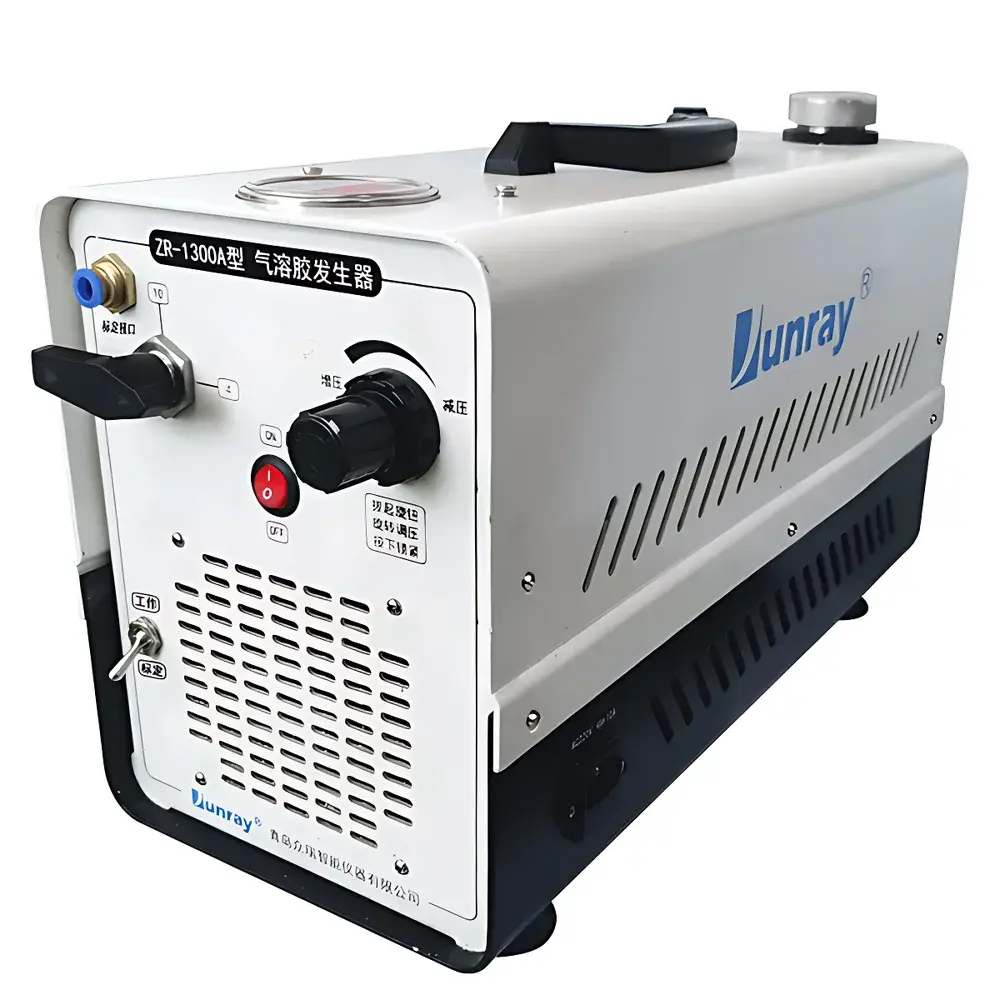
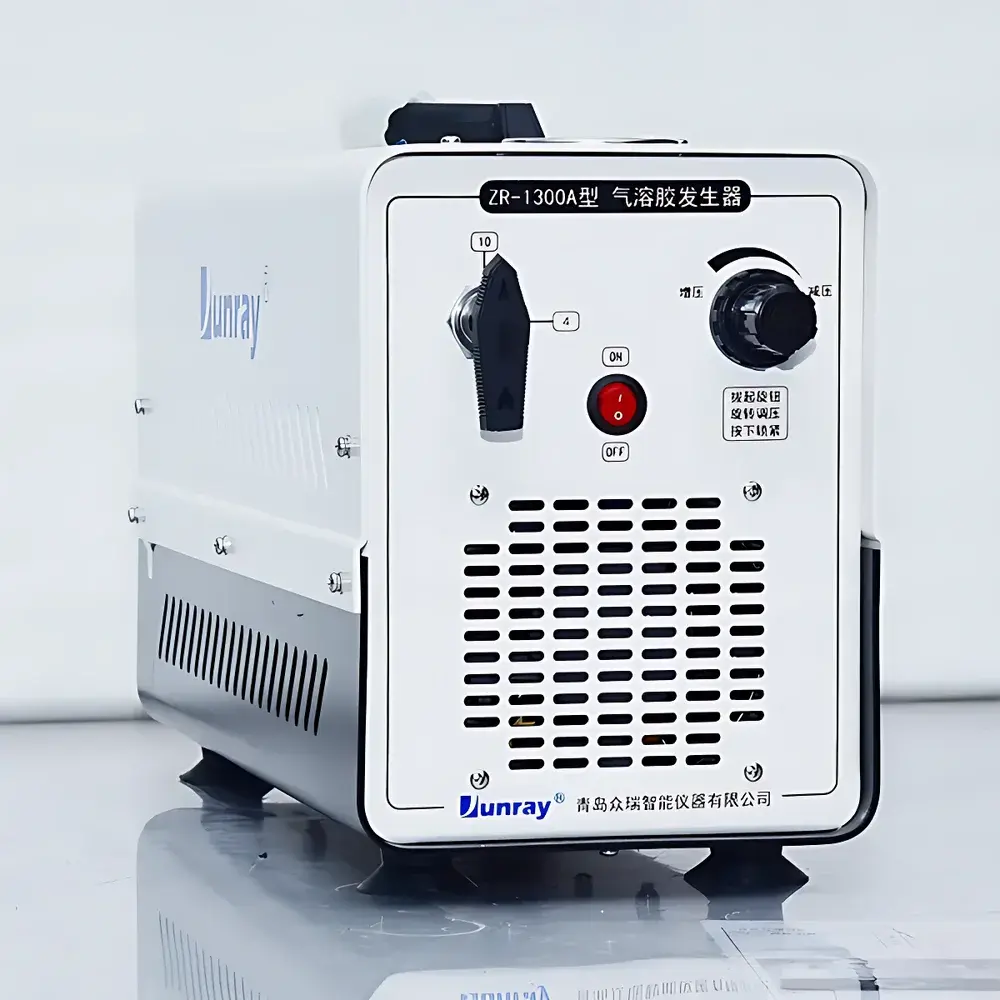
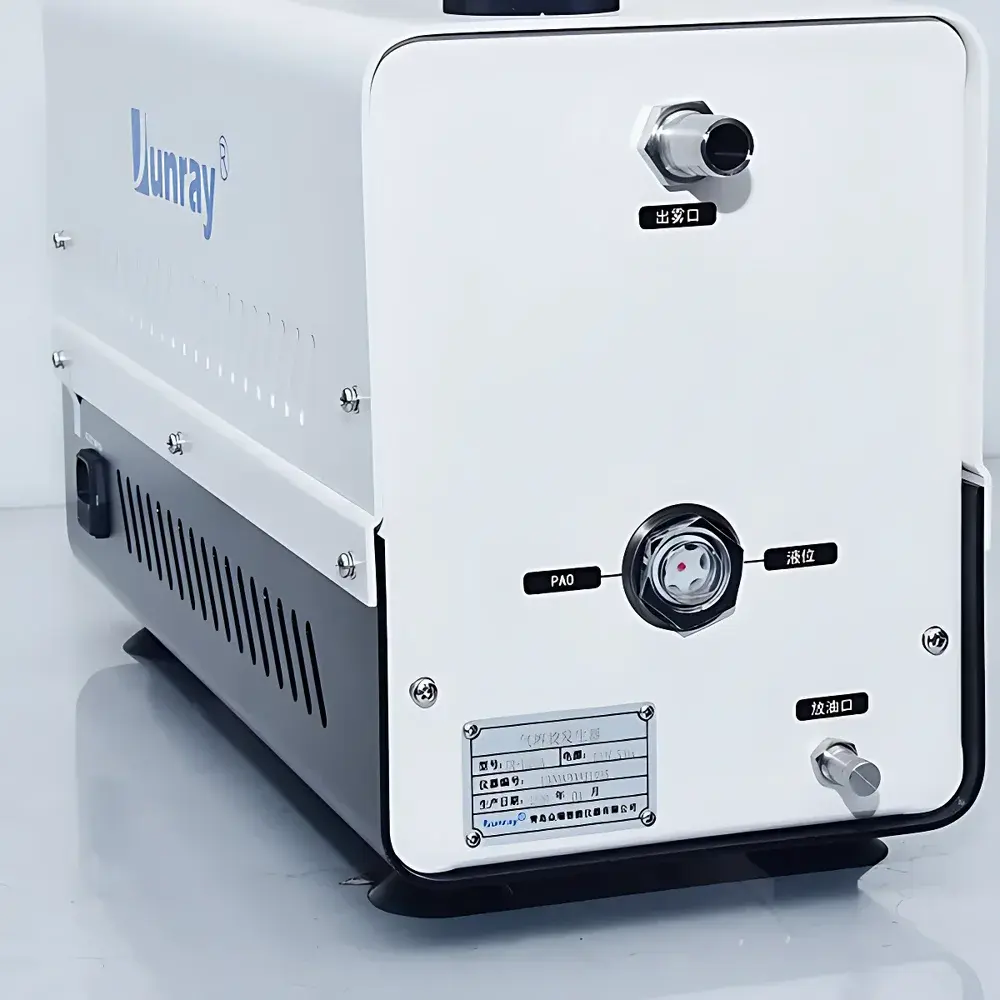
Junray ZR-1300A Aerosol Generator
| Brand | Junray |
|---|---|
| Origin | Shandong, China |
| Manufacturer Type | Original Equipment Manufacturer (OEM) |
| Country of Origin | China |
| Model | ZR-1300A |
| Price | USD 8,100 (FOB Qingdao) |
| Aerosol Generation Principle | Laskin Nozzle Atomization |
| Compatible Test Agents | PAO-4, Di-Octyl Phthalate (DOP), Di-Octyl Sebacate (DOS) |
| Airflow Range | 1.4–56.6 m³/min |
| Aerosol Concentration Output | 10–100 µg/L |
| Compliance Standards | YY 0569–2005, GB/T 13554–2008, GB 50591–2010 |
| Patented Design | CN Utility Model Patent No. ZL201320159883.1 |
Overview
The Junray ZR-1300A Aerosol Generator is a precision-engineered instrument designed for controlled, reproducible generation of polydisperse oil-based aerosols—specifically PAO-4 (Polyalphaolefin), Di-Octyl Phthalate (DOP), and Di-Octyl Sebacate (DOS)—for integrity testing of high-efficiency particulate air (HEPA) and ultra-low penetration air (ULPA) filters. It operates on the well-established Laskin nozzle principle: compressed air is forced through precisely machined stainless-steel nozzles to shear liquid test agent into fine droplets, forming a stable, monodisperse-capable polydisperse aerosol cloud. Unlike thermal or condensation-based generators, the ZR-1300A delivers cold, non-pyrolytic aerosol—critical for validating filter performance without introducing thermal degradation artifacts or altering particle morphology. Its primary application domain spans cleanroom commissioning, biopharmaceutical facility qualification, biosafety cabinet certification per YY 0569–2005, and HEPA/ULPA filter leak detection in accordance with ISO 14644-3 and IEST-RP-CC001. The unit is explicitly engineered for integration into standardized challenge protocols requiring traceable, repeatable mass concentration delivery under variable airflow conditions.
Key Features
- Modular Laskin nozzle array with selectable 4-nozzle or 10-nozzle configuration—enabling precise scaling of aerosol output across wide volumetric flow ranges (1.4–56.6 m³/min).
- Integrated precision pressure-regulated air supply and calibrated needle valve for continuous, stepless adjustment of aerosol mass concentration from 10 µg/L to 100 µg/L.
- Stainless-steel fluid path and corrosion-resistant wetted components ensure long-term compatibility with PAO, DOP, and DOS—minimizing residue buildup and cross-contamination risk.
- Patented gas-distribution manifold (CN ZL201320159883.1) ensures uniform velocity profiles across all active nozzles, eliminating localized over-concentration and enhancing spatial homogeneity of the generated aerosol cloud.
- Front-panel analog pressure gauges and calibrated flow indicators support real-time operational verification without external instrumentation.
- Compact benchtop footprint (W × D × H: 320 × 280 × 220 mm) with CE-compliant electrical safety and IP20 enclosure rating for laboratory and cleanroom ante-room deployment.
Sample Compatibility & Compliance
The ZR-1300A is validated for use with standard challenge agents specified in international and national filter testing standards: PAO-4 (ISO 29463-3 Annex C), DOP (historically referenced in older USP and MIL-STD-282), and DOS (increasingly adopted as a non-phthalate alternative per ISO 14644-3:2019). Its output stability and concentration linearity have been verified under steady-state airflow conditions compliant with GB/T 13554–2008 (High-Efficiency Air Filters), YY 0569–2005 (Biological Safety Cabinets), and GB 50591–2010 (Acceptance Testing of Cleanrooms). While not intrinsically certified to ISO/IEC 17025, the generator supports GLP-compliant test documentation when operated within defined SOPs—including logged air pressure, temperature, and run duration. It meets electromagnetic compatibility (EMC) requirements per GB/T 18268.1–2010 and low-voltage directive LVD 2014/35/EU.
Software & Data Management
The ZR-1300A is a manually operated, hardware-controlled instrument with no embedded microprocessor or digital interface. All operational parameters—including air inlet pressure (0.2–0.6 MPa), liquid feed rate, and nozzle selection—are set via mechanical valves and monitored using analog instrumentation. This architecture intentionally eliminates software dependencies, ensuring deterministic behavior, zero firmware update requirements, and full auditability of physical settings. Users maintain full control over protocol execution timing and parameter recording via external logbooks or validated LIMS-integrated data capture systems. For facilities operating under FDA 21 CFR Part 11 or EU Annex 11, manual operation necessitates documented operator training, equipment calibration logs (pressure transducers, rotameters), and signed run records—all aligned with ALCOA+ data integrity principles.
Applications
- Leak testing of HEPA/ULPA filters in pharmaceutical manufacturing suites, hospital isolation rooms, and aseptic processing isolators.
- Performance validation of Class II and III biological safety cabinets per YY 0569–2005 and NSF/ANSI 49.
- Commissioning and periodic requalification of ISO Class 5–8 cleanrooms per GB 50591–2010 and ISO 14644-1.
- Filter media efficiency evaluation in R&D laboratories using gravimetric or photometric challenge methods.
- Calibration support for aerosol photometers (e.g., TSI 8160, Palas U-SMPS) during field service and instrument verification.
FAQ
What test agents are compatible with the ZR-1300A?
PAO-4, Di-Octyl Phthalate (DOP), and Di-Octyl Sebacate (DOS) are fully supported; other non-corrosive, low-volatility oils may be used subject to viscosity and flash point validation.
Is the ZR-1300A suitable for ISO 14644-3:2019 compliance testing?
Yes—the device meets the aerosol generation requirements for “polydisperse oil aerosol” challenge tests when operated within its specified airflow and concentration range.
Does the unit include calibration certification?
No factory calibration certificate is supplied; users must perform initial and periodic verification of air pressure regulators and flow indicators using traceable NIST-equivalent standards.
Can the ZR-1300A be integrated into automated test sequences?
Not natively—it lacks digital I/O or communication ports. Integration requires external pneumatic logic controllers or PLC-driven air supply management.
What maintenance intervals are recommended?
Nozzle inspection and ultrasonic cleaning every 50 hours of cumulative operation; O-ring replacement annually or after exposure to aggressive solvents.







