
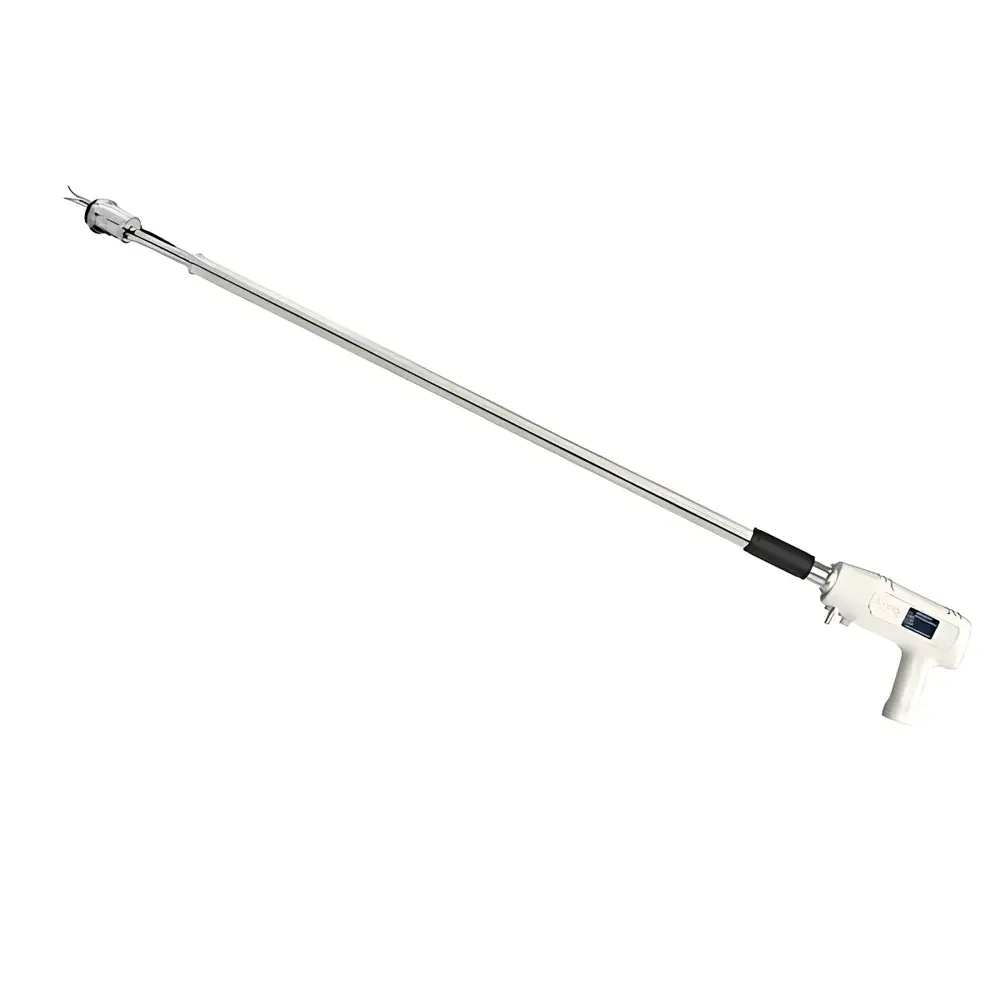
Junray ZR-D09U High-Humidity Low-Concentration Particulate Sampling Probe
| Brand | Junray |
|---|---|
| Origin | Shandong, China |
| Manufacturer Type | Direct Manufacturer |
| Country of Origin | China |
| Model | ZR-D09U |
| Instrument Category | Particulate Matter Sampler |
| Sampled Gases | SO₂, NOₓ |
| Flow Accuracy | ±2.5% |
| Sampling Flow Rate | 5–100 L/min |
| Flue Gas Velocity Range | 1–45 m/s |
| Moisture Content Range | 0–95% |
Overview
The Junray ZR-D09U High-Humidity Low-Concentration Particulate Sampling Probe is a precision-engineered sampling interface designed for gravimetric determination of low-level particulate matter (PM) in saturated or near-saturated flue gas streams from stationary emission sources. It operates on the principle of isokinetic sampling—maintaining proportional velocity between the gas stream and the probe inlet to ensure representative particle capture—while integrating active thermal management to prevent condensation-induced bias. Specifically developed for compliance with weight-based PM measurement protocols under high-moisture conditions (up to 95% RH), the ZR-D09U enables accurate quantification of particulate concentrations below 50 mg/m³, a critical threshold defined in HJ 836–2017 and DB37/T 2537–2014. Its design addresses two primary analytical challenges in low-concentration PM sampling: (1) mass loss due to moisture adsorption/desorption on filter media, and (2) flow resistance increase caused by water condensation in the sampling train. By incorporating full-path heating of the post-filter conduit and a thermally stabilized sampling head, the probe maintains filter integrity and sampling isokineticity across variable stack conditions.
Key Features
- Integrated sampling head comprising a calibrated S-type Pitot tube, stainless steel or titanium alloy sampling nozzle (Φ47 mm filter-compatible), support mesh, aluminum foil gasket, and pre-weighed quartz or PTFE membrane—designed for whole-assembly gravimetric analysis per HJ 836–2017.
- Full-path heated sampling line downstream of the filter, with user-adjustable temperature setpoint (typically 110–140 °C) to eliminate condensate formation and preserve filter loading integrity.
- Compact co-location of differential pressure sensing (Pitot tube), temperature measurement (Pt100 RTD), and particulate capture within a single rigid probe body—minimizing spatial error and simplifying field calibration.
- Modular nozzle selection kit enabling isokinetic adaptation across flue gas velocities from 1 to 45 m/s; nozzles are pre-characterized and supplied with certified dimensional tolerances.
- OLED display with wide-temperature operational range (–20 °C to 60 °C), supporting real-time visualization of flow rate, velocity, temperature, and accumulated volume—without requiring external data loggers.
- Customizable probe length (standard 1.2 m; optional up to 5 m) and material configuration (316L stainless steel or Grade 2 titanium alloy) for corrosion resistance in acidic, chloride-rich, or high-temperature exhaust environments.
- Standardized interface for optional wireless industrial condition monitoring module (W06), enabling direct acquisition of stack temperature, static/velocity pressure, and O₂ concentration without additional cabling.
Sample Compatibility & Compliance
The ZR-D09U is validated for use with standard 47-mm diameter quartz fiber or polytetrafluoroethylene (PTFE) filters compliant with GB/T 16157–1996 and ISO 9096:2003. It supports sequential sampling of gaseous pollutants (SO₂, NOₓ) via integrated sorbent tubes mounted upstream of the filter, provided appropriate thermal segregation is maintained. The probe meets all mechanical and metrological requirements specified in HJ/T 48–1999 (Technical Specifications for Particulate Samplers), HJ 836–2017 (Gravimetric Method for Low-Concentration PM in Stationary Source Emissions), and DB37/T 2537–2014 (Shandong Provincial Standard for Low-Concentration PM Measurement). Its construction materials and thermal control architecture are aligned with GLP-aligned field measurement practices, including traceable temperature calibration (NIST-traceable Pt100 sensor) and documented isokinetic verification procedures.
Software & Data Management
While the ZR-D09U operates as a hardware probe without embedded firmware, it interfaces seamlessly with Junray’s suite of certified flue gas samplers (e.g., ZR-3260 series) that feature onboard data acquisition systems compliant with China’s Environmental Monitoring Technical Specifications (HJ 1017–2020). All recorded parameters—including volumetric flow (corrected to standard conditions), isokinetic ratio, filter temperature history, and cumulative sampling time—are stored with timestamped audit trails. When paired with the W06 wireless module, raw sensor data (static/velocity pressure, temperature, O₂) is transmitted via RS485/Modbus RTU to host instruments, supporting automated calculation of dry standard cubic meters (dscm) and enabling full traceability required for regulatory reporting under China’s MEP Order No. 39 and EPA Method 5/17 equivalents.
Applications
- Regulatory compliance monitoring of coal-fired, biomass, and waste-to-energy boilers where flue gas moisture exceeds 60% RH and PM emissions fall below 50 mg/m³.
- Performance evaluation of electrostatic precipitators (ESPs), fabric filters (FFs), and wet scrubbers operating under high-humidity bypass conditions.
- Source testing for cement kilns, glass furnaces, and metallurgical roasters where acid dew point and condensable particulate matter pose sampling artifacts.
- Research-grade characterization of secondary aerosol formation in simulated flue gas environments with controlled humidity and temperature gradients.
- Field validation of continuous emission monitoring systems (CEMS) for PM, serving as a reference method per HJ 75–2017 QA/QC protocols.
FAQ
What filter types are compatible with the ZR-D09U probe?
Quartz fiber filters (QFF) meeting GB/T 16157–1996 specifications and hydrophobic PTFE membranes with ≤0.3 µm pore size are recommended. Filter selection must be documented in the test plan per HJ 836–2017 Section 6.2.
Is the probe suitable for sampling at temperatures above 200 °C?
Standard configurations support continuous operation up to 180 °C. For applications exceeding this limit, titanium alloy construction with high-temp RTD and ceramic-insulated heating elements is available upon request.
How is isokinetic sampling verified during field use?
The integrated S-type Pitot tube provides real-time differential pressure output; users calculate actual flue gas velocity using the measured ΔP, static pressure, and stack temperature—then adjust sampler flow rate to match nozzle-specific isokinetic ratio per HJ 836–2017 Annex B.
Does the probe include built-in data logging capability?
No—the ZR-D09U is a passive sampling interface. All parameter logging occurs on the connected sampler (e.g., ZR-3260) or via external DAQ systems interfaced through its analog/digital I/O ports.
Can the heating system be powered independently of the main sampler?
Yes—external 24 VDC power input is provided for standalone heater operation during pre-heating or when used with third-party sampling platforms.







