
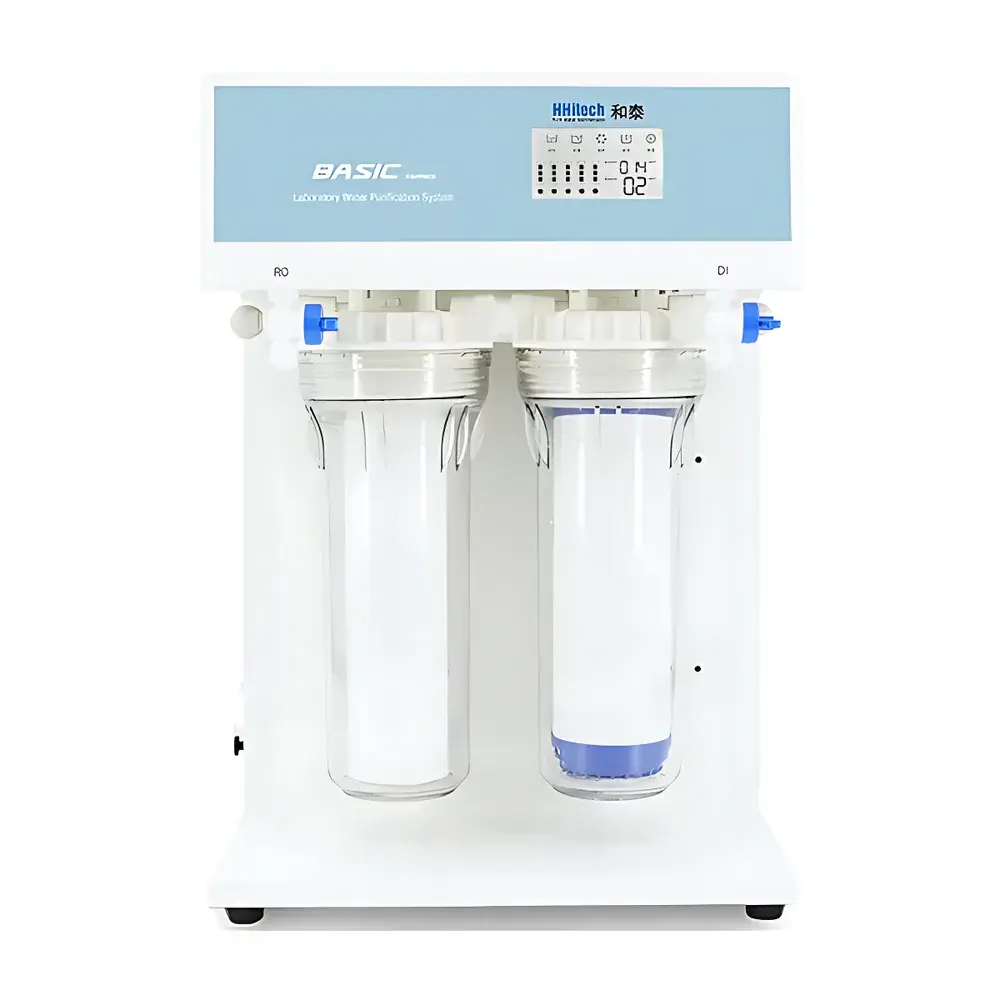
HHitech Basic-Q Ultra Pure Water System
| Brand | HHitech |
|---|---|
| Origin | Shanghai, China |
| Manufacturer Type | Manufacturer |
| Product Category | Domestic |
| Model | Basic-Q |
| Price Range | USD 700–1,400 (FOB) |
| Purified Water Grade | ASTM Type I / ISO 3696 Class 1 |
| Resistivity | 18.2 MΩ·cm at 25 °C |
| Heavy Metals & Soluble Silica | <0.1 ppb |
| Total Organic Carbon (TOC) | <3 ppb |
| Microbial Count | <0.1 CFU/mL |
| Endotoxin | <0.001 EU/mL |
| Particles (>0.1 µm) | <1 particle/mL |
| RO Membrane | Dow FilmTec™ FT30 |
| Feed Water | Municipal tap water (5–45 °C, 0.1–0.4 MPa) |
| Output Flow | 15–30 L/h (Basic-Q15/Basic-Q30 variants) |
| DI Water Flow Rate | Up to 2.0 L/min (with pressurized reservoir) |
| Power Supply | AC 100–240 V, 50/60 Hz |
| Power Consumption | 48 W (Q15) / 72 W (Q30) |
| Dimensions (W×D×H) | 34 × 32 × 47 cm |
| Weight | ~15 kg |
| Certifications | NSF/ANSI 58 (RO components), GLP-compliant design, CE-marked electrical system |
Overview
The HHitech Basic-Q Ultra Pure Water System is an integrated, modular laboratory water purification platform engineered for consistent production of ASTM Type I (ISO 3696 Class 1) ultrapure water from municipal tap feed. It employs a multi-stage purification architecture—comprising prefiltration, reverse osmosis (RO), and dual-stage ion exchange/deionization—to eliminate particulates, dissolved ions, organic contaminants, endotoxins, and microorganisms. Unlike energy-intensive distillation systems, the Basic-Q utilizes low-power, high-efficiency Dow FilmTec™ FT30 RO membranes coupled with precision-grade mixed-bed deionization cartridges to deliver stable resistivity ≥18.2 MΩ·cm at 25 °C, TOC <3 ppb, and endotoxin levels below 0.001 EU/mL—meeting stringent requirements for HPLC mobile phase preparation, cell culture media formulation, molecular biology applications (e.g., PCR, sequencing), and trace elemental analysis (ICP-MS). Its compact footprint, low thermal load, and silent operation make it suitable for benchtop integration in QC labs, academic research facilities, and regulated GMP/GLP environments where space, energy efficiency, and audit-ready documentation are critical.
Key Features
- Microprocessor-controlled operation with backlit LCD interface displaying real-time animated status: RO flush, tank full, active production, low feed pressure, and service alerts.
- Dual-channel online water quality monitoring: TDS sensors continuously track feed water and RO permeate or final DI output, enabling proactive maintenance and traceable performance logs.
- Intelligent RO membrane protection protocol: automatic flushing at startup, after water shortage recovery, post-tank-fill idle, and every 2 hours of cumulative operation—significantly extending membrane service life and maintaining >97% salt rejection over time.
- Comprehensive consumables lifecycle management: digital tracking of prefilter, RO membrane, and polishing cartridge remaining service life; visual and audible alerts trigger prior to performance degradation.
- NSF-certified fluid path: all tubing, quick-connect fittings, and housing materials comply with NSF/ANSI Standard 58 for RO system components, ensuring leachate-free delivery of ultrapure water.
- Modular, service-friendly architecture: independent prefiltration, RO, and polishing modules allow tool-free replacement without system disassembly or downtime.
- Flexible installation options: benchtop or wall-mount configuration (excluding Q45 and integrated reservoir models); optional 12 L pressurized stainless steel reservoir minimizes footprint and enables gravity-free dispensing.
Sample Compatibility & Compliance
The Basic-Q is validated for use with standard municipal drinking water meeting WHO and local regulatory limits (e.g., turbidity <1 NTU, chlorine <3 mg/L, total hardness <450 mg/L as CaCO₃). It complies with key international standards governing analytical water quality: ASTM D1193-20 (Type I specifications), ISO 3696:1987 (Grade 1), CLSI EP22-A (water for clinical laboratories), and USP Purified Water monograph. All electronic controls support GLP-aligned data integrity: timestamped event logging, user-accessible audit trails, and non-volatile memory retention during power loss. Optional configurations include FDA 21 CFR Part 11–compliant software modules for electronic signatures and secure data export.
Software & Data Management
The embedded control firmware supports automated generation of daily operational summaries—including total volume produced, cumulative runtime, alarm history, and sensor calibration timestamps—exportable via USB to CSV or PDF. No proprietary software installation is required; raw log files are human-readable and compatible with LIMS integration via RS232 or optional Ethernet module. System diagnostics include self-calibrating TDS sensors with ±2% accuracy across 0–200 ppm range, temperature-compensated resistivity measurement, and predictive algorithm-based consumables estimation based on actual flow rate, inlet conductivity, and usage duration.
Applications
- HPLC, UHPLC, and LC-MS mobile phase and blank preparation
- Cell culture media and reagent dilution requiring endotoxin-free water
- PCR, qRT-PCR, NGS library preparation, and electrophoresis buffers
- Atomic absorption spectroscopy (AAS), ICP-OES, and ICP-MS standards dilution
- Pharmaceutical stability testing and dissolution media preparation per USP & EP guidelines
- Calibration of conductivity meters and pH electrodes
- General labware rinsing where residual ions must be minimized
FAQ
What feed water quality is required for optimal Basic-Q performance?
Municipal tap water with temperature between 5–45 °C, pressure of 0.1–0.4 MPa (1–4 bar), and free chlorine ≤3 mg/L. Pre-treatment with activated carbon and sediment filtration is recommended if feed water exceeds 1 NTU turbidity or contains >0.5 mg/L iron/manganese.
Can the Basic-Q meet USP Purified Water specifications?
Yes—the RO + DI configuration consistently delivers water meeting USP requirements for conductivity (<1.3 µS/cm at 25 °C), TOC (<500 ppb), and microbial limits (<10 CFU/100 mL) when operated within validated parameters and maintained per HHitech’s scheduled service intervals.
Is the system compliant with ISO/IEC 17025 documentation requirements?
All hardware-level logs (alarms, sensor readings, service events) are time-stamped and stored in non-volatile memory. When paired with HHitech’s optional DataLink software, full traceability—including operator ID, calibration records, and change history—is maintained in accordance with ISO/IEC 17025 clause 7.7 on result reporting and record keeping.
How often must consumables be replaced under typical lab usage?
Prefilters: every 3–6 months; RO membrane: 2–3 years (dependent on feed water TDS and chlorine exposure); polishing cartridge: 6–12 months (based on total throughput and resistivity drift). The system calculates remaining life using real-time flow and conductivity data.
Does the Basic-Q support external storage tanks?
Yes—via standardized 1/4″ push-to-connect ports, the system can integrate with third-party stainless steel or polyethylene reservoirs up to 100 L capacity, with optional level-sensing feedback to modulate pump duty cycle and prevent dry-run conditions.



