
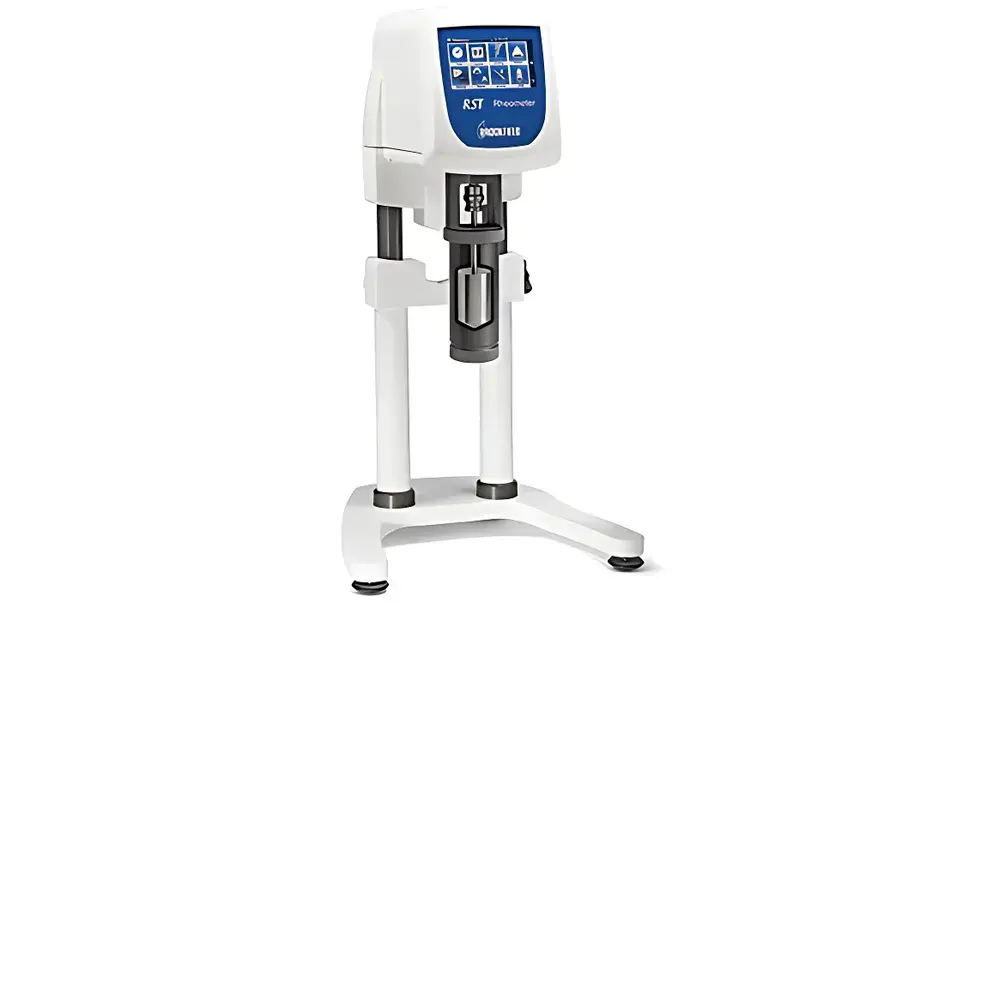
Brookfield RST Soft Solids Testing Rheometer
| Brand | Brookfield |
|---|---|
| Origin | USA |
| Manufacturer Type | Authorized Distributor |
| Product Category | Imported Instrument |
| Model | RST |
| Instrument Type | Rotational Rheometer |
| Viscosity Range | 5.41 mPa·s to 10⁷ mPa·s (10⁷ cP) |
| Yield Stress Measurement Capability | Yes |
| Shear Stress Control Mode | Yes |
| Shear Rate Control Mode | Yes |
| Compliance | FDA 21 CFR Part 11 Ready (with Rheo 3000 Software) |
| Display | Full-color LCD touchscreen with graphical real-time curve rendering |
| Memory Slots | 11 programmable multi-step test protocols |
| Rotor Identification | Auto-reading barcode system |
| Gap Setting | Motorized and manual dual-mode adjustment |
| Geometry Compatibility | Cone-and-plate, parallel-plate, concentric cylinder (optional) |
| Software Option | Rheo 3000 PC-based control & data management suite |
Overview
The Brookfield RST Soft Solids Testing Rheometer is a precision-engineered rotational rheometer designed specifically for the mechanical characterization of structured, yield-stress materials—such as pastes, gels, creams, adhesives, slurries, and thick suspensions—that exhibit both solid-like and fluid-like behavior under applied stress. Unlike conventional viscometers limited to steady-state viscosity reporting, the RST implements controlled-stress and controlled-rate methodologies grounded in classical Couette flow rheology. It enables full viscoelastic profiling—including yield stress determination via creep-recovery or stress ramping, oscillatory amplitude sweeps for linear viscoelastic region (LVR) identification, and time-dependent measurements such as thixotropy recovery and structural breakdown. Its architecture supports both fundamental research into microstructural response and routine QC/QA testing in regulated environments where reproducibility, traceability, and audit readiness are mandatory.
Key Features
- True dual-mode operation: independent control of shear stress (0.01–200 Pa) and shear rate (10⁻⁴–10³ s⁻¹), enabling comprehensive flow curve generation and yield point quantification.
- Integrated barcode reader on the motor housing automatically detects and validates rotor geometry (e.g., CP-41, PP-20, CC-15), eliminating manual entry errors and ensuring correct instrument calibration mapping.
- Motorized gap adjustment mechanism with sub-micron resolution (±0.001 mm), coupled with tactile feedback and visual confirmation on the touchscreen interface, guarantees repeatable sample loading across operators and shifts.
- 11 built-in memory slots support pre-programmed, multi-step test sequences—ideal for standardized protocols such as ASTM D2196 (viscosity of paints), ISO 3219 (rheological properties of polymer solutions), or internal SOPs requiring sequential oscillation, ramp, and hold steps.
- Full-color LCD touchscreen with intuitive icon-driven navigation, real-time graph overlay (stress vs. strain, G′/G″ vs. frequency), and on-screen parameter validation before run initiation.
- Rapid-connect quick-release coupling allows tool-free rotor exchange; optional concentric cylinder fixtures extend applicability to low-viscosity liquids or high-shear Newtonian reference fluids.
Sample Compatibility & Compliance
The RST accommodates heterogeneous, non-Newtonian samples ranging from highly filled pastes (e.g., battery electrode slurries, ceramic green bodies) to temperature-sensitive pharmaceutical ointments and food gels. Its parallel-plate and cone-and-plate geometries minimize edge fracture and wall slip artifacts common in soft solids. All firmware and hardware comply with electromagnetic compatibility (EMC) standards IEC 61326-1 and safety standard IEC 61010-1. When paired with the optional Rheo 3000 software, the system meets FDA 21 CFR Part 11 requirements—including electronic signature enforcement, role-based user access levels (Administrator, Operator, Reviewer), full audit trail logging (timestamped parameter changes, test starts/stops, data exports), and encrypted local database storage. It supports GLP/GMP-aligned workflows and is routinely validated per IQ/OQ protocols in pharmaceutical, cosmetic, and advanced materials labs.
Software & Data Management
Rheo 3000 is a Windows-based application providing full remote control, real-time visualization, and post-acquisition analysis. It supports export to CSV, Excel, and universal .rhe file formats compatible with third-party tools (e.g., OriginLab, MATLAB). Built-in analysis modules include yield stress calculation (Herschel-Bulkley fit), Cox-Merz superposition validation, time-temperature superposition (TTS), and thixotropic loop quantification (area ratio, hysteresis index). Data integrity safeguards include automatic checksum verification upon save, read-only archive mode, and configurable auto-backup intervals synced to network drives. All raw sensor outputs (torque, angular displacement, temperature) are recorded at ≥100 Hz sampling rate, preserving transient response fidelity.
Applications
- Yield stress mapping of lithium-ion battery cathode slurries to optimize coating uniformity and prevent sedimentation.
- Texture stability assessment of topical dermatological formulations under simulated skin shear conditions.
- Quality release testing of epoxy adhesives per MIL-STD-883 Method 2019.7 (rheological screening).
- Structural recovery kinetics of yogurt gels following mechanical disruption—quantified via step-strain recovery with G′(t) tracking.
- Process simulation of ceramic extrusion using controlled-stress ramp tests to predict die swell and pressure drop.
- Regulatory submission support for FDA IND/NDA dossiers requiring rheological justification of product consistency and batch-to-batch equivalence.
FAQ
Does the RST support oscillatory testing?
Yes—it performs amplitude sweeps, frequency sweeps, and time sweeps in strain-controlled or stress-controlled modes to determine G′, G″, tan δ, and critical strain values.
Can I use the RST without a computer?
Yes—the standalone unit executes all 11 preloaded methods via touchscreen; PC connectivity is required only for advanced analysis, long-term data archiving, or 21 CFR Part 11 compliance.
What sample volume is required for cone-and-plate geometry?
Typically 0.5–1.2 mL, depending on cone angle (1°, 2°, or 4°) and truncation; automated gap calibration compensates for minor volume discrepancies.
Is temperature control integrated?
No—temperature regulation requires external Peltier or circulating bath systems; however, the RST features a dedicated RTD input port and software synchronization for ambient or jacketed temperature logging.
How is calibration verified?
Using NIST-traceable standard oils and certified torque calibration standards; Brookfield provides documented calibration certificates and annual recalibration services.



