
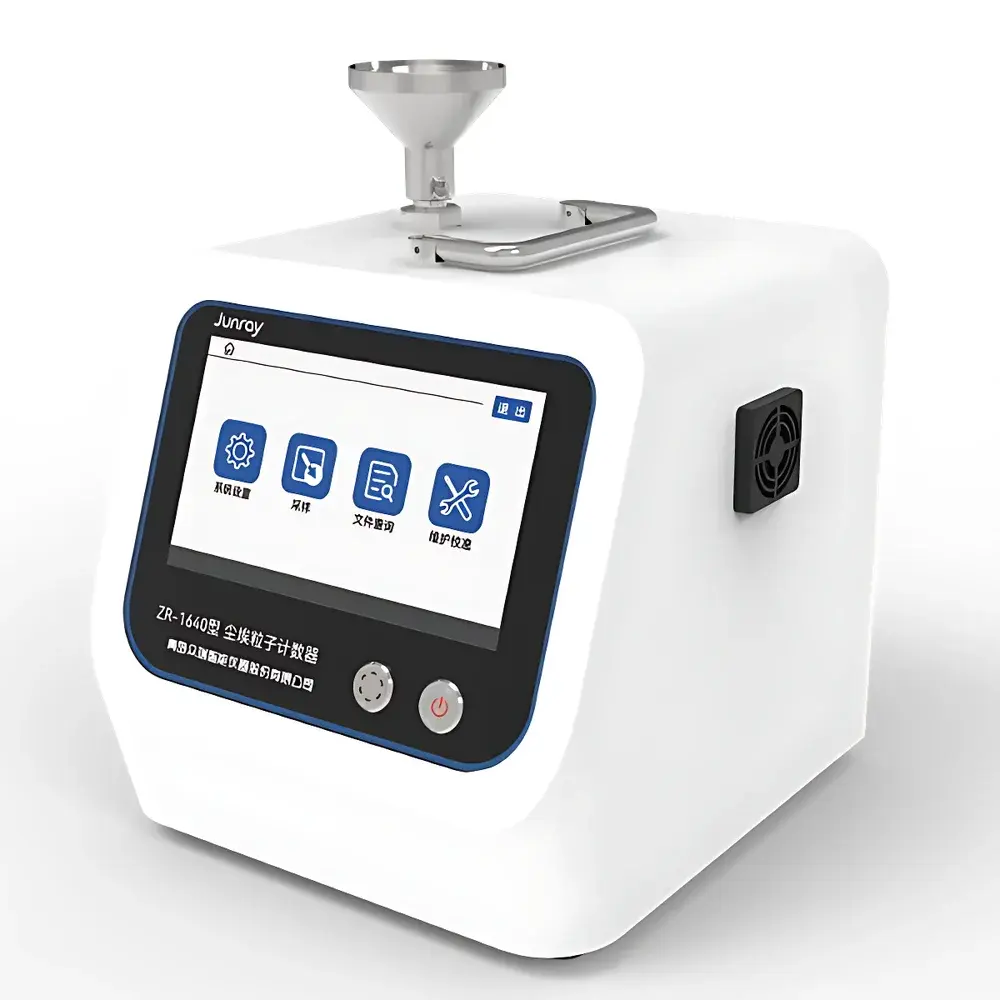
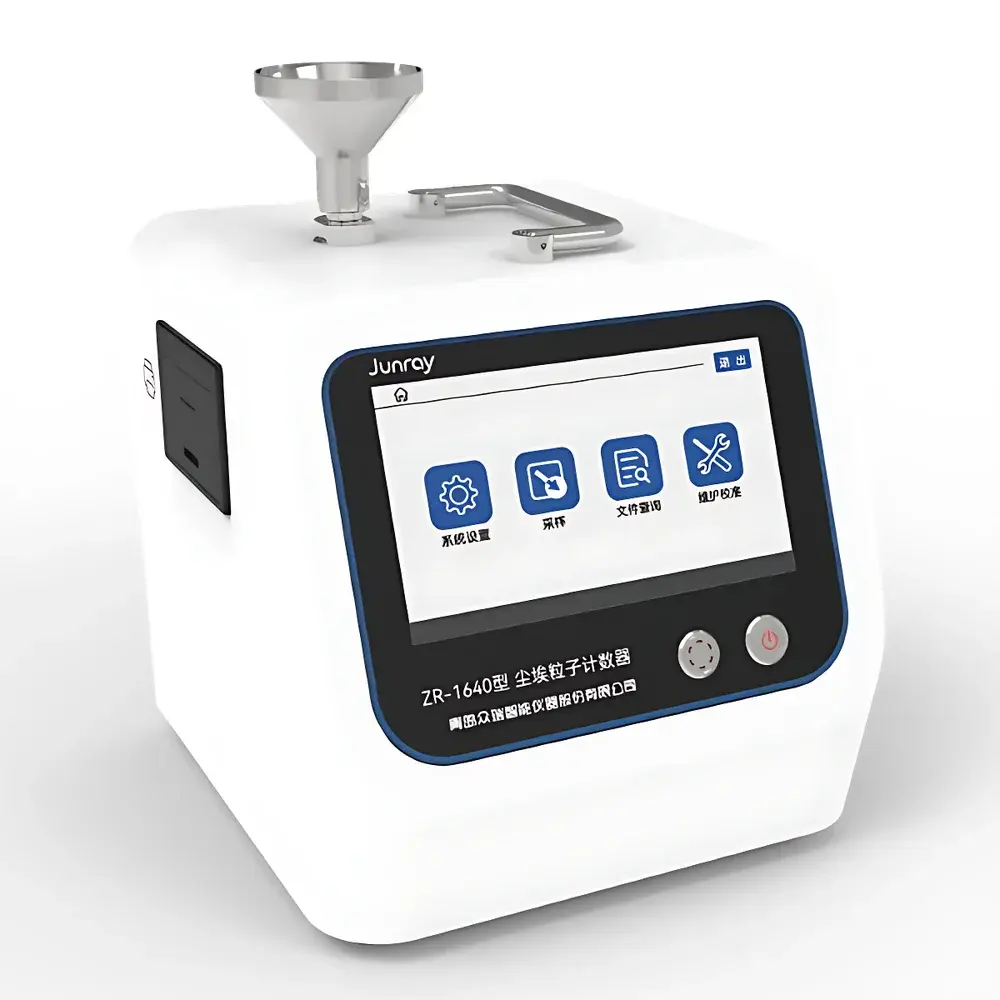
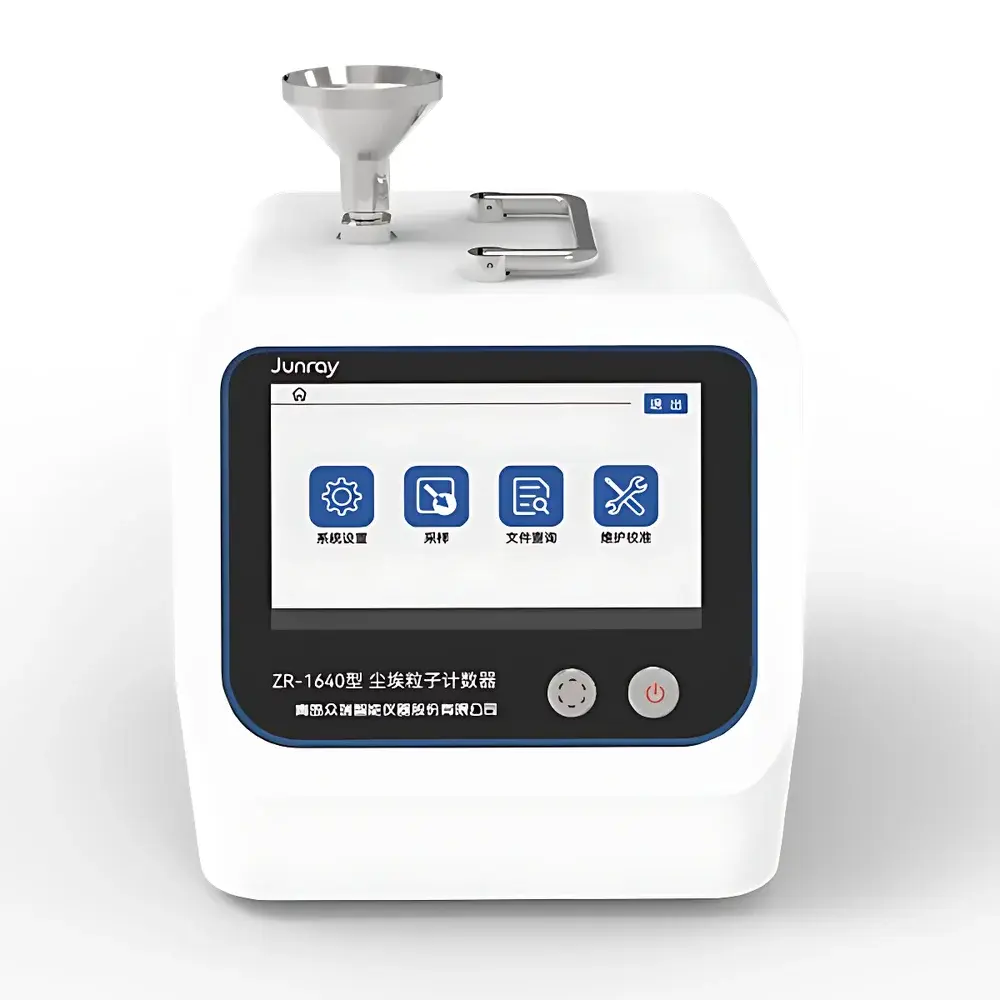
Junray ZR-1640 High-Flow Airborne Particle Counter (100 L/min)
| Brand | Junray |
|---|---|
| Origin | Shandong, China |
| Manufacturer Type | Direct Manufacturer |
| Product Category | Domestic |
| Model | ZR-1640 |
| Instrument Type | Laboratory-Grade Portable Particle Counter |
| Flow Rate | 100 L/min (High-Flow) |
| Flow Accuracy | ±2% |
| Repeatability | ≤10% FS under identical conditions |
| Size Calibration Error | ≤±30% at 0.5 µm and 5.0 µm channels |
| Indication Error | ±30% FS at 0.5 µm channel |
| Particle Sizing Channels | 0.3, 0.5, 1.0, 3.0, 5.0, 10.0 µm |
| Self-Cleaning Time | <10 min |
| Power Supply | Internal Li-ion Battery (4 h continuous operation) |
| Data Output | USB export + built-in thermal printer |
| Environmental Sensors | Integrated temperature, humidity, and barometric pressure monitoring |
| Sampling Probe | Standard isokinetic probe |
| Exhaust Filtration | Built-in HEPA filter (≥99.995% @ 0.3 µm) |
Overview
The Junray ZR-1640 High-Flow Airborne Particle Counter is a laboratory-grade, portable optical particle counter engineered for quantitative assessment of airborne particulate contamination in cleanroom environments and controlled facilities. It operates on the principle of single-particle light scattering—where aerosolized particles pass through a focused laser beam, generating scattered light pulses proportional to their size and refractive index. The instrument detects and classifies particles across six discrete size channels: 0.3, 0.5, 1.0, 3.0, 5.0, and 10.0 µm, enabling compliance-driven monitoring per ISO 14644-1, ISO 21501-4:2018, and JJF 1190–2008 calibration protocols. With a nominal sampling flow rate of 100 L/min, the ZR-1640 delivers statistically robust data for large-volume air sampling—critical for rapid qualification of ISO Class 5–8 cleanrooms, HVAC system validation, and filter integrity testing.
Key Features
- High-flow sampling at precisely regulated 100 L/min (±2% flow accuracy), ensuring representative sample volume acquisition within short measurement intervals;
- Six simultaneous particle size channels with calibrated response per ISO 21501-4:2018, supporting differential counting and size distribution analysis;
- Integrated isokinetic sampling probe for unbiased particle aspiration across varying air velocities—essential for duct and laminar flow hood assessments;
- Self-cleaning cycle completed in under 10 minutes, minimizing cross-contamination risk between sequential sampling locations;
- Onboard environmental sensors measuring ambient temperature, relative humidity, and atmospheric pressure—automatically logged with each particle count record;
- Built-in HEPA exhaust filtration (≥99.995% efficiency at 0.3 µm) to prevent re-entrainment of sampled particles into the test environment;
- Dual data handling: real-time thermal printing and structured CSV export via USB flash drive for traceable audit trails;
- Internal rechargeable lithium-ion battery providing up to 4 hours of uninterrupted operation—ideal for mobile validation tasks and remote facility audits.
Sample Compatibility & Compliance
The ZR-1640 is validated for use in non-hazardous, non-corrosive ambient air environments typical of pharmaceutical manufacturing suites, biotechnology labs, medical device cleanrooms, and HVAC commissioning sites. Its optical design and flow path geometry conform to ISO 21501-4:2018 requirements for light-scattering airborne particle counters—including linearity verification, counting efficiency, and false count rate specifications. The instrument supports full traceability in GMP-regulated settings: all measurements are time-stamped, location-tagged (via manual input), and stored with environmental metadata. While not intrinsically compliant with FDA 21 CFR Part 11 out-of-the-box, its data export architecture enables integration with validated LIMS or electronic lab notebook (ELN) systems that enforce electronic signature, audit trail, and user access controls per GLP/GMP guidelines.
Software & Data Management
The ZR-1640 operates without external PC dependency—its embedded firmware manages real-time particle accumulation, differential channel counts, and statistical reporting (e.g., particles/m³, cumulative vs. differential histograms). Data files follow a standardized naming convention and include header metadata: date/time stamp, instrument ID, operator ID (manually entered), sampling duration, flow rate, and environmental sensor readings. USB-exported datasets are compatible with Microsoft Excel, MATLAB, and industry-standard cleanroom monitoring platforms such as KIWI, TSI TrakPro, or custom Python-based validation scripts. Optional firmware updates—distributed via secure download portal—maintain alignment with evolving ISO calibration methodologies and regulatory expectations.
Applications
- ISO 14644-1 cleanroom classification and routine monitoring (Class 5–8);
- HEPA/ULPA filter leak testing and performance validation;
- Pharmaceutical aseptic processing environment qualification (e.g., isolators, RABS, filling lines);
- Airborne particle challenge studies for filter media and containment devices;
- Biological safety cabinet (BSC) and laminar flow workbench certification;
- Environmental baseline characterization prior to equipment installation or facility renovation;
- Root cause analysis of particulate excursions during process investigations.
FAQ
What calibration standards does the ZR-1640 comply with?
The instrument adheres to JJF 1190–2008 (China National Metrological Verification Regulation) and ISO 21501-4:2018 for light-scattering airborne particle counters. Calibration traceability is maintained using NIST-traceable PSL (polystyrene latex) reference particles.
Can the ZR-1640 be used for outdoor or industrial aerosol measurements?
It is designed exclusively for indoor, low-concentration clean environments (typically <10⁶ particles/m³ at 0.5 µm). High-concentration or oily/hygroscopic aerosols may saturate the detector or cause optical window fouling.
Is the internal battery replaceable by the end user?
Battery replacement requires authorized service calibration to verify flow stability and photodetector alignment; field replacement is not supported without post-service recalibration.
Does the ZR-1640 support remote data transmission or network connectivity?
No Ethernet, Wi-Fi, or Bluetooth interfaces are included. Data transfer is limited to USB mass storage mode and local thermal printout.
How is flow rate stability ensured across varying inlet pressures?
A closed-loop mass flow controller with active feedback maintains 100 L/min within ±2% tolerance, independent of minor upstream pressure fluctuations typical in duct or room-sampling scenarios.
Related Products







