
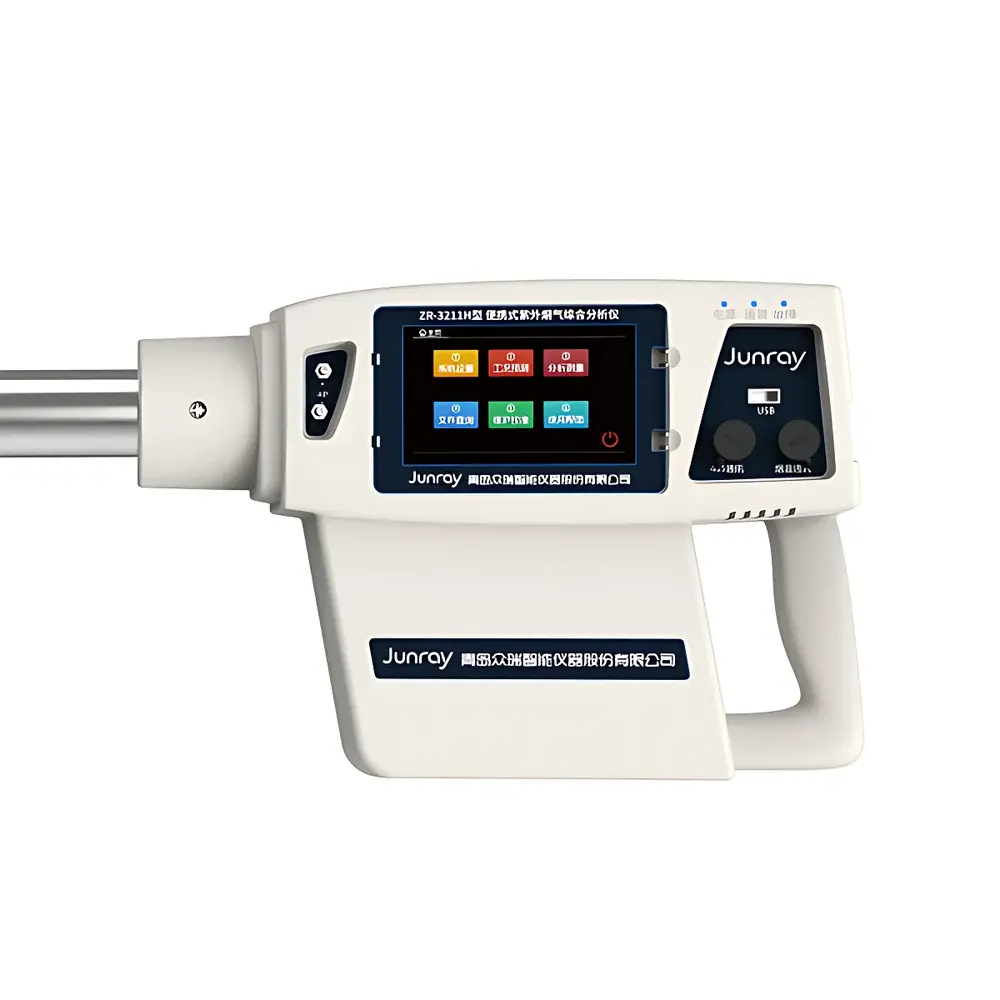
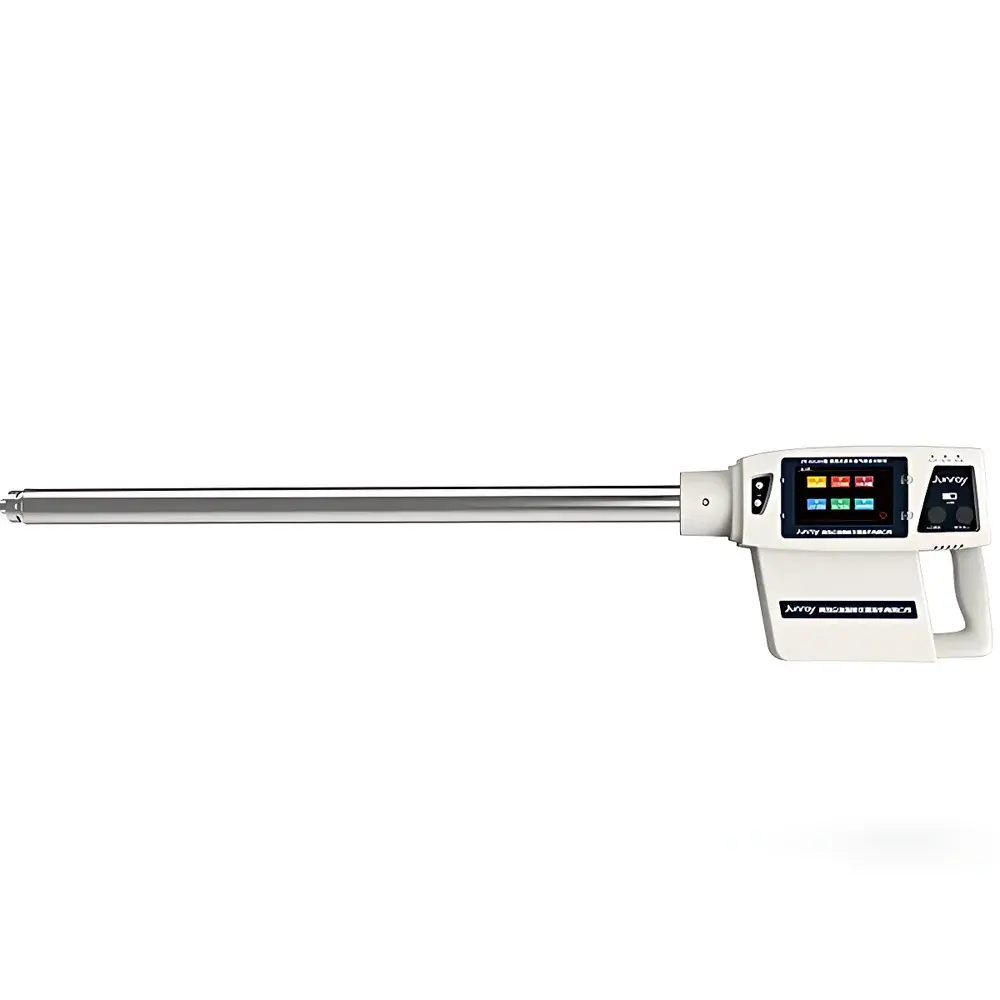
Junray ZR-3211H Portable UV Differential Optical Absorption Spectroscopy (DOAS) Flue Gas Analyzer – Hot-Wet Method
| Brand | Junray |
|---|---|
| Origin | Shandong, China |
| Manufacturer | Junray Instruments Co., Ltd. |
| Model | ZR-3211H (Hot-Wet Method) |
| Instrument Type | Portable Flue Gas Analyzer |
| Measurement Principle | UV Differential Optical Absorption Spectroscopy (UV-DOAS) |
| Measured Gases | SO₂, NO, NO₂, NH₃ (core) |
| Accuracy | ±5% of reading |
| Repeatability | ≤2.0% |
| Response Time (T90) | ≤90 s |
| Drift | <5% over 1 hour |
| Operating Temperature Range | Probe up to 200 °C (adjustable), Sample Path Heated to 180 °C |
| Moisture Handling | Hot-wet measurement with integrated heated sampling line, heated gas cell, and resistive-capacitive (RC) humidity sensor for real-time wet/dry conversion |
| Compliance Standards | HJ 1045–2019, HJ 1131–2020, HJ 1132–2020, GB/T 37186–2018, HJ 973–2018, HJ 870–2017, HJ/T 397–2007 |
Overview
The Junray ZR-3211H is a field-deployable, hot-wet flue gas analyzer engineered for regulatory-grade emission monitoring in industrial stack and boiler applications. It employs ultraviolet differential optical absorption spectroscopy (UV-DOAS) as its primary quantification method for sulfur dioxide (SO₂), nitrogen monoxide (NO), nitrogen dioxide (NO₂), and ammonia (NH₃). Unlike cold-dry systems that require condensate removal prior to analysis, the ZR-3211H maintains the entire sample path—including probe, transfer line, and optical cell—at elevated temperatures (up to 180 °C), preserving reactive and water-soluble species such as NH₃ and HNO₂ that would otherwise be lost during chilling and dehydration. This thermal integrity ensures high fidelity in high-humidity, low-concentration sulfur environments—common in waste incineration, biomass combustion, and selective non-catalytic reduction (SNCR) process monitoring. The instrument integrates auxiliary electrochemical (O₂, CO, H₂S) and non-dispersive infrared (CO₂) sensors, enabling simultaneous multi-gas reporting in accordance with national Chinese emission standards including HJ 1045–2019 and HJ 1131–2020.
Key Features
- Hot-wet UV-DOAS architecture with full-path heating: titanium-alloy vacuum-insulated sampling probe and heated optical cell (180 °C) prevent condensation and adsorptive loss.
- Integrated resistive-capacitive (RC) humidity sensor enables real-time moisture content measurement (0–40% v/v), supporting automatic dry-base concentration correction per HJ/T 397–2007.
- Onboard pitot tube and thermocouple for concurrent flue gas temperature (0–200 °C) and velocity (2–30 m/s) acquisition—required for volumetric flow and mass emission rate calculation.
- Self-contained rechargeable Li-ion battery (≥4 h continuous operation) with automated post-measurement purge cycle to clear residual gas from optical and sensor pathways.
- Heated sampling system includes dual-stage thermal management: primary probe heating + secondary gas-cell heating, both independently monitored and regulated.
- Field-configurable data output: Bluetooth-enabled thermal printer support, USB mass storage export (CSV/Excel-compatible), and on-device display of standardized emission metrics—including mg/m³ (dry, 6% O₂), t/h, and excess air ratio.
Sample Compatibility & Compliance
The ZR-3211H is validated for use across diverse combustion sources: coal-fired boilers, cement kilns, municipal solid waste incinerators, and chemical process heaters. Its hot-wet methodology meets the metrological requirements defined in HJ 1045–2019 for portable UV-absorption analyzers, including linearity (R² ≥ 0.999), zero drift (<2% FS/24 h), and span drift (<3% FS/24 h). It conforms to GB/T 37186–2018 for SO₂/NOₓ speciation via UV-DOAS and supports traceability to national calibration standards referenced in JJG 968–2002. While designed primarily for Chinese regulatory frameworks, its measurement uncertainty profile (±5% FS) and documented repeatability (≤2.0%) align with ISO 12039:2002 (stationary source emissions—determination of SO₂) and EN 14791:2017 (automated measuring systems for NOₓ/SO₂) when operated under controlled ambient conditions (15–30 °C, <80% RH).
Software & Data Management
The embedded firmware provides ISO/IEC 17025-aligned data handling: all measurements include timestamp, GPS coordinates (optional external module), operator ID, and instrument serial number. Audit trails record calibration events, zero/span checks, and configuration changes—supporting GLP-compliant documentation. Exported datasets contain raw absorbance spectra (for SO₂/NO/NO₂/NH₃), sensor voltage outputs, environmental parameters (T, P, RH, velocity), and calculated dry-standard concentrations. Firmware supports user-defined reporting templates compliant with provincial environmental bureaus’ digital submission portals. No cloud dependency: all processing occurs locally; data encryption (AES-128) applies during USB transfer.
Applications
- Regulatory stack testing per HJ/T 397–2007 and provincial enforcement protocols.
- Performance verification of flue gas desulfurization (FGD) and selective catalytic/non-catalytic reduction (SCR/SNCR) systems.
- Commissioning and periodic QA/QC of continuous emission monitoring systems (CEMS).
- Source apportionment studies requiring speciated NOₓ (NO vs. NO₂) and NH₃ slip quantification in ammonia-injected processes.
- Research-grade characterization of transient combustion events where cold-dry artifacts (e.g., nitrous acid formation, ammonium salt deposition) compromise data integrity.
FAQ
Does the ZR-3211H require external drying or conditioning equipment?
No. Its hot-wet design eliminates the need for permeation dryers, chiller units, or Nafion™ membranes—reducing maintenance points and eliminating bias from soluble gas loss.
Can it measure NH₃ accurately in high-moisture flue gas?
Yes. UV-DOAS at 190–220 nm enables direct NH₃ detection without interference from H₂O vapor bands, and the heated path prevents NH₃ adsorption on wet surfaces.
Is the instrument suitable for unattended long-term monitoring?
It is optimized for grab-sampling and short-duration compliance audits (≤4 h/session). For continuous operation, integration with a fixed CEMS platform is recommended.
How is calibration traceability maintained?
Certified gas standards (NIST-traceable or CNAS-accredited) are used for initial factory calibration; field zero/span verification follows HJ 1045–2019 procedures using certified zero air and span gases.
What maintenance intervals are recommended?
Optical window cleaning every 50 hours of operation; RC humidity sensor recalibration annually; electrochemical sensors replaced per manufacturer’s service life specification (typically 12–18 months).
Related Products







