
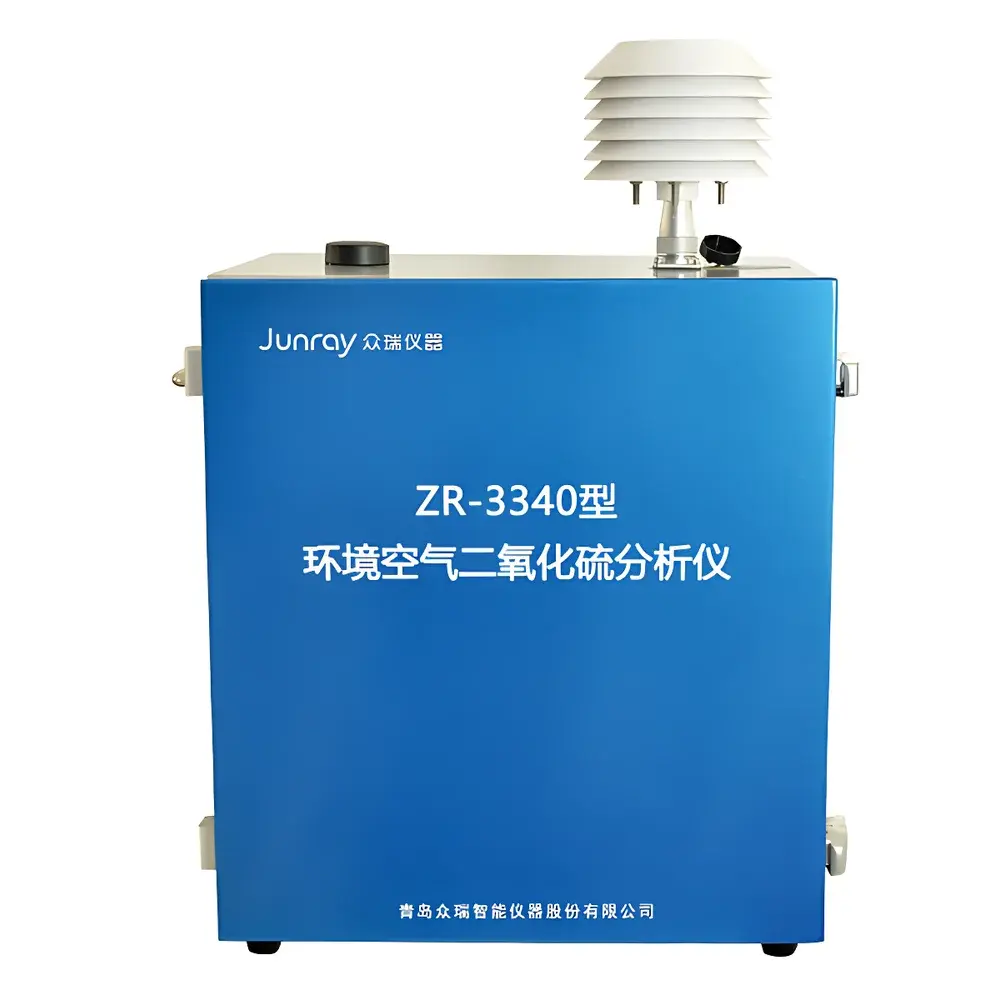
Junray ZR-3340 Ambient Air Sulfur Dioxide (SO₂) Analyzer
| Brand | Junray |
|---|---|
| Origin | Shandong, China |
| Manufacturer Type | Direct Manufacturer |
| Product Category | Domestic |
| Model | ZR-3340 |
| Instrument Type | Online Fixed-Station Analyzer |
| Target Gas | SO₂ |
| Response Time | ≤120 s |
| Measurement Accuracy | ±0.1 nmol/mol |
| Measurement Range | (0–500) nmol/mol |
Overview
The Junray ZR-3340 Ambient Air Sulfur Dioxide (SO₂) Analyzer is a fully automated, continuous-emission monitoring system engineered for high-fidelity quantification of sulfur dioxide in ambient air matrices. It operates on the principle of ultraviolet fluorescence (UVF), wherein SO₂ molecules are excited by UV radiation in the 200–220 nm spectral band and subsequently emit characteristic fluorescence in the 240–420 nm range upon relaxation to the ground electronic state. The intensity of this emitted fluorescence is linearly proportional to the SO₂ concentration over the specified dynamic range—enabling trace-level detection with sub-part-per-trillion (ppt) sensitivity. Designed for unattended, long-term deployment in outdoor environments, the ZR-3340 integrates robust environmental protection (IP65-rated enclosure), low-power operation, and modular gas-handling architecture to ensure stable performance under variable temperature, humidity, and particulate loading conditions. Its compact footprint and lightweight chassis support rapid installation at regulatory monitoring stations, mobile laboratories, and field-deployed networks without requiring dedicated infrastructure.
Key Features
- UV fluorescence detection with inherent selectivity for SO₂—minimizing cross-sensitivity to ozone, NO₂, hydrocarbons, and particulate matter
- Low detection limit of <0.1 nmol/mol (sub-ppb), validated per HJ 1044–2019 methodology
- Real-time response time ≤120 seconds (T₉₀), compliant with HJ 654–2013 requirements for continuous gaseous pollutant analyzers
- Integrated sample conditioning: heated sampling line (60 °C), particulate filter (2.5 µm cut-off), and moisture removal via Nafion® membrane dryer
- Self-diagnostic firmware with automatic zero/span verification cycles, alarm logging, and fault-code reporting
- Modular design supporting field-replaceable optical source, detector assembly, and flow control components—reducing mean time to repair (MTTR)
Sample Compatibility & Compliance
The ZR-3340 is optimized for ambient air matrices meeting ISO 12039:2000 and EN 14625:2012 specifications for gaseous pollutant measurement systems. It complies with national Chinese environmental standards including HJ 1044–2019 (UV fluorescence method for SO₂), HJ 654–2013 (performance requirements), HJ 193–2013 (installation and acceptance), and HJ 818–2018 (operational QA/QC protocols). All calibration procedures align with JJG 551–2003 metrological verification guidelines. The analyzer supports traceable calibration using certified SO₂ permeation tubes or dynamic dilution systems traceable to NIM (National Institute of Metrology, China). Its data output format conforms to HJ 212–2017 communication protocol for environmental monitoring instruments, enabling seamless integration into provincial and national air quality monitoring platforms.
Software & Data Management
The embedded Linux-based controller provides local data acquisition at 1-second resolution, with configurable averaging intervals (1-min, 5-min, hourly). Raw fluorescence signals, flow rates, pressure, temperature, and diagnostic flags are stored internally for ≥30 days. Remote access is supported via Ethernet (TCP/IP) or optional 4G LTE module, enabling secure HTTPS/FTP data upload to central servers. Software features include audit-trail-enabled user authentication, version-controlled firmware updates, and GLP-compliant electronic logbooks that record all calibration events, maintenance actions, and parameter changes—including timestamps, operator IDs, and justification notes. Data export supports CSV, XML, and MODBUS RTU formats for compatibility with third-party SCADA and LIMS platforms.
Applications
- Regulatory ambient air quality monitoring networks (AAQMs) operated by ecological environment bureaus
- Source attribution studies and receptor modeling requiring high-temporal-resolution SO₂ time series
- Intercomparison campaigns between reference-grade analyzers and low-cost sensor networks
- Industrial fence-line monitoring and emission verification near coal-fired power plants, smelters, and petrochemical facilities
- Mobile monitoring deployments on vehicle-mounted or drone-integrated platforms (with optional vibration-damping mounting kit)
- Long-term trend analysis for compliance with WHO Air Quality Guidelines (AQG) and China’s GB 3095–2012 Class II standards
FAQ
What is the recommended calibration frequency for regulatory compliance?
Per HJ 818–2018, zero and span calibration must be performed at least once every 7 days; full multi-point linearity verification is required monthly.
Does the ZR-3340 support remote diagnostics and firmware updates?
Yes—via secure TLS-encrypted web interface or SSH terminal; all update packages are cryptographically signed and validated prior to installation.
Can the analyzer operate reliably in high-humidity environments (e.g., coastal regions)?
Yes—the integrated Nafion® dryer maintains dew point below −10 °C across 5–95% RH ambient conditions, preventing condensation-induced signal drift.
Is the instrument suitable for use in explosion-hazardous areas?
No—the ZR-3340 is rated for general-purpose outdoor use (IP65) but lacks ATEX or IECEx certification; intrinsic safety barriers are not included.
How is measurement traceability ensured during factory calibration?
Each unit undergoes end-to-end calibration using NIM-certified SO₂ standard gases (uncertainty ≤1.2%, k=2) and is supplied with a traceable calibration certificate valid for 12 months.
Related Products







