
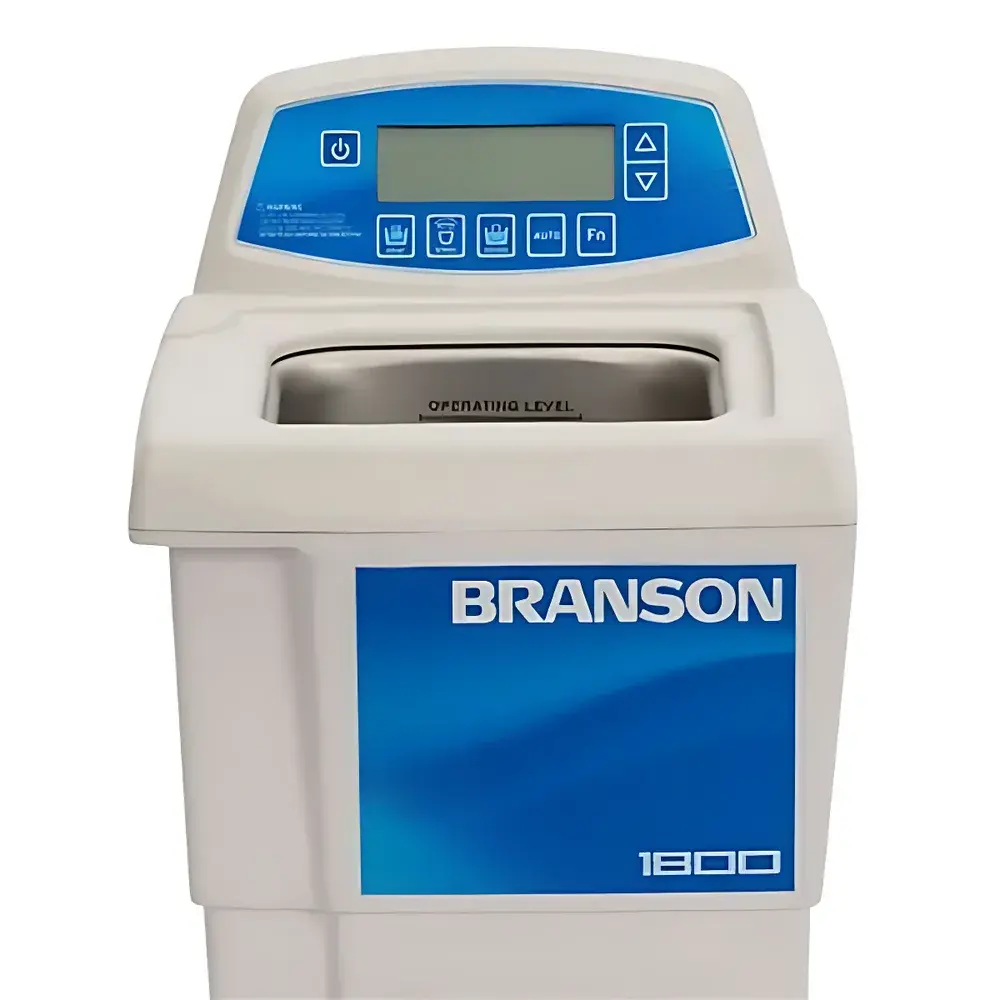
Branson CPX1800-C Benchtop Ultrasonic Cleaner
| Brand | Branson |
|---|---|
| Origin | USA |
| Model | CPX1800-C |
| Capacity | 1.9 L (0.5 Gal) |
| Ultrasonic Frequency | 40 kHz |
| Ultrasonic Power Output | 90 W |
| Power Adjustment | Yes |
| Temperature Control | Yes |
| Timer Range | 0–99 min or continuous |
| Sound-Dampening Lid | Included |
| Drain Port | Manual control |
| Construction | Polypropylene (PP) housing with 304 stainless steel tank |
| Transducer Type | Langevin-type metal/ceramic |
| Mounting | Adhesive-bonded transducers |
| Circuit Board Orientation | Vertical mounting |
| Control Panel | Top-mounted digital interface |
| Degassing Function | Yes |
| Sweep Frequency Technology | Yes |
| Water Level Indicator | Marked standard fill line |
Overview
The Branson CPX1800-C is a precision-engineered benchtop ultrasonic cleaner designed for routine and critical cleaning applications in analytical laboratories, quality control environments, medical device reprocessing units, optics workshops, and electronics manufacturing facilities. It operates on the principle of acoustic cavitation: at 40 kHz, high-frequency sinusoidal voltage drives piezoelectric ceramic elements bonded to a 304 stainless steel tank wall, generating longitudinal pressure waves in the cleaning medium. These waves induce transient microcavities that collapse asymmetrically near solid surfaces—releasing localized energy densities exceeding 5,000 K and 1,000 atm—mechanically dislodging particulate contaminants, organic residues, and thin oxide layers from complex geometries, blind holes, and microfissures without abrasion or thermal degradation. Unlike fixed-frequency systems, the CPX1800-C employs sweep frequency modulation (±1 kHz around 40 kHz) to distribute acoustic energy uniformly across the tank volume, minimizing standing wave nodes and ensuring reproducible cleaning efficacy across load configurations.
Key Features
- Digital microprocessor-controlled interface with intuitive top-mounted panel for precise parameter entry and real-time status feedback
- Automatic power tracking circuitry maintains consistent acoustic output despite load variation, temperature drift, or fluid level changes
- Dual-power mode (High/Low) enables optimization for delicate substrates (e.g., coated lenses, MEMS devices) or heavy soiling (e.g., machined metal parts)
- Degassing cycle (0–99 min programmable) removes dissolved gases prior to cleaning—critical for maximizing cavitation density and reducing surface pitting
- Chemically resistant polypropylene (PP) chassis with seamless 304 stainless steel tank ensures long-term compatibility with aqueous alkaline, acidic, and mild solvent-based solutions
- Langevin-type transducers utilize metallized ceramic discs bonded directly to the tank wall via proprietary epoxy—eliminating mechanical fasteners and enhancing energy transfer efficiency
- Vertical PCB layout improves thermal dissipation and reduces electromagnetic interference with adjacent instrumentation
- Integrated sound-dampening lid doubles as a drip tray when rotated open, supporting GMP-aligned workflow hygiene protocols
- Factory-calibrated water level indicator ensures optimal coupling between transducer and liquid medium—deviations beyond ±5 mm significantly reduce cavitation intensity
Sample Compatibility & Compliance
The CPX1800-C accommodates a broad range of sample types—including glassware (vials, cuvettes, pipette tips), stainless steel tools, silicon wafers, printed circuit boards (PCBs), surgical instruments, and optical components—provided they are compatible with ultrasonic energy and the selected cleaning chemistry. Its construction meets UL 61010-1 and IEC 61010-1 safety standards for laboratory electrical equipment. While not certified for sterile processing per ISO 17664 or AAMI ST79, the unit supports GLP/GMP-aligned documentation when integrated with validated cleaning SOPs. The absence of an automatic drain port requires manual fluid disposal—a design consideration aligned with containment requirements for hazardous or regulated solvents under OSHA 29 CFR 1910.1200.
Software & Data Management
The CPX1800-C operates as a standalone instrument with no embedded software stack or network connectivity. All operational parameters—including time, temperature, power level, and degas duration—are set via tactile membrane switches and displayed on a 3-digit LED screen. No data logging, audit trail, or electronic record functionality is included; therefore, it does not comply with FDA 21 CFR Part 11 requirements for electronic signatures. Users implementing this unit in regulated environments must supplement operation with paper-based logbooks or external timestamped video recording to satisfy traceability expectations under ISO/IEC 17025 Clause 7.7.
Applications
- Pretreatment of HPLC vials and GC autosampler inserts to eliminate carryover contamination
- Removal of photoresist residues and etch byproducts from semiconductor wafers prior to metrology
- Cleaning of reusable surgical forceps, biopsy needles, and endoscope components in low-risk reprocessing workflows
- Decontamination of spectrophotometer cuvettes and NMR tubes to prevent spectral interference
- Preparation of electron microscopy grids and TEM specimen holders for ultra-low particulate loading
- Restoration of vintage optical components (e.g., telescope eyepieces, camera lenses) without lens coating damage
FAQ
What cleaning solutions are compatible with the CPX1800-C?
Aqueous alkaline detergents (pH 9–11), mild acidic formulations (pH 3–5), and low-surface-tension alcohols (e.g., isopropanol) are suitable. Avoid halogenated solvents, strong oxidizers (e.g., nitric acid >10%), and undiluted surfactants that promote excessive foaming.
Is the CPX1800-C suitable for cleaning delicate MEMS devices?
Yes—when operated in Low-power mode with degassed deionized water and short cycle durations (≤5 min), it achieves sub-micron particle removal without stiction or structural resonance damage.
Does the unit include temperature calibration certification?
No. The built-in thermistor provides approximate bath temperature indication (±3 °C accuracy); users requiring traceable thermal validation must employ external calibrated probes per ASTM E2251.
Can multiple CPX1800-C units be synchronized for parallel processing?
Not natively. Each unit operates independently with no master-slave or timing sync capability. Synchronization must be managed externally via lab scheduling protocols.
What maintenance intervals are recommended for transducer longevity?
Inspect transducer bonding integrity annually using ultrasonic pulse-echo testing. Replace tank fluid after every 100 operating hours or when conductivity exceeds 500 µS/cm to prevent electrode corrosion and power loss.
Related Products



