
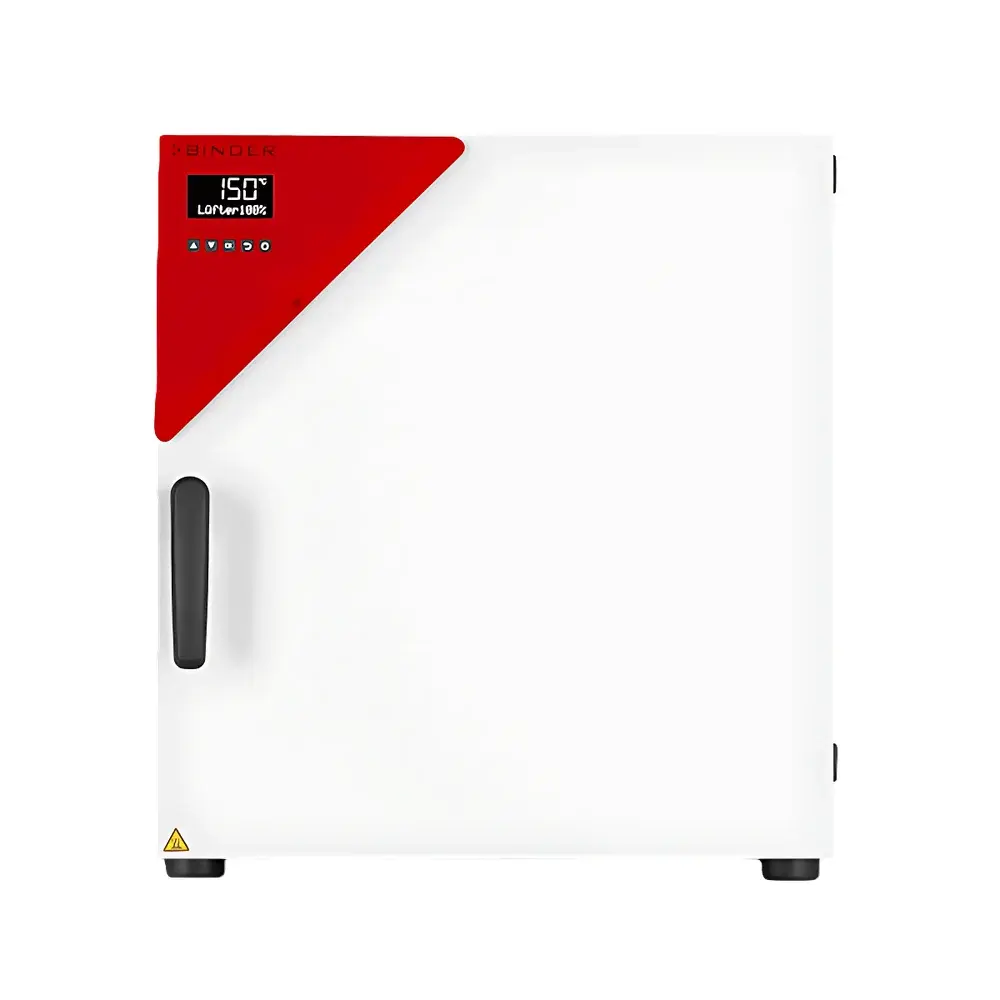
BINDER ED-S 56 Natural Convection Drying Oven
| Brand | BINDER |
|---|---|
| Origin | Germany |
| Manufacturer | BINDER GmbH |
| Type | High-Temperature Laboratory Drying Oven |
| Model | ED-S 56 |
| Temperature Range | Ambient +7 °C to 250 °C |
| Temperature Uniformity | ±0.8 °C at 150 °C |
| External Dimensions (W×D×H) | 590 × 580 × 515 mm |
| Internal Chamber Dimensions (W×D×H) | 400 × 440 × 350 mm |
| Chamber Material | Stainless Steel (AISI 304) |
| Heating System | APT Line Preheating Chamber |
| Convection Type | Natural Convection |
| Safety Class | Independent Adjustable Temperature Safety Device, Class 2 (DIN 12880) |
| Controller | Integrated Timer with Optical Alarm |
| Shelving | Chrome-Plated Adjustable Shelves |
| Ventilation | Adjustable Exhaust Valve |
| Compliance | CE, DIN EN 61000-6-3, DIN EN 61000-6-4 |
Overview
The BINDER ED-S 56 is a precision-engineered natural convection drying oven designed for reliable thermal processing in research laboratories, quality assurance environments, and industrial R&D settings. Built upon BINDER’s decades of German engineering heritage, the ED-S 56 employs passive air circulation—eliminating forced-air fans—to ensure gentle, uniform heat distribution ideal for moisture removal, pre-baking, sterilization validation support, and thermal stabilization of temperature-sensitive samples. Its operational range extends from ambient +7 °C up to 250 °C, enabling routine drying, conditioning, and aging applications without introducing mechanical stress or particle disturbance associated with fan-driven airflow. The core thermal architecture centers on the proprietary APT Line preheating chamber, which thermally isolates and stabilizes heating elements prior to energy transfer into the working chamber—enhancing both setpoint accuracy and long-term reproducibility across repeated cycles.
Key Features
- APT Line preheating chamber technology ensures precise thermal delivery and minimizes overshoot during ramp-up phases.
- Natural convection design eliminates airflow turbulence—critical for handling powders, filters, coated substrates, and delicate biological matrices where particle displacement must be avoided.
- Dual-stage temperature safety system (DIN 12880 Class 2) includes an independently adjustable mechanical overtemperature cut-off, providing fail-safe protection against controller failure.
- Optical alarm integrated into the digital controller alerts users immediately upon deviation from set parameters or safety limit activation.
- Stainless steel interior (AISI 304) offers corrosion resistance, ease of decontamination, and compatibility with common laboratory solvents and cleaning agents.
- Three chrome-plated, height-adjustable shelves allow flexible load configuration; shelf positions can be modified without tools.
- Manually adjustable exhaust valve enables fine-tuned control of chamber humidity and volatile compound evacuation during extended drying protocols.
- Compliant with electromagnetic compatibility standards (DIN EN 61000-6-3/6-4) and CE-marked for use across EU member states under Directive 2014/30/EU.
Sample Compatibility & Compliance
The ED-S 56 accommodates a broad spectrum of sample types—including glassware, metal parts, polymer films, ceramic substrates, filter papers, and pharmaceutical excipients—without risk of oxidation-induced degradation or surface abrasion. Its absence of internal fans prevents cross-contamination between samples and preserves structural integrity of friable materials. The stainless steel chamber meets material traceability requirements per ISO 9001 and supports GLP-compliant documentation workflows when paired with external data loggers. While not certified for explosion-proof operation, the unit conforms to general-purpose laboratory equipment safety directives and may be deployed in non-hazardous environments aligned with IEC 61010-1. For regulatory submissions involving thermal process validation (e.g., residual solvent testing per USP ), the oven’s documented temperature stability and repeatability support IQ/OQ protocol development.
Software & Data Management
The ED-S 56 operates via a dedicated microprocessor-based controller with intuitive push-button interface and LED display. It features programmable timer functionality (up to 99 hours 59 minutes), real-time temperature readout, and visual status indicators for heating phase, alarm condition, and safety cutoff activation. Though the base model does not include built-in data logging or Ethernet connectivity, it supports analog output (0–10 V) for integration with third-party SCADA systems or chart recorders. When used in GxP-regulated facilities, users commonly pair the oven with validated external temperature mapping probes and time-stamped data acquisition software to fulfill FDA 21 CFR Part 11 audit trail requirements. BINDER’s optional APT-COM software (sold separately) enables remote monitoring and parameter archiving for multi-unit installations.
Applications
- Drying of moisture-sensitive analytical standards and reference materials prior to gravimetric analysis.
- Conditioning of test specimens for tensile, adhesion, or coating performance evaluation (ASTM D618, ISO 291).
- Thermal stabilization of electronic components and PCB assemblies before soldering or reliability testing.
- Pre-heating of crucibles, pipettes, and volumetric glassware in analytical chemistry workflows.
- Accelerated aging studies for packaging materials and medical device polymers (ISO 11607, ASTM F1980).
- Residual solvent removal from API intermediates in small-batch pharmaceutical development.
FAQ
What is the maximum recommended operating temperature for continuous use?
The ED-S 56 is rated for continuous operation at temperatures up to 250 °C. Prolonged exposure above this threshold may compromise sensor calibration and insulation integrity.
Does the oven support validation for ISO/IEC 17025-accredited laboratories?
Yes—the unit’s documented temperature uniformity (±0.8 °C at 150 °C), mechanical safety redundancy, and stainless steel construction align with technical requirements for equipment qualification in accredited testing labs.
Can the exhaust valve be connected to an external fume hood duct system?
No—the adjustable exhaust valve is designed for passive venting only and lacks threaded or flanged interfaces for hard-piped connections. Forced extraction may disrupt natural convection dynamics and invalidate temperature specifications.
Is calibration certificate included with shipment?
A factory calibration report (traceable to PTB standards) is provided as standard. Full UKAS or NIST-traceable calibration requires optional on-site service or third-party certification.
How often should the temperature safety device be functionally tested?
Per DIN 12880 guidance, the Class 2 safety device should undergo verification at least once per year—or prior to any critical validation run—as part of preventive maintenance procedures.



