
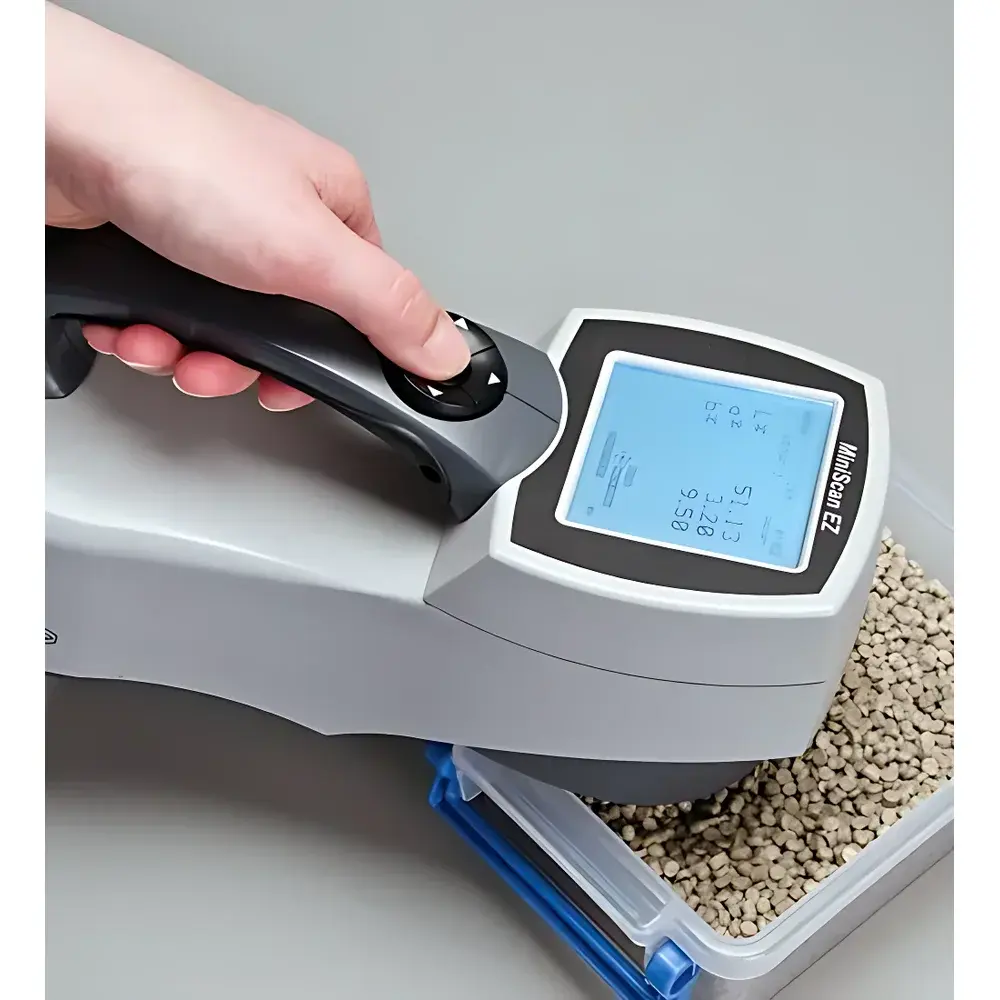
HunterLab MiniScan EZ 45/0 Reflective Spectrophotometric Colorimeter
| Brand | HunterLab |
|---|---|
| Origin | USA |
| Model | MSEZ 45/0 |
| Instrument Type | Portable |
| Optical Geometry | 0°/45° (45° illumination / 0° viewing) |
| Light Source | Pulsed Xenon Lamp |
| Spectral Range | 400–700 nm |
| Spectral Resolution | <3 nm, FWHM: 10 nm |
| Reflectance Range | 0–150% |
| Repeatability | ΔE* ≤ 0.05 (CIE L*a*b* on certified white tile) |
| Aperture Sizes | 6.0 mm (SAV), 31.8 mm (LAV) |
| Detector | 256-element silicon photodiode array with precision holographic grating |
| Display | Backlit monochrome LCD with rotatable orientation |
| Data Storage | 100 standards (with tolerance limits), 800 measurements |
| Connectivity | USB |
| Power | Rechargeable lithium-ion battery pack (optional AC adapter) |
Overview
The HunterLab MiniScan EZ 45/0 is a portable, high-precision spectrophotometric colorimeter engineered for industrial color quality control in production, incoming inspection, and field applications. It operates on the 0°/45° optical geometry—where light is directed at the sample from 45° relative to the surface normal and reflected light is collected at 0°—a configuration standardized in ASTM D2244 and ISO 11664-4 for minimizing directional effects such as texture and gloss interference. Unlike diffuse/8° instruments, the 45/0 design provides consistent color measurement on moderately textured or directional surfaces common in coatings, plastics, textiles, paper, and food packaging. The system employs a pulsed xenon lamp for stable, flash-based illumination across the full visible spectrum (400–700 nm), eliminating thermal drift and enabling rapid, repeatable measurements without warm-up time. Its 256-element silicon photodiode array coupled with a precision holographic grating delivers spectral data with <3 nm resolution and 10 nm full-width-at-half-maximum (FWHM), supporting CIE-compliant tristimulus calculations under multiple standard illuminants (A, C, D50, D65, F2, etc.) and observers (2° and 10°).
Key Features
- True 0°/45° optical path optimized for non-diffuse, structured, and glossy surfaces per ASTM E308 and ISO/CIE 11664 series
- Pulsed xenon light source ensures spectral stability, eliminates lamp aging artifacts, and supports >100,000 measurements per charge
- Two aperture options: 6.0 mm (Small Area View, SAV) for localized spot analysis and 31.8 mm (Large Area View, LAV) for averaging heterogeneous or textured substrates
- Robust, single-body magnesium alloy housing rated IP54 for dust and splash resistance—designed for factory floor, warehouse, and dockside use
- Rotatable backlit LCD display with user-configurable orientation for ergonomic operation in any spatial constraint
- Onboard storage of up to 100 reference standards—including user-defined tolerances—and 800 measurement records with timestamp and operator ID fields
- Integrated “555 Color Intensity Code” classification system for rapid visual grouping of textile and apparel shades—aligned with AATCC TM179 and ISO 105-J03 workflows
Sample Compatibility & Compliance
The MiniScan EZ 45/0 accommodates flat, curved, and slightly irregular samples typical of molded plastics, painted panels, woven fabrics, laminated films, and coated paperboards. Its fixed-angle geometry avoids specular component exclusion (SCE) complications inherent in d/8° systems, making it particularly suitable for evaluating metallic, pearlescent, and gonioapparent finishes where angular consistency is critical. The instrument complies with key regulatory and industry frameworks: data integrity meets FDA 21 CFR Part 11 requirements when used with validated EasyMatch QC software (v5.0+); measurement traceability aligns with NIST-traceable calibration standards; and reporting structures support ISO/IEC 17025 accredited labs through audit-ready metadata logging (including instrument ID, calibration date, operator, ambient temperature/humidity if logged externally). It satisfies color acceptance criteria defined in ASTM D313, ISO 12647-2 (graphic arts), and AATCC Evaluation Procedure 1.
Software & Data Management
USB connectivity enables seamless integration with HunterLab’s EasyMatch QC software—a GxP-ready platform supporting method-driven workflows, statistical process control (SPC), and automated pass/fail reporting. Software features include multi-instrument fleet management, customizable report templates (PDF/CSV/XLSX), real-time delta-E trend charts, and GLP-compliant electronic signatures with full audit trail (user actions, parameter changes, calibration events). All spectral data are stored in open-format .qtx files compatible with third-party color formulation systems (e.g., X-Rite Color iMatch, Datacolor Match Textile). Firmware updates and calibration verification routines are delivered via secure HTTPS portal with version-controlled release notes and validation documentation.
Applications
- Automotive: In-line paint booth verification, trim component matching, and supplier color approval against OEM master standards
- Plastics & Polymers: Batch-to-batch consistency monitoring of injection-molded parts, extruded profiles, and recycled resin blends
- Textiles & Apparel: Shade sorting of dyed yarns, fabric rolls, and finished garments—leveraging the 555 coding system for rapid QC triage
- Packaging: Color fidelity assessment of flexographic and gravure-printed cartons, labels, and foil-laminated pouches
- Food & Beverage: Objective evaluation of product appearance (e.g., cheese rind, chocolate bloom, fruit skin tone) under controlled lighting conditions
- Building Materials: Consistency verification of ceramic tiles, vinyl flooring, and architectural coatings across large production lots
FAQ
What is the difference between 0°/45° and d/8° geometry in color measurement?
0°/45° isolates directional reflectance and suppresses gloss influence, making it ideal for textured or directional surfaces. d/8° integrates both diffuse and specular components, better suited for matte, Lambertian materials.
Does the MiniScan EZ 45/0 support measurement of transparent or translucent samples?
No—it is designed exclusively for opaque and reflective surfaces. Transmission or translucency measurements require a d/0° or d/8° spectrophotometer with transmission port and backing standard.
How often must the instrument be calibrated?
A daily zero and white calibration using supplied ceramic tiles is recommended. Full recalibration by an authorized HunterLab service center is advised annually or after physical impact or environmental shock.
Can measurement data be exported to ERP or MES systems?
Yes—EasyMatch QC supports ODBC and REST API interfaces for direct integration with SAP QM, Oracle Quality, and custom manufacturing execution platforms.
Is the device compliant with ISO/IEC 17025 for accredited testing laboratories?
When operated within documented procedures—including traceable calibration, environmental monitoring, and staff competency records—the MiniScan EZ 45/0 serves as a compliant measurement tool under ISO/IEC 17025:2017 Clause 6.4 and 6.5.





