
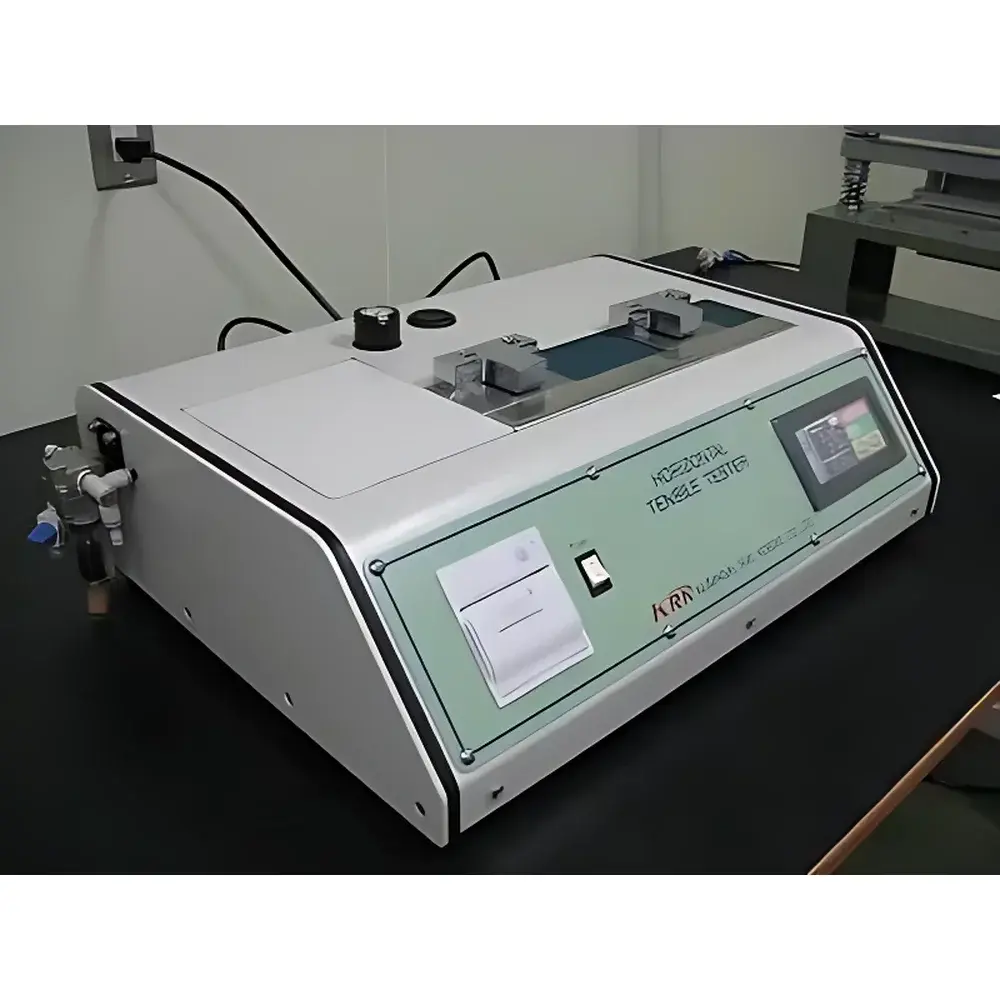
KRK 2000D Horizontal Tensile Testing Machine
| Brand | KRK |
|---|---|
| Origin | Japan |
| Model | KRK 2000D |
| Maximum Load Capacity | 500 N (standard) |
| optional | 100 N, 200 N, 1000 N |
| Gauge Length | 100–180 mm |
| Elongation Range | up to 20 mm (at 180 mm gauge length) |
| Tensile Speed | 2–50 mm/min |
| Specimen Width | 15 mm or 25 mm |
| Clamping Method | Pneumatic jaws |
| Power Supply | 100/110/220 V AC, 50/60 Hz, 2 A |
| Air Supply | 0.4–0.6 MPa |
| Dimensions (W×D×H) | 700 × 430 × 440 mm |
| Weight | 38 kg |
| Compliance | TAPPI T494, ISO 1924-2, GB/T 12914 |
Overview
The KRK 2000D Horizontal Tensile Testing Machine is an engineered precision instrument designed for static mechanical property evaluation of thin, flexible sheet materials—particularly paper, board, nonwovens, films, and lightweight textiles. Its horizontal configuration minimizes gravitational influence on specimen alignment and eliminates sag-induced measurement artifacts common in vertical systems, thereby enhancing repeatability and fidelity in low-force tensile regimes. The system operates on the principle of controlled uniaxial tension, applying calibrated force via a servo-controlled drive while continuously monitoring displacement and load response. All measurements conform to internationally recognized standards including TAPPI T494 (tensile properties of paper and paperboard), ISO 1924-2 (determination of tensile strength and elongation), and GB/T 12914 (Chinese national standard for paper tensile testing), ensuring data interoperability across global quality assurance workflows.
Key Features
- Horizontal loading architecture optimized for planar specimen geometry and minimal bending moment during clamping.
- Intuitive 7-inch LCD touchscreen interface enabling rapid parameter setup—including gauge length (100–180 mm), tensile speed (2–50 mm/min), specimen orientation (MD/CD/ND), basis weight, and thickness input.
- Modular load cell options: standard 500 N capacity with field-replaceable alternatives of 100 N, 200 N, and 1000 N to accommodate diverse material stiffness ranges.
- Pneumatic clamping system (0.4–0.6 MPa supply pressure) delivering uniform, repeatable grip pressure without manual torque variation—critical for minimizing slippage in low-modulus specimens.
- Integrated thermal printer for immediate hard-copy output of test reports, including raw curves and calculated metrics.
- RS-232 serial interface for bidirectional communication with external LIMS or laboratory data management platforms.
Sample Compatibility & Compliance
The KRK 2000D accommodates specimens 15 mm or 25 mm wide, with maximum elongation capability of 20 mm at full 180 mm gauge length—sufficient for evaluating both high-ductility films and brittle specialty papers. Its design supports standardized conditioning per ISO 187 and ASTM D685, and all reported parameters—including tensile strength (N, kN/m, kgf), elongation at break (%), tensile energy absorption (J/m²), tensile stiffness (kN/m), Young’s modulus (MPa), and breaking length (km)—are traceable to SI units and aligned with metrological best practices. Instrument validation documentation supports GLP-compliant environments; audit trails for method changes, calibration logs, and user access can be maintained externally via RS-232-linked database systems compliant with FDA 21 CFR Part 11 requirements when integrated into validated software ecosystems.
Software & Data Management
While the KRK 2000D operates autonomously via its embedded firmware, its RS-232 port enables seamless integration with third-party data acquisition and analysis software (e.g., LabVIEW, MATLAB, or custom Python-based parsers). Test parameters and results—including time-stamped load-displacement curves—are transmitted as ASCII-formatted strings with configurable delimiters, facilitating automated parsing and batch reporting. The onboard display retains last-run configuration profiles and stores up to 100 test records internally, each tagged with specimen ID, orientation, basis weight, and operator-defined metadata. For regulated laboratories, external software packages may implement electronic signatures, version-controlled method files, and change-control logs—extending compliance coverage beyond the instrument’s native capabilities.
Applications
This system is routinely deployed in R&D labs and QC departments for comparative tensile benchmarking across pulp grades, coated vs. uncoated substrates, recycled fiber blends, and biodegradable packaging films. It supports failure mode analysis (e.g., necking onset, yield point detection in thermoplastics), correlation studies between tensile stiffness and caliper/basis weight, and specification conformance verification against customer technical data sheets. In academic settings, it serves as a reference platform for validating constitutive models of viscoelastic sheet materials under quasi-static loading conditions.
FAQ
What standards does the KRK 2000D comply with?
TAPPI T494, ISO 1924-2, and GB/T 12914 are natively supported through preconfigured test protocols and unit conventions.
Can the instrument measure Young’s modulus?
Yes—the system calculates initial slope of the linear elastic region in the stress–strain curve, reporting Young’s modulus in MPa based on specimen cross-section and gauge length inputs.
Is calibration traceable to national standards?
Load cells are supplied with individual calibration certificates traceable to JCSS (Japan Calibration Service System) or equivalent ISO/IEC 17025-accredited bodies.
Does the pneumatic clamping require an external air compressor?
Yes—a clean, oil-free compressed air source delivering 0.4–0.6 MPa is required; typical lab-grade compressors with desiccant filtration meet this specification.
Can test data be exported in CSV format?
Direct CSV export is not available onboard, but RS-232 ASCII output is structured for reliable conversion to CSV using host-side scripting or commercial DAQ software.
Related Products



