
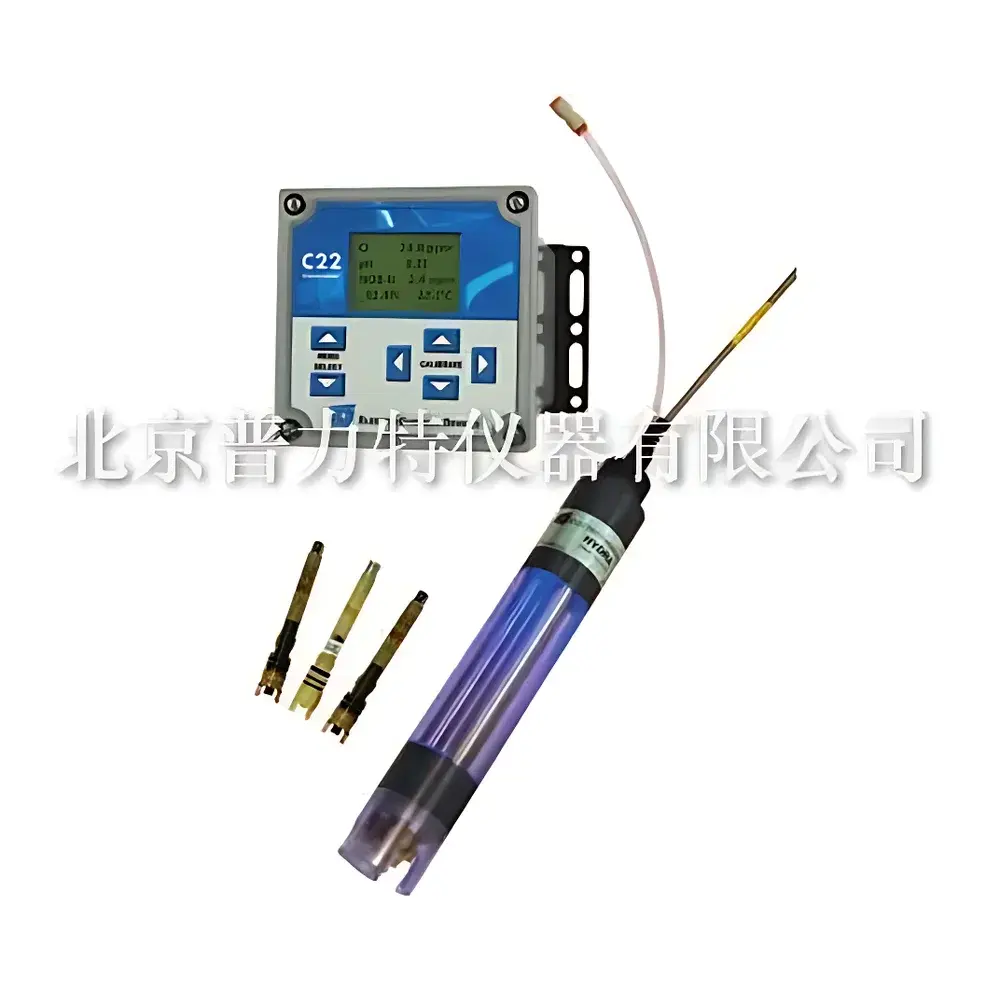
HYDRA2 Online Nitrate-Nitrogen (NO₃⁻-N) Monitor
| Origin | USA |
|---|---|
| Manufacturer Type | Distributor |
| Origin Category | Imported |
| Model | HYDRA2 |
| Pricing | Upon Request |
Overview
The HYDRA2 Online Nitrate-Nitrogen (NO₃⁻-N) Monitor is a field-deployable, potentiometric ion-selective electrode (ISE)-based analyzer engineered for continuous, real-time quantification of nitrate-nitrogen concentration in natural and engineered water systems. Designed for long-term unattended operation in lakes, rivers, groundwater wells, wastewater treatment effluents, and industrial discharge streams, the system employs a dual-electrode measurement principle grounded in Nernstian response kinetics. The primary sensing element is a selective nitrate ion (NO₃⁻) electrode; however, chloride (Cl⁻) — a ubiquitous interferent in environmental waters — induces measurable cross-sensitivity. To ensure analytical integrity, the HYDRA2 integrates a co-located chloride-selective electrode and a precision thermistor within a single, compact sensor body. Real-time Cl⁻ compensation is applied algorithmically to the raw NO₃⁻ signal, while temperature-dependent slope and offset corrections are dynamically applied using the embedded thermal sensor. This three-parameter (NO₃⁻, Cl⁻, T) simultaneous acquisition architecture delivers traceable, interference-corrected NO₃⁻-N data compliant with EPA Method 353.2 principles and aligned with ISO 10304-1 (ion chromatography validation benchmarks) for method equivalence assessment.
Key Features
- Triple-sensor ISE platform: Integrated NO₃⁻-selective, Cl⁻-selective, and PT1000 temperature electrodes in a single IP68-rated housing
- Onboard signal conditioning circuitry: Enables stable analog transmission over distances up to 200 meters without signal degradation or external amplification
- Automated pneumatic jet cleaner: Programmable cleaning cycles remove biofilm, silt, and organic fouling from electrode surfaces; cleaning duration and frequency fully configurable via C22 datalogger interface
- Modular electrode protection sleeve: Removable fluoropolymer shield facilitates rapid electrode inspection, calibration, and replacement without disassembling the sensor body
- Ruggedized construction: Sensor wetted materials include PVC, PVDF, PES, PTFE, FKM fluoroelastomer, borosilicate glass, and 316 stainless steel — certified for continuous immersion in aggressive aqueous matrices
- Fail-safe output hold logic: During cleaning cycles, the 4–20 mA output maintains the last valid reading or a user-defined hold value, ensuring uninterrupted SCADA integration
Sample Compatibility & Compliance
The HYDRA2 is validated for use across a broad spectrum of water matrices, including freshwater (pH 5.0–9.0), brackish estuarine water (Cl⁻ ≤ 1000 ppm), treated wastewater effluent, and low-conductivity groundwater. It meets NEMA 4X enclosure rating for the C22 datalogger and conforms to IEC 60529 for IP68 submersion (up to 10 m depth, indefinite duration). While not a certified reference method per se, its measurement protocol adheres to fundamental electrochemical validation criteria outlined in ASTM D3370 (Standard Practices for Sampling Water), EPA SW-846 Method 9056A (Ion Selective Electrode Analysis), and supports GLP-compliant data integrity when paired with audit-trail-enabled data loggers. The system’s ±3% accuracy specification (relative to calibrated standard) is achievable only under routine two-point calibration (low/high) and verified Cl⁻ interference profiling at installation.
Software & Data Management
The C22 datalogger serves as the central control and communication hub. Its backlit LCD display (6.35 cm × 4.45 cm, 4-line character format) provides local visualization of real-time NO₃⁻-N, Cl⁻, and temperature values, along with diagnostic flags (e.g., “CLEANING”, “CALIBRATION DUE”, “SENSOR FAULT”). Two isolated 4–20 mA outputs support connection to PLCs, DCS systems, or telemetry units; each channel is independently scalable (0–14000 ppm NO₃⁻-N default range). Optional configurations allow expansion to four analog outputs and up to eight relay-controlled functions — including dedicated relays for jet cleaning activation and dual-level alarm thresholds (high/low). All configuration parameters, calibration history, cleaning logs, and alarm events are timestamped and stored internally with non-volatile memory retention exceeding 30 days at 1 Hz sampling. Data export is supported via RS-232 serial interface for integration into LIMS or cloud-based water quality dashboards.
Applications
- Real-time nutrient loading assessment in watershed monitoring networks
- Process control of denitrification basins and tertiary treatment trains
- Early-warning detection of agricultural runoff events in receiving streams
- Compliance monitoring for NPDES permits requiring NO₃⁻-N reporting
- Groundwater plume tracking at remediation sites contaminated with nitrogenous fertilizers or septic leachate
- Research-grade longitudinal studies on nitrification/denitrification dynamics in mesocosms and pilot-scale reactors
FAQ
What is the typical electrode service life under continuous operation?
Ion-selective electrodes exhibit finite functional longevity due to membrane aging and reference junction depletion. Under standard environmental conditions (20°C, pH 6–8, <500 ppm Cl⁻), the NO₃⁻ and Cl⁻ electrodes maintain metrological stability for 4–6 months. Routine calibration and cleaning extend usable life toward the upper bound.
Can the HYDRA2 be deployed in high-turbidity or high-biofouling environments?
Yes — the integrated jet cleaner is specifically designed for such conditions. For extreme biofouling scenarios (e.g., warm wastewater outfalls), cleaning intervals may be reduced to every 2–4 hours; the C22 supports programmable duty cycles from 1 second to 24 hours.
Is temperature compensation automatic and embedded?
Yes. Temperature measurement is performed continuously by an internal PT1000 sensor, and all NO₃⁻ and Cl⁻ electrode responses are corrected in real time using the Nernst equation’s temperature coefficient (dE/dT), eliminating manual correction tables.
Does the system support remote diagnostics or firmware updates?
Remote diagnostics are accessible via RS-232 serial connection using terminal emulation software. Firmware updates require physical access to the C22 unit and must be performed using manufacturer-provided utilities; no over-the-air (OTA) update capability is implemented for security and regulatory compliance reasons.
How is Cl⁻ interference quantified and compensated?
The Cl⁻ electrode measures ambient chloride activity concurrently with NO₃⁻. A linear interference coefficient (kCl) — determined during factory characterization and verified during site-specific calibration — is applied to the Cl⁻ reading. The compensated NO₃⁻ signal equals: ENO₃,comp = ENO₃,raw − kCl × ECl. This calculation occurs continuously within the sensor’s analog front-end.







