
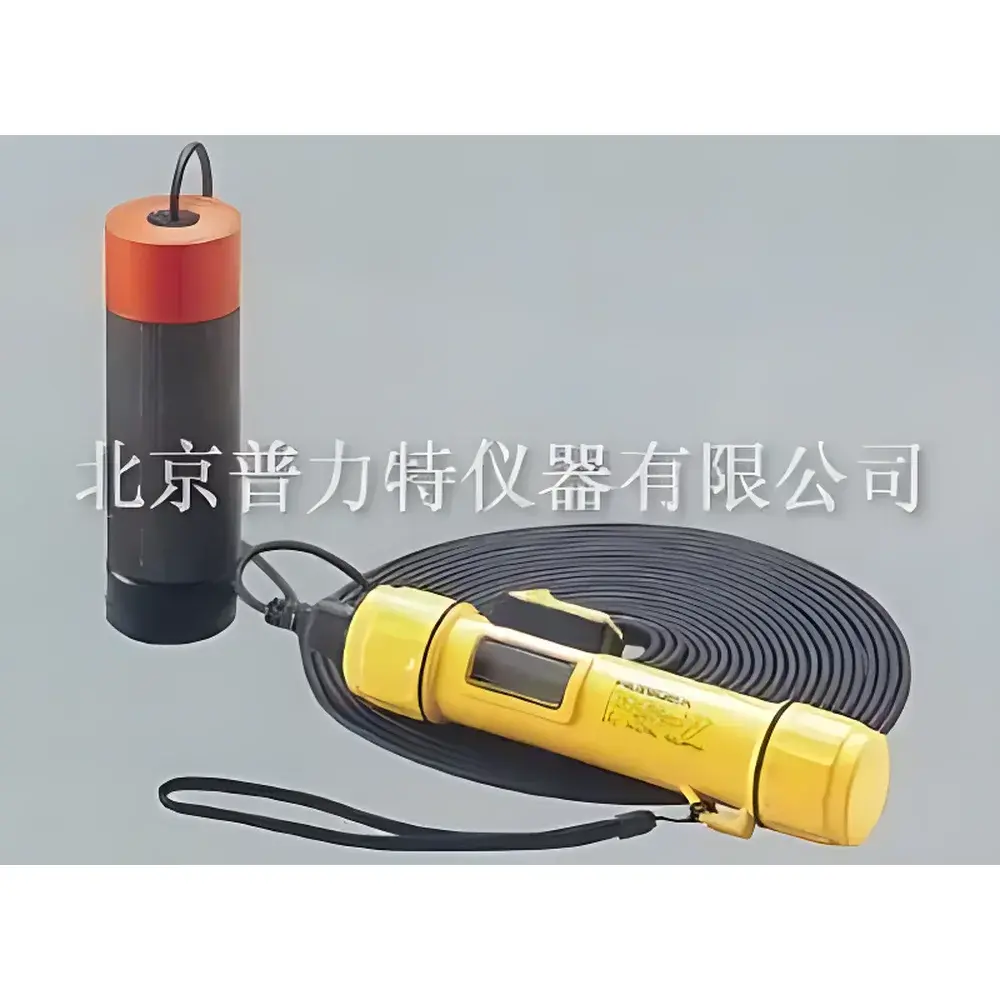
EchoSounder 81180 Portable Echo Sounder
| Origin | Japan |
|---|---|
| Manufacturer Type | Authorized Distributor |
| Origin Category | Imported |
| Model | 81180 |
| Price | Upon Request |
| Display | LCD |
| Operating Frequency | 200 kHz (Beam Width: 24°) |
| Depth Measurement Range | 0.6–80 m |
| Waterproof Rating | IP68 (50 m submersion rated) |
| Power Supply | 9 V alkaline battery (IEC 6F22 / ANSI 006P) |
Overview
The EchoSounder 81180 is a compact, field-deployable echo sounder engineered for accurate and repeatable water depth measurement in freshwater and coastal marine environments. Based on pulse-echo ultrasonic principle, it transmits short-duration 200 kHz acoustic pulses vertically downward and calculates depth by measuring the time-of-flight between transmission and reception of the reflected signal from the water bottom. Its narrow beam width (24°) minimizes side-lobe interference and improves vertical resolution—critical for distinguishing shallow sediment layers or submerged structures in turbid or vegetation-rich waters. Designed for portability and rapid deployment, the unit integrates a ruggedized transducer, low-power display console, and standardized 10 m shielded cable assembly—making it suitable for manual sounding operations from small boats, piers, or wading surveys.
Key Features
- High-frequency 200 kHz transducer with 24° nominal beam angle ensures optimal balance between penetration depth and lateral resolution in typical inland and estuarine conditions.
- LCD display module provides real-time depth readout with automatic gain control and signal strength indicator—enabling reliable operation under variable water clarity and temperature profiles.
- IP68-rated transducer housing withstands continuous submersion up to 50 meters, certified per IEC 60529; compatible with both freshwater and low-salinity brackish applications.
- Low-power architecture supports extended field use: powered exclusively by a single 9 V alkaline battery (IEC 6F22), delivering >12 hours of continuous operation under typical duty cycles.
- Modular design enables quick disassembly for transport and cleaning; transducer and display unit are connected via a 10 m shielded coaxial cable with waterproof M12 connectors (EN 61076-2-101 compliant).
Sample Compatibility & Compliance
The EchoSounder 81180 is validated for use in natural water bodies including rivers, lakes, reservoirs, canals, and sheltered coastal zones. It performs reliably across water temperatures ranging from 0 °C to 40 °C and salinities up to 15 ppt—covering most inland and transitional aquatic systems. While not intended for deep-ocean or high-turbidity sediment-laden environments (>100 NTU), its acoustic output and signal processing are optimized for stable bottom detection in moderate suspended solids conditions. The device complies with electromagnetic compatibility standards IEC 61326-1 (industrial environment) and meets RoHS Directive 2011/65/EU requirements. No calibration certificate is supplied as standard; however, field verification using known-depth reference points (e.g., marked poles or surveyed benchmarks) is recommended prior to data-critical deployments.
Software & Data Management
The EchoSounder 81180 operates as a standalone instrument without embedded data logging or PC connectivity. All measurements are displayed in real time on the integrated LCD screen and must be manually recorded. For traceable environmental monitoring workflows, users may integrate the unit into broader data acquisition frameworks via external digital logging—e.g., pairing with GPS-enabled tablets running GIS-compatible survey apps (such as QField or Survey123) for georeferenced depth point capture. Though the device itself does not support FDA 21 CFR Part 11 or GLP audit trails, its consistent output format and mechanical simplicity support reproducible manual data entry protocols aligned with ISO 5725 (accuracy and precision of measurement methods) and ASTM D1129 (standard terminology relating to water).
Applications
- Bathymetric profiling of small reservoirs and irrigation channels during routine infrastructure maintenance.
- Pre- and post-dredging verification in municipal harbors and marinas where depth tolerances ≤ ±0.15 m are required.
- Seasonal sediment accumulation monitoring in lake inlets and river floodplains under EPA Region 10 or EU WFD (Water Framework Directive) reporting frameworks.
- Supporting ISO 7888-compliant turbidity-depth correlation studies when deployed alongside calibrated optical sensors.
- Field training and educational use in hydrology and environmental science curricula due to intuitive interface and robust physical design.
FAQ
Does the EchoSounder 81180 support data export or Bluetooth connectivity?
No. This is a self-contained analog echo sounder with no internal memory, serial interface, or wireless communication capability.
Can it be used in saltwater environments?
Yes—within limits. It functions reliably in brackish and low-salinity seawater (≤15 ppt); prolonged immersion in full-strength seawater (>35 ppt) is not recommended due to potential long-term corrosion risk at connector interfaces.
What is the minimum detectable depth and resolution?
The specified lower limit is 0.6 m; depth resolution is approximately ±0.05 m under stable acoustic conditions, consistent with time-of-flight quantization at 200 kHz.
Is the transducer compatible with third-party mounting brackets or hull installations?
Yes—the transducer features a standard 1″–14 NPT threaded base and includes rubber isolation gasketing, permitting secure mechanical integration with common marine transom mounts or custom aluminum housings.
How often should the transducer face be cleaned or inspected?
Before each deployment, especially after use in algae-prone or silt-laden waters; biofouling or particulate buildup directly attenuates acoustic output and degrades signal-to-noise ratio.
Related Products







