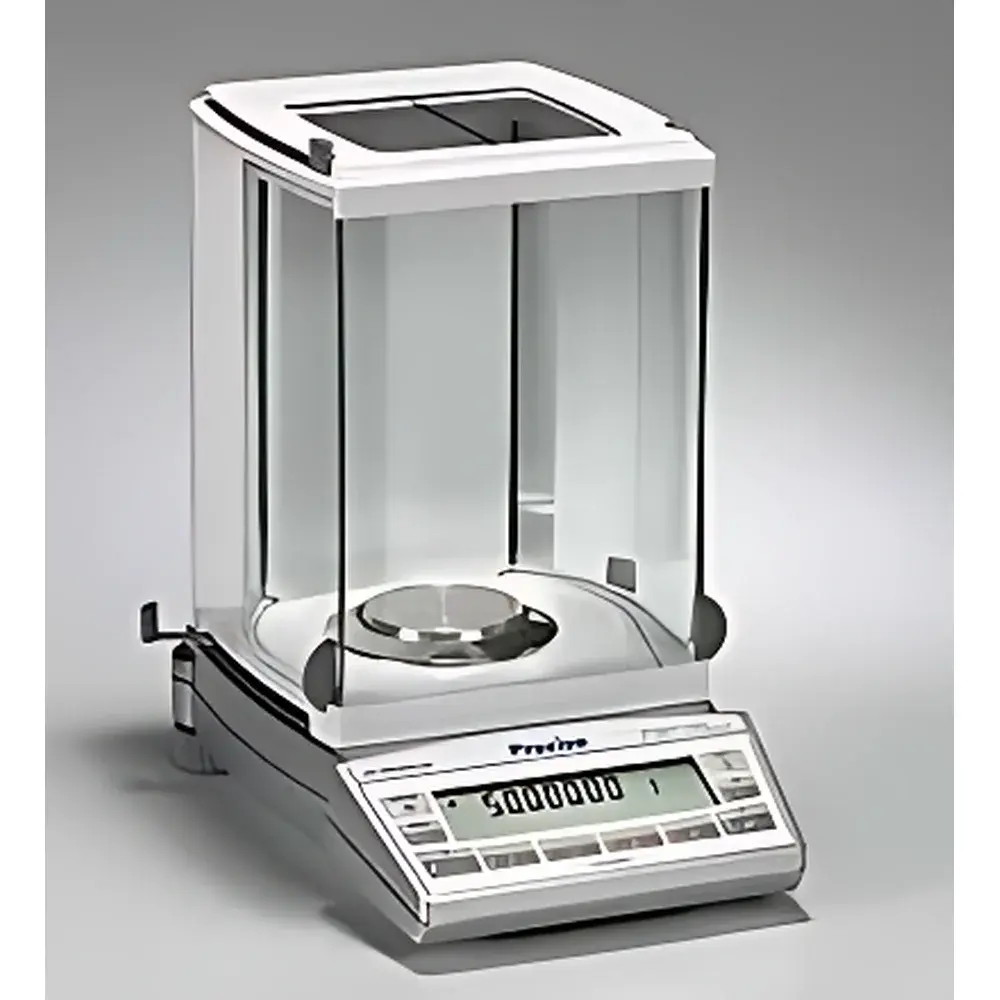
Precisa XR125SM Ultra-Micro Analytical Balance
| Brand | Precisa |
|---|---|
| Origin | Switzerland |
| Model | XR125SM |
| Maximum Capacity | 125 g |
| Readability | 0.01 mg |
| Calibration | Internal motorized calibration weight with automatic scheduling (every 24 h) and temperature-triggered recalibration (ΔT ≥ 2 °C) |
| Draft Shield Height | 230 mm |
| Construction | Full aluminum alloy housing with anti-static treatment |
| Connectivity | RS-232 interface |
| Compliance | Approved per Chinese National Type Evaluation Regulation (JJG 1036–2022) |
Overview
The Precisa XR125SM Ultra-Micro Analytical Balance is a high-precision weighing instrument engineered for laboratories requiring trace-level mass determination under regulated and research-intensive environments. Designed and manufactured in Switzerland, the XR125SM operates on electromagnetic force compensation (EMFC) principle — the industry-standard method for analytical balances — delivering exceptional linearity, repeatability, and long-term stability. With a maximum capacity of 125 g and readability of 0.01 mg (10 µg), it bridges the performance gap between semi-micro and ultra-micro platforms, enabling accurate quantification of small-volume samples in pharmaceutical formulation, reference standard preparation, catalyst dosing, and microchemical synthesis. Its design complies with national type evaluation requirements per China’s JJG 1036–2022, ensuring metrological traceability and legal validity for quality control documentation in GLP and GMP settings.
Key Features
- Internal motorized calibration system featuring a built-in precision weight; fully automated recalibration triggered either on a fixed 24-hour schedule or upon detection of ambient temperature drift ≥ 2 °C.
- Smart calibration recognition: supports manual initiation using user-provided certified weights, including custom-defined mass values — eliminating dependency on proprietary calibration kits.
- Ergonomic draft shield with recessed sliding glass doors; optimized footprint preserves rear bench space while maintaining ISO 17025-compliant weighing conditions.
- Multi-function weighing modes: piece counting, percentage weighing, animal/dynamic weighing, and cumulative multi-sample summation — all accessible via intuitive front-panel navigation.
- Built-in density determination program compatible with optional density kit (including sinker, thermometer, and liquid support stand); automates calculation per Archimedes’ principle using user-input reference liquid density.
- Full aluminum alloy monocoque chassis with conductive surface treatment ensures electrostatic dissipation and mechanical robustness across variable lab environments.
- Standard RS-232 serial interface enables direct connection to laboratory PCs, LIMS systems, or thermal printers for audit-trail-compliant data export.
Sample Compatibility & Compliance
The XR125SM accommodates a broad range of sample types — from hygroscopic powders and volatile solvents to static-prone polymers and fine catalysts — thanks to its low-noise EMFC sensor architecture and adaptive filtering algorithms. Its draft shield geometry meets ISO 9001 and ISO/IEC 17025 environmental control guidelines for analytical balance operation. The instrument conforms to international regulatory expectations for data integrity: all calibration events, weighing sessions, and parameter changes are timestamped and stored internally. When integrated into validated workflows, it supports compliance with FDA 21 CFR Part 11 (with appropriate software layer), EU Annex 11, and WHO TRS 992 Annex 5 requirements for electronic records and signatures.
Software & Data Management
While the XR125SM operates autonomously via its embedded firmware, its RS-232 port allows seamless integration with third-party laboratory software such as LabX (Mettler Toledo), WinWedge, or custom Python-based acquisition scripts. All weighing data — including gross/net/tare values, timestamps, operator ID (if configured), and calibration logs — are transmitted in ASCII format with configurable delimiters. Internal memory retains up to 1,000 weighing records with full metadata, supporting retrospective review during internal audits or regulatory inspections. Optional data logging modules can extend storage duration and enable CSV export for statistical process control (SPC) analysis in JMP or Minitab.
Applications
- Pharmaceutical QC: Accurate dispensing of active pharmaceutical ingredients (APIs) at sub-milligram levels for dissolution testing and reference standard preparation.
- Materials science: Weighing nanomaterial dispersions, thin-film precursors, and battery electrode slurries where mass uncertainty directly impacts stoichiometric fidelity.
- Environmental testing: Quantification of filter-bound particulates (e.g., PM2.5 filters) following gravimetric analysis protocols per EPA Method 201A and ISO 12103-1.
- Academic research: High-reproducibility mass measurements in synthetic chemistry, isotopic labeling studies, and enzymatic assay development.
- Forensic labs: Trace evidence handling requiring documented chain-of-custody and calibrated mass verification per SWGDRUG guidelines.
FAQ
Does the XR125SM support external calibration with user-provided weights?
Yes — the balance recognizes any certified mass standard placed on the pan and allows assignment of its nominal value during manual calibration, supporting flexibility in metrology workflows.
Is temperature compensation automatic or user-configurable?
Temperature-triggered recalibration is factory-enabled (ΔT ≥ 2 °C), but sensitivity threshold and activation logic can be adjusted via service mode for specialized environmental conditions.
Can the density module be used with non-aqueous liquids?
Yes — the built-in density program accepts user-defined reference liquid density values, enabling accurate measurements in ethanol, acetone, or silicone oil with appropriate sinker selection.
What is the recommended warm-up time before first use?
A minimum 30-minute stabilization period is advised after power-on to ensure thermal equilibrium of the EMFC sensor and internal electronics.
Is the RS-232 interface optically isolated?
No — the interface uses standard TTL-level signaling; for electrically noisy environments, an external USB-to-RS-232 isolator is recommended to prevent ground-loop interference.