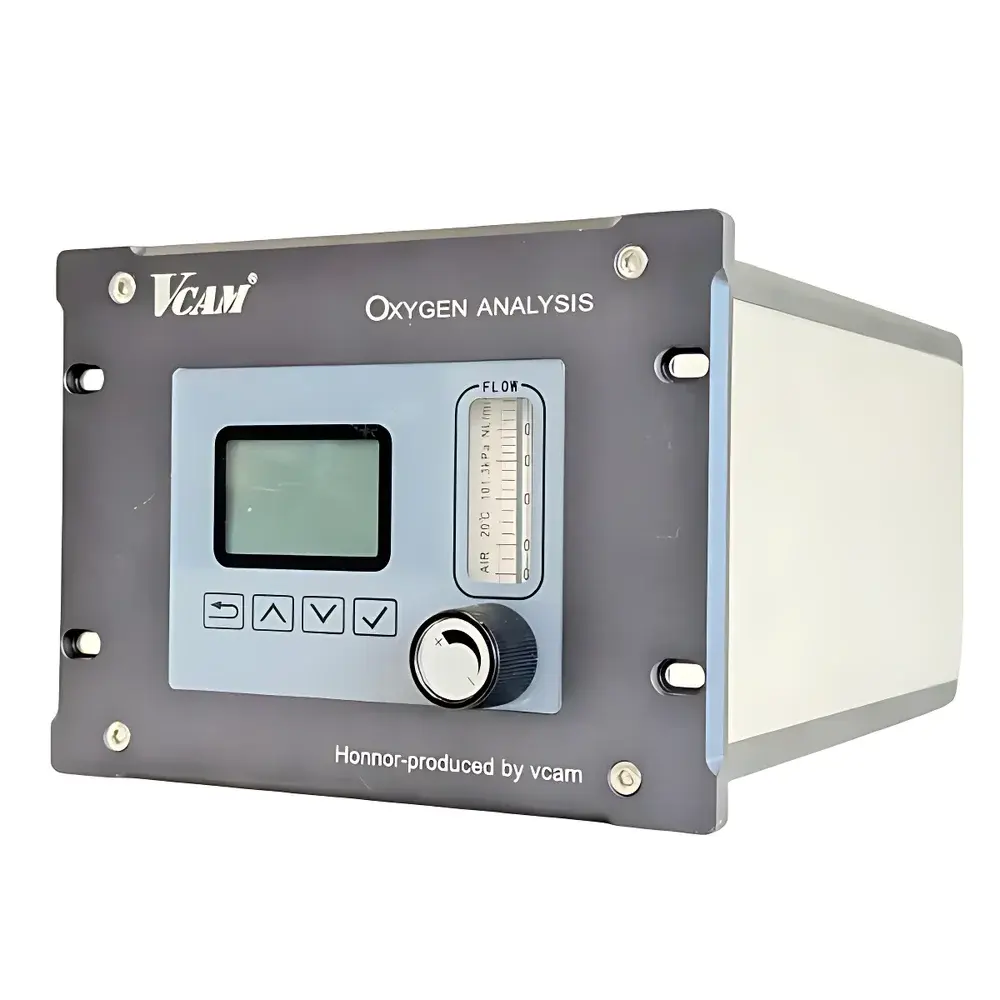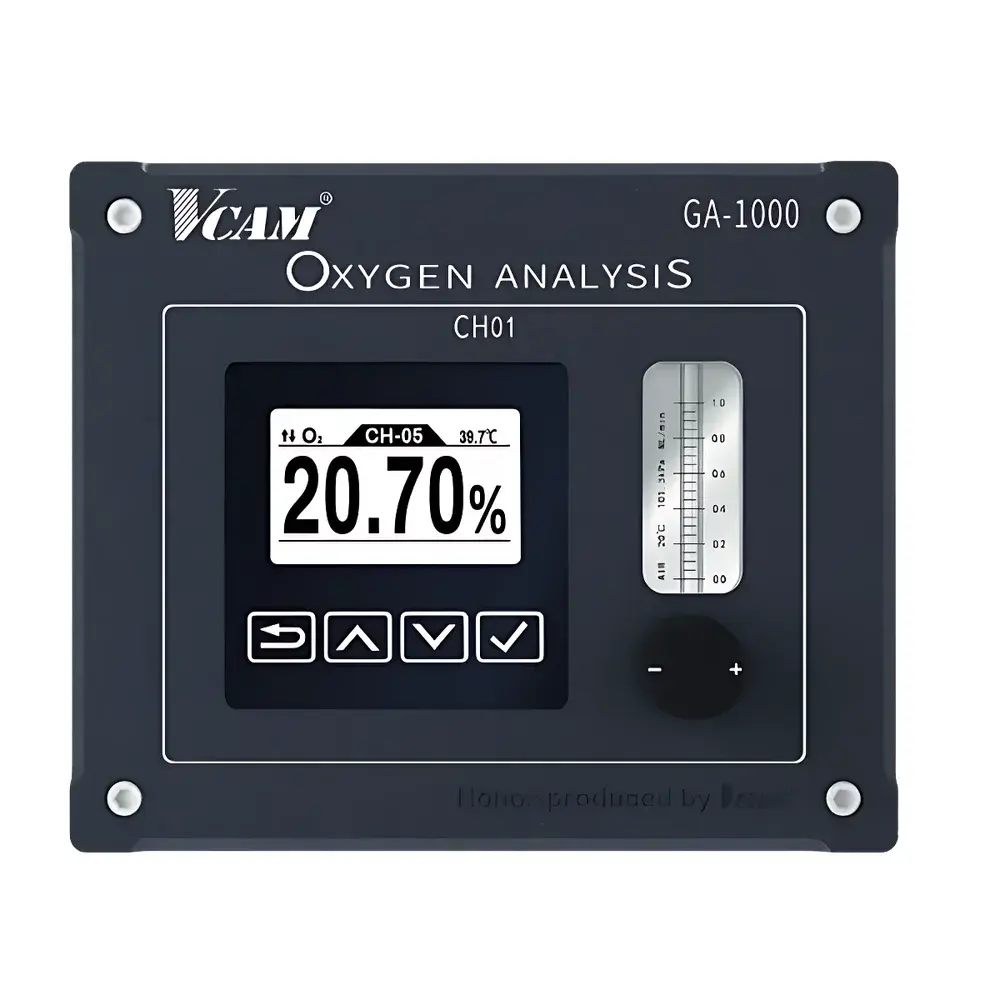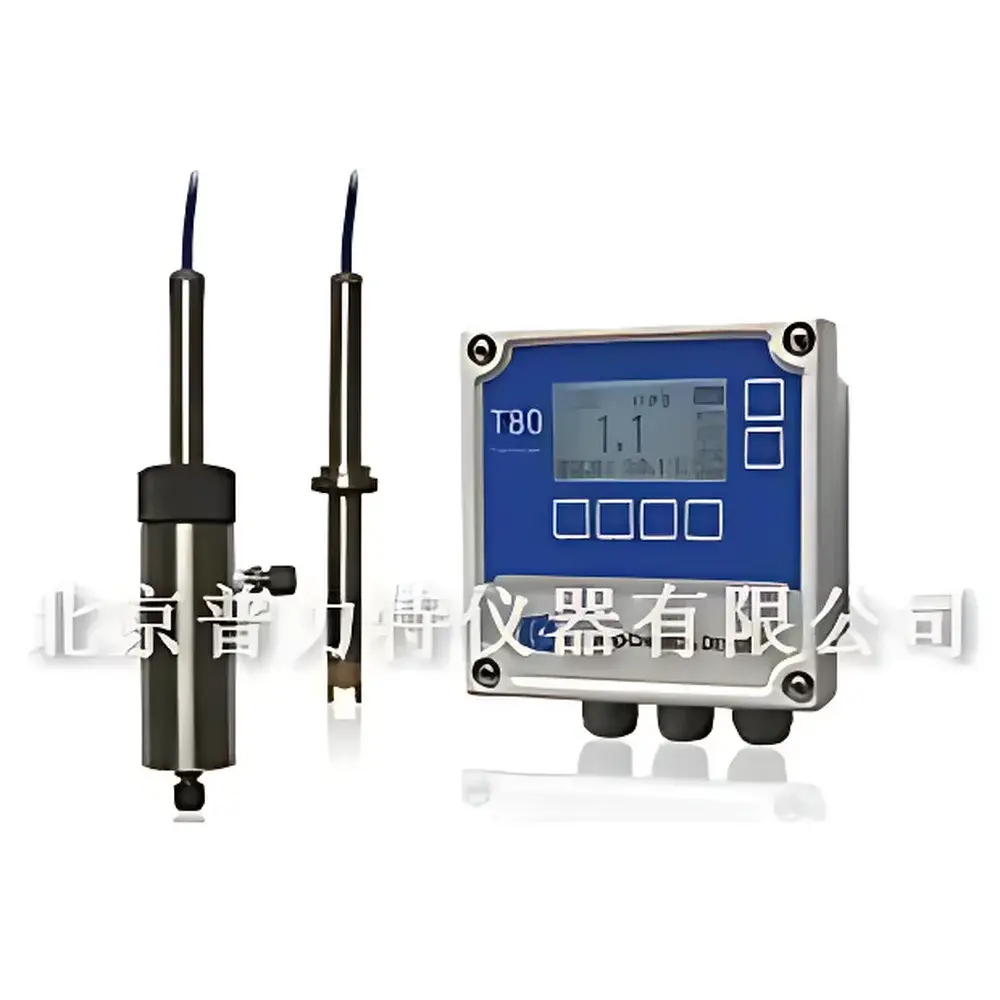
Purity Triton DO90 Online Trace Dissolved Oxygen Analyzer
| Brand | Purity |
|---|---|
| Origin | USA |
| Model | DO90 |
| Resolution | 0.1 ppb |
| Measurement Range | 0.001–20 ppb or mg/L (ppm) |
| Repeatability | ±1% FS |
| Stability | ±1% FS |
| Temperature Compensation | Yes |
| Communication Interface | 4–20 mA analog output |
| Dimensions | 43 cm × 30 cm panel-mount enclosure |
| Operating Ambient Temperature | −5 to 50 °C |
| Measurement Principle | Clark-type polarographic (membrane-covered electrochemical cell) |
| Electrode Materials | Ag cathode, Pb anode |
| Membrane | PFA (2 mil thickness) |
| Housing | AISI 316 Ti stainless steel |
| Flow Requirement | ≥200 mL/min |
| Max Cable Length | 100 m |
| Drift | <1% per month |
| Pressure Rating | 0–15 psi (gauge), non-vacuum rated |
Overview
The Purity Triton DO90 Online Trace Dissolved Oxygen Analyzer is a high-precision, industrial-grade electrochemical instrument engineered for continuous, real-time monitoring of dissolved oxygen (DO) at trace concentrations in liquid process streams. Utilizing a Clark-type polarographic sensing principle, the DO90 employs a gas-permeable PFA membrane to selectively allow molecular oxygen diffusion into an electrolyte-filled chamber, where it undergoes reduction at a silver cathode and oxidation at a lead anode—generating a current proportional to the partial pressure of O₂. This current is linearly correlated with DO concentration across the full range of 0.001–20 ppb (or mg/L), enabling reliable quantification in ultra-low-oxygen environments such as boiler feedwater, ultrapure water loops, semiconductor rinse tanks, and aerobic bioreactor effluents. The system integrates a replaceable electrode module, built-in temperature compensation via NTC thermistor (100 kΩ, 0–50 °C), and automatic signal conditioning—all calibrated parameters stored permanently in the sensor’s embedded EEPROM chip. Designed for uninterrupted operation under demanding plant conditions, the DO90 meets functional safety expectations for critical water quality control without requiring periodic recalibration beyond routine verification.
Key Features
- Trace-level detection capability down to 0.001 ppb with 0.1 ppb resolution—optimized for applications where sub-ppb oxygen ingress compromises system integrity
- Modular, field-replaceable electrode assembly minimizing downtime and eliminating full-sensor replacement costs
- Self-contained calibration memory: all slope, zero offset, and temperature coefficients stored on sensor chip—ensuring consistent measurement traceability across instrument swaps
- Integrated air-saturation calibration support using ambient air (20.9% O₂ at 1013 hPa), eliminating need for certified span gases during routine verification
- Robust mechanical architecture: 316 Ti stainless steel sensor body, PFA membrane (2 mil), and PEEK electrode housing provide long-term chemical resistance in chlorinated, acidic, or high-purity water matrices
- Standard 4–20 mA isolated analog output compatible with DCS, PLC, and SCADA systems—no external signal converters required
Sample Compatibility & Compliance
The DO90 is validated for use with aqueous media across a broad pH range (2–12) and conductivity spectrum (0.055–5.5 µS/cm typical for UPW). It operates within a flow velocity window of 200–2000 mL/min when installed with the included 316 stainless steel flow cell, which features integrated air purge channels and dual 1/4″ NPT inlet/outlet ports. The analyzer complies with IEC 61000-6-2 (EMC immunity) and IEC 61000-6-4 (EMC emission) standards. While not intrinsically safe, its enclosure meets NEMA 4X/IP66 environmental ratings for indoor/outdoor panel mounting. For regulated industries, the DO90 supports audit-ready operation when paired with T80 data logger firmware v3.2+, offering timestamped calibration logs, sensor diagnostics history, and configurable alarm thresholds—fully aligned with GLP/GMP documentation requirements per FDA 21 CFR Part 11 when deployed with compliant data archiving infrastructure.
Software & Data Management
The DO90 operates autonomously without host software but interfaces seamlessly with the optional T80 Smart Display Controller. The T80 provides local real-time DO readout, live temperature compensation status, and on-screen guided calibration workflows—including two-point (zero/air-sat) and single-point air-saturation modes. All calibration events, sensor diagnostics (e.g., membrane integrity check, electrolyte depletion warning), and raw analog output diagnostics are logged with ISO 8601 timestamps and retained for ≥30 days onboard. Exportable CSV reports can be generated via USB or RS-485 (Modbus RTU) for integration into LIMS or MES platforms. Firmware updates are performed via secure signed binaries, preserving configuration integrity during version upgrades.
Applications
- Boiler feedwater and condensate monitoring in power generation plants—ensuring compliance with ASTM D852 and EPRI guidelines for <5 ppb O₂
- Ultrapure water (UPW) distribution systems in pharmaceutical and semiconductor manufacturing—meeting USP , SEMI F63, and ISO 3696 Grade 1 specifications
- Aerobic wastewater treatment process control—optimizing aeration basin efficiency through dynamic DO feedback loops
- Recirculating aquaculture systems (RAS)—maintaining species-specific DO setpoints while minimizing energy-intensive aeration
- Chemical injection loop validation—verifying deaerator performance and hydrazine/DEHA residual effectiveness
FAQ
What is the recommended calibration frequency for the DO90 in continuous operation?
For GMP-compliant installations, quarterly zero and span verification is advised; for non-regulated utility water monitoring, semiannual verification suffices—provided drift remains <1% FS/month as specified.
Can the DO90 be used in vacuum or negative-pressure piping systems?
No. The sensor and flow cell are rated for 0–15 psi (gauge) only and must not be exposed to vacuum or suction-side pump conditions.
Is temperature compensation automatic and factory-configured?
Yes. An integrated NTC thermistor (100 kΩ, 0–50 °C) enables real-time thermal correction using the built-in Stern–Volmer algorithm; no user adjustment is required.
What maintenance intervals apply to the PFA membrane and electrolyte?
Membrane replacement is recommended every 12–18 months under normal operation; electrolyte refill is required every 6 months—both procedures are tool-free and consumable-kit supported.
Does the DO90 support digital communication protocols beyond 4–20 mA?
Yes. When connected to the T80 controller, Modbus RTU over RS-485 is available as an optional secondary interface for centralized data aggregation.