
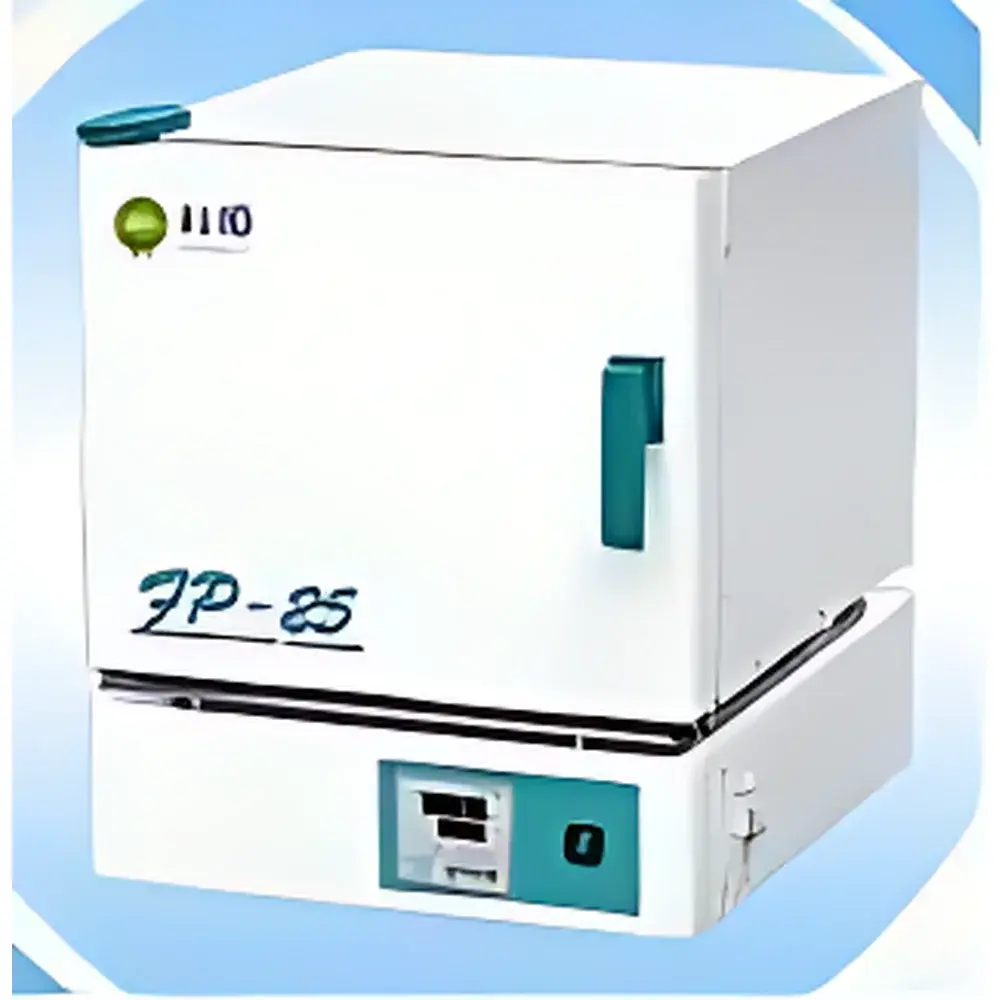
KeHeng FP-40 Ceramic Fibre Muffle Furnace (1000°C Box-Type Resistance Furnace)
| Brand | KeHeng |
|---|---|
| Origin | Shanghai, China |
| Model | FP-40 |
| Instrument Type | Box-Type Muffle Furnace |
| Max. Operating Temperature | 1000°C |
| Temperature Control Accuracy | ±3°C |
| Rated Power | 4000 W |
| Heating Time to 1000°C | ≤60 min |
| Heating Method | Resistance Wire Heating |
| Internal Chamber Dimensions | 300 × 200 × 120 mm |
| Nominal Volume | 7 L |
Overview
The KeHeng FP-40 Ceramic Fibre Muffle Furnace is a compact, high-performance box-type resistance furnace engineered for precise thermal processing in laboratory and light industrial environments. Designed around a lightweight, low-thermal-mass ceramic fibre insulation system, the FP-40 achieves rapid thermal response and exceptional energy efficiency while maintaining structural integrity at continuous operating temperatures up to 1000°C. Its muffle configuration isolates the heating chamber from external atmosphere and combustion by-products—ensuring uniform temperature distribution, minimal contamination risk, and reproducible thermal profiles critical for analytical sample preparation, metallurgical heat treatment, and ceramic sintering. The furnace operates on standard single-phase AC power and integrates a robust resistive heating element array embedded within the insulated chamber walls, delivering stable, controllable heat input without reliance on gas or vacuum systems.
Key Features
- Ceramic fibre insulation (density ~128 kg/m³) with low thermal conductivity (<0.09 W/m·K at 800°C), enabling fast ramp rates and reduced standby heat loss
- Digital PID temperature controller with dual-sensor input (type K thermocouple + backup sensor) and programmable 30-segment ramp-soak profiles
- Stainless steel outer casing with reinforced double-layer door seal and integrated safety cut-off switch activated upon door opening
- Front-loading horizontal chamber with smooth-sliding refractory-lined door and ergonomic handle design
- Internal chamber constructed from high-purity alumina-silica refractory board (Al₂O₃ ≥45%, SiO₂ ≥52%), rated for continuous use at 1000°C
- Over-temperature protection circuit with independent mechanical limit switch (setpoint: 1050°C) compliant with IEC 61000-6-2 EMC immunity requirements
Sample Compatibility & Compliance
The FP-40 accommodates crucibles, boats, and small workpieces up to 300 × 200 × 120 mm in dimension and is routinely deployed for ASTM E112 grain size analysis sample annealing, ISO 6892-1 tensile specimen stress-relieving, USP residual solvent removal in pharmaceutical excipients, and ISO 17892-5 soil calcination protocols. Its sealed muffle architecture prevents cross-contamination between successive runs—a key requirement in GLP-compliant elemental analysis workflows (e.g., ICP-OES sample ashing). While not certified to UL 746B or EN 61000-3-2 harmonic emission limits out-of-the-box, the unit meets CE marking essential requirements for electrical safety (EN 61010-1) when installed per manufacturer-specified clearances (≥100 mm rear/side ventilation gap, non-combustible surface mounting).
Software & Data Management
The built-in controller supports RS-485 Modbus RTU communication (optional USB-to-RS485 adapter required) for integration into centralized lab automation systems. KeHeng’s optional LabFurnaceControl™ software (v2.3+) enables remote parameter setting, real-time temperature logging at 1-second intervals, automated report generation (CSV/PDF), and audit trail export compliant with FDA 21 CFR Part 11 Annex 11 requirements—including electronic signatures, user access levels, and immutable event logs. All thermal profiles are timestamped and stored with firmware-tracked calibration history (last verification date, reference standard ID, deviation values).
Applications
- Thermal pre-treatment of geological and environmental samples prior to XRF or AAS analysis
- Controlled-atmosphere-free annealing, tempering, and normalizing of tool steels and aluminum alloys
- Sintering of oxide ceramics (Al₂O₃, ZrO₂), ferrites, and low-temperature co-fired ceramics (LTCC)
- Ignition loss (LOI) determination per ASTM C114 and ISO 21067-2
- Char yield evaluation of polymers and biomass feedstocks under inert or air atmospheres
- Calibration verification of thermocouples and RTDs using fixed-point reference materials (e.g., Al, Zn, Sn melting points)
FAQ
What is the recommended maintenance interval for the ceramic fibre lining?
Visual inspection every 200 operating hours; replacement advised after cumulative exposure exceeding 1500 hours at ≥900°C or upon visible cracking/fibreglass shedding.
Can the FP-40 be operated under inert gas purge?
Yes—two 6-mm NPT threaded ports (inlet/outlet) are provided on the rear panel; gas flow must be regulated externally and verified for leak integrity prior to operation.
Is the temperature uniformity specification documented per ASTM E220 or ISO 9001?
Uniformity mapping data (±5°C at 1000°C, 3-point measurement per IEC 60584-2) is available in the factory calibration certificate; full ASTM E220-compliant validation requires user-conducted mapping with traceable sensors.
Does the unit support ramp-hold-cool cycles with dwell time precision better than ±1 second?
Yes—the controller maintains soak timing accuracy of ±0.5 seconds over durations ≥10 seconds, verified during final QA testing using a calibrated timebase reference.



