
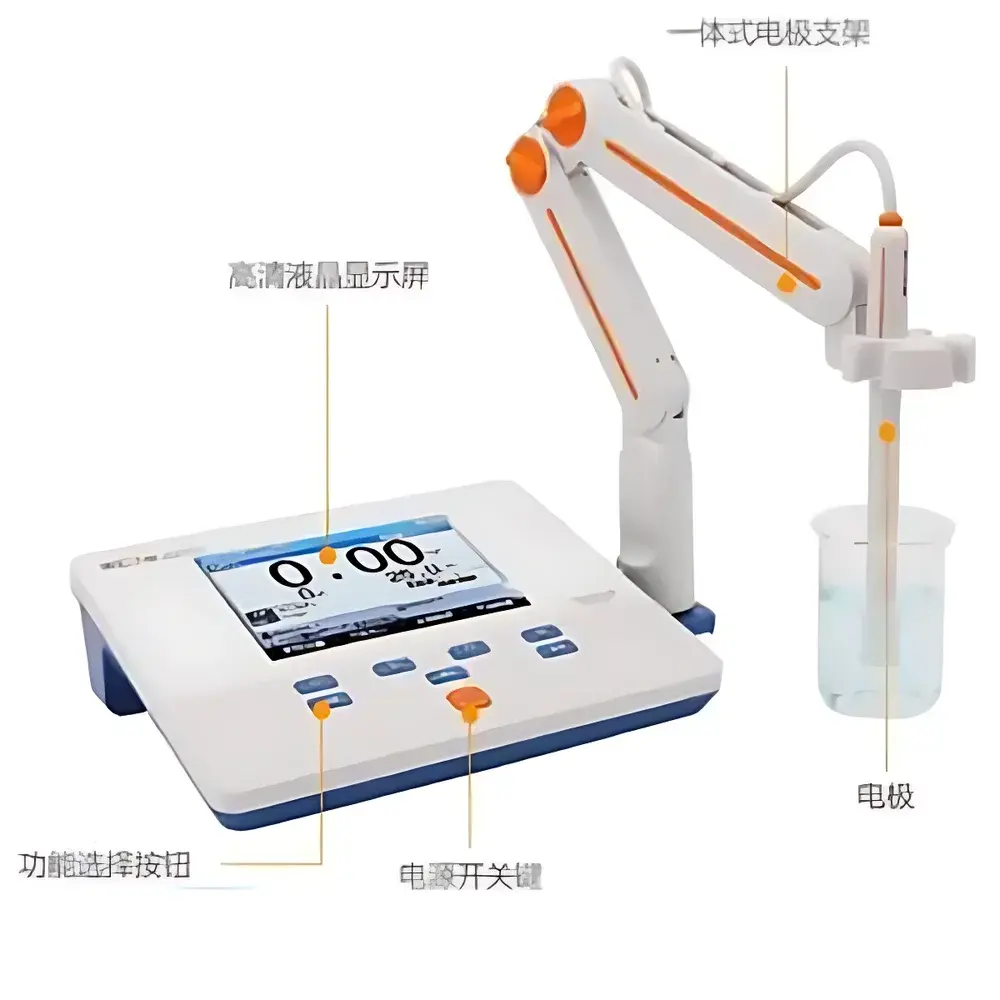
Leichi JPSJ-605F Benchtop Dissolved Oxygen Meter
| Brand | Leichi |
|---|---|
| Origin | Shanghai, China |
| Model | JPSJ-605F |
| Instrument Type | Laboratory Benchtop |
| Measurement Principle | Polarographic Electrochemical Probe |
| DO Range | 0.00–99.99 mg/L |
| DO Accuracy | ±0.10 mg/L |
| DO Resolution | 0.01 mg/L |
| Saturation Range | 0.0–600.0 % |
| Temperature Range | −10.0–135.0 °C |
| Temperature Accuracy | ±0.2 °C |
| Temperature Resolution | 0.1 °C |
| Atmospheric Pressure Compensation | Manual (60.0–110.0 kPa) |
| Salinity Compensation | Manual (0.0–40.0 g/L) |
| Data Storage Capacity | 500 datasets |
| Interface | RS-232 & USB |
| Power Supply | 9 VDC, 500 mA (center-positive) |
Overview
The Leichi JPSJ-605F Benchtop Dissolved Oxygen Meter is a precision laboratory instrument engineered for reliable, traceable measurement of dissolved oxygen (DO) concentration in aqueous solutions using the polarographic electrochemical probe principle. Based on Clark-type amperometric detection, the system employs a gold cathode and silver/silver chloride anode housed within a gas-permeable membrane, enabling selective O₂ reduction at a fixed applied potential (−0.6 V vs. Ag/AgCl). This method delivers high reproducibility across diverse water matrices—including freshwater, seawater, wastewater, and bioreactor broths—while maintaining stability under variable temperature and salinity conditions. Designed for routine QC/QA laboratories, environmental monitoring centers, and academic research facilities, the JPSJ-605F complies with fundamental metrological requirements outlined in ISO 5814:2012 (Water quality — Determination of dissolved oxygen — Electrochemical probe method) and supports traceable calibration protocols aligned with GLP and ISO/IEC 17025 frameworks.
Key Features
- Polarographic DO sensor (standard DO-958-S electrode) with integrated temperature thermistor for real-time thermal compensation
- Triple-compensation architecture: automatic temperature compensation (0.0–40.0 °C), manual atmospheric pressure adjustment (60.0–110.0 kPa), and manual salinity correction (0.0–40.0 g/L)
- Three operational modes: Continuous measurement, Equilibrium-based measurement (with dynamic stability threshold detection), and Timed measurement (programmable interval or single-point timing)
- GLP-compliant data management: User ID and sample ID entry, timestamped records, and audit-ready storage of up to 500 full measurement sets
- Large backlit LCD display (128 × 64 pixels) supporting dual-language UI (English and Chinese) with intuitive icon-driven navigation
- Dual communication interfaces: RS-232 for direct thermal printer output and USB for bidirectional PC connectivity via proprietary Leichi DataLink software
- Robust power architecture: External 9 VDC regulated supply (center-positive, 500 mA), ensuring stable operation during extended calibration or multi-sample runs
Sample Compatibility & Compliance
The JPSJ-605F is validated for use with liquid samples exhibiting low to moderate turbidity and suspended solids content (< 50 NTU). It accommodates standard 100 mL beakers, BOD bottles, and flow-through cells compatible with the DO-958-S probe’s 12 mm diameter shaft and replaceable Teflon membrane cap. The instrument meets essential electrical safety requirements per IEC 61010-1:2010 (Measurement, control and laboratory equipment – Safety requirements) and supports documentation practices required under FDA 21 CFR Part 11 for electronic records when used with validated software workflows. While not certified for field deployment, its benchtop form factor and calibrated performance make it suitable for reference measurements in EPA Method 360.1–compliant laboratories.
Software & Data Management
Leichi DataLink software (Windows-compatible, v3.2+) enables secure export of raw and processed datasets in CSV and XLSX formats. Each record includes DO concentration (mg/L), saturation (%), temperature (°C), atmospheric pressure (kPa), salinity (g/L), calibration timestamps, operator ID, and sample ID. The software enforces electronic signature capture, change logging, and version-controlled configuration backups—facilitating internal audits and external accreditation reviews. All stored data retain native metadata; no compression or lossy encoding is applied during transfer or archival.
Applications
- Wastewater treatment plant process control (aeration basin DO profiling, nitrification monitoring)
- Environmental water quality assessment (lake, river, estuary sampling per APHA Standard Methods 4500-O G)
- Pharmaceutical water system validation (PW, WFI, and purified water DO verification per USP )
- Academic aquatic ecology studies requiring high-resolution DO kinetics
- Bioreactor and fermentation tank calibration support for dissolved oxygen sensors
- Educational laboratory instruction in analytical environmental chemistry
FAQ
What calibration standards are required for the JPSJ-605F?
Zero-oxygen solution (e.g., sodium sulfite saturated solution) and air-saturated water (or certified DO standard at known temperature, pressure, and salinity) are required for two-point calibration.
Is the DO-958-S electrode included with the instrument?
Yes—the JPSJ-605F is supplied with one DO-958-S polarographic dissolved oxygen electrode, complete with membrane cap, electrolyte fill solution, and calibration accessories.
Can the instrument perform automatic pressure compensation?
No—pressure compensation is manual; users must input local barometric pressure prior to measurement or calibration.
Does the JPSJ-605F meet ISO/IEC 17025 traceability requirements?
When operated with NIST-traceable calibration standards and documented procedures, the instrument supports measurement traceability pathways consistent with ISO/IEC 17025:2017 Clause 6.4.6 and 7.7.
What is the recommended maintenance schedule for the DO-958-S electrode?
Membrane replacement and electrolyte replenishment are recommended every 2–4 weeks under daily use; storage in moist KCl solution between uses extends service life and preserves cathode integrity.
Related Products







