
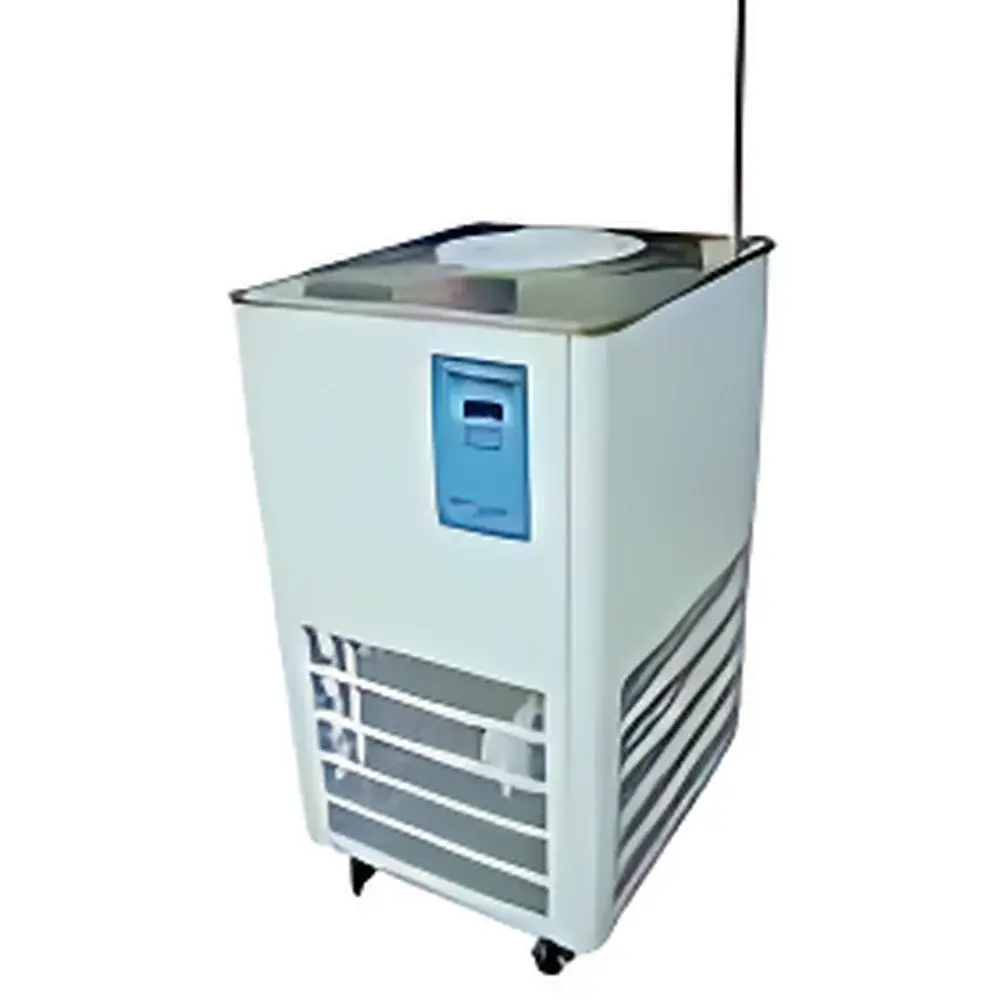
ZiQi DLSB-20/20 Cryogenic Constant Temperature Circulator
| Brand | ZiQi |
|---|---|
| Origin | Shanghai, China |
| Manufacturer | ZiQi Experimental Equipment Co., Ltd. |
| Model | DLSB-20/20 |
| Cooling Bath Volume | 20 L |
| Temperature Control Range | −20 °C to ambient |
| Temperature Stability | ±0.2 °C |
| Dimensions (L×W×H) | 500 × 450 × 780 mm |
| Power Supply | 220 V / 50 Hz |
| Refrigeration System | Hermetically sealed compressor (imported) |
| Pump Type | Corrosion-resistant circulation pump |
| Display | Digital LED with microcomputer PID control |
Overview
The ZiQi DLSB-20/20 Cryogenic Constant Temperature Circulator is a precision-engineered refrigerated recirculating chiller designed for stable, long-duration thermal management in laboratory and analytical instrumentation environments. Utilizing a hermetically sealed, imported compressor-based vapor-compression refrigeration cycle, the unit delivers consistent sub-ambient cooling performance without requiring external chilled water infrastructure. Its core function is to maintain a precisely regulated low-temperature liquid bath (−20 °C minimum, adjustable up to ambient) while continuously circulating temperature-controlled coolant through external devices—such as rotary evaporators, vacuum freeze dryers, spectrophotometers, laser systems, or electron microscopy platforms—via a closed-loop fluid circuit. The system operates on a dual-purpose principle: it serves both as a low-temperature bath reservoir and as a high-reliability external cooling source, enabling reproducible reaction conditions, solvent condensation efficiency, and thermal stabilization of sensitive optoelectronic or vacuum-based equipment.
Key Features
- Stable temperature control within ±0.2 °C across the full operating range (−20 °C to ambient), achieved via microcomputer-based PID algorithm and high-resolution digital temperature sensing
- 20-liter corrosion-resistant stainless steel bath tank with integrated level monitoring and overflow protection
- Hermetically sealed, low-noise imported compressor delivering robust refrigeration capacity at −20 °C (3.17 kW nominal output per manufacturer specifications)
- High-efficiency, chemically resistant circulation pump with adjustable flow rate (up to 30 L/min) and head pressure up to 4 m, compatible with standard 1/2″–3/4″ tubing connections
- Full-circuit anti-corrosion construction: wetted parts fabricated from 304 stainless steel, fluoropolymer-coated impellers, and EPDM seals to resist degradation from organic solvents, glycol-water mixtures, or deionized water
- Digital LED interface with intuitive menu navigation, real-time setpoint/actual temperature display, and programmable auto-shutdown timers
- Integrated safety protections including over-temperature cutoff, low-level alarm, compressor overheat lockout, and phase-failure detection
Sample Compatibility & Compliance
The DLSB-20/20 supports compatibility with a broad spectrum of laboratory instruments requiring external cooling, including but not limited to rotary evaporators (e.g., 10–20 L capacity units), vacuum freeze dryers, NMR pre-cooling circuits, X-ray diffractometers, and high-power laser diode arrays. Its closed-loop architecture eliminates reliance on municipal water supply, making it suitable for facilities with limited water availability, variable inlet pressure, or concerns regarding scaling and biofilm formation. While not certified to ISO/IEC 17025 or GLP-specific validation protocols out-of-the-box, the unit’s repeatable thermal performance and digital audit trail (via optional RS485/Modbus interface) support integration into GMP-aligned workflows where temperature traceability is required. It complies with IEC 61000-6-3 (EMC emissions) and IEC 61000-6-2 (immunity), and meets CE marking requirements for laboratory equipment under Directive 2014/30/EU and 2014/35/EU.
Software & Data Management
The DLSB-20/20 features a standalone embedded control system with no proprietary software dependency. All operational parameters—including setpoint, actual bath temperature, pump status, compressor runtime, and fault codes—are displayed locally and retained in non-volatile memory for post-operation review. For integration into centralized lab infrastructure, an optional RS485 serial port enables Modbus RTU communication, allowing remote monitoring and parameter adjustment via SCADA platforms or custom LabVIEW/Python scripts. While native data logging is not included, third-party USB-to-RS485 adapters and open-source logging tools (e.g., QLog, Modbus Poll) can be deployed to capture timestamped temperature and status logs compliant with FDA 21 CFR Part 11 when paired with appropriate electronic signature and audit trail configurations.
Applications
- Condensation support for rotary evaporation of heat-sensitive compounds (e.g., cannabinoids, peptides, natural extracts) at −20 °C to maximize recovery yield and minimize thermal decomposition
- Cooling of vacuum manifold systems and cold traps in lyophilization pre-freezing stages
- Thermal regulation of magnetron sputtering chambers and plasma etch tools requiring stable coolant temperature to prevent target warping or arcing
- Stabilization of high-resolution TEM/SEM specimen stages and detector cooling circuits
- Low-temperature reaction baths for Grignard, lithiation, or cryo-organometallic syntheses conducted under inert atmosphere
- Environmental simulation support for accelerated aging tests in polymer science and pharmaceutical stability studies (ICH Q1A–Q1E)
FAQ
What is the minimum achievable temperature with a full 20 L bath charge?
The unit achieves a verified no-load minimum of −20 °C; with full bath volume and typical coolant (e.g., 30% ethylene glycol/water), sustained operation at −18 °C to −20 °C is attainable under standard ambient conditions (≤25 °C, ≤60% RH).
Can this circulator be used with organic solvents such as acetone or chloroform?
Yes—provided the selected heat transfer fluid is chemically compatible (e.g., silicone oil or specialized low-temp organics); however, aqueous glycol mixtures are recommended for general use. Always verify seal material compatibility prior to solvent exposure.
Is remote monitoring supported natively?
No native Ethernet or Wi-Fi interface is included; however, the optional RS485 port supports industrial protocol integration for supervisory control and data acquisition.
Does the unit meet regulatory requirements for pharmaceutical QC labs?
It satisfies baseline electrical and mechanical safety standards (CE, IEC). Full 21 CFR Part 11 compliance requires supplemental validation, electronic signature implementation, and audit-trail-enabled software—none of which are built-in but can be layered externally.
What maintenance intervals are recommended?
Compressor oil and refrigerant integrity should be verified annually; pump impeller and seal inspection is advised every 18 months; bath fluid replacement and system flush recommended every 6–12 months depending on usage frequency and coolant type.




