
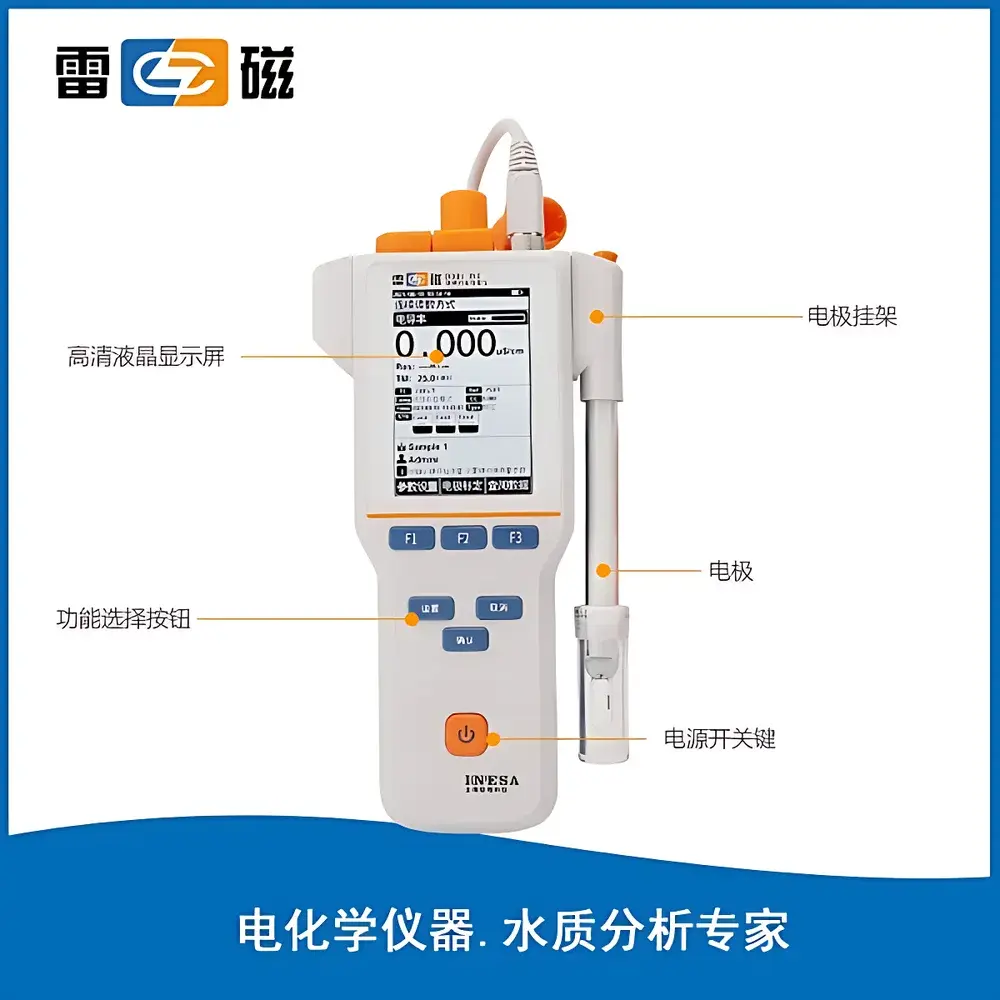
Leici DDBJ-350 and DDBJ-350F Portable Conductivity Meters
| Brand | Leici |
|---|---|
| Origin | Shanghai, China |
| Model | DDBJ-350, DDBJ-350F |
| Portability | Portable |
| Application Environment | Laboratory & Field |
| Conductivity Range | 0.000 µS/cm to 500 mS/cm (DDBJ-350) / 1000 mS/cm (DDBJ-350F) |
| TDS Range | 0.00 mg/L to 300 g/L |
| Resistivity Range | 5.00 Ω·cm to 20.00 MΩ·cm |
| Salinity Range | (0.00–8.00)% |
| Temperature Range | −5.0 to 110.0 °C |
| Accuracy | ±1.0% FS (conductivity, resistivity, TDS), ±0.2% FS (salinity), ±0.2 °C (temperature) |
| Minimum Resolution | 0.001 µS/cm |
| IP Rating | IP65 |
| Compliance | GLP-compliant data management, supports ASTM D1125, ISO 7888, and GB/T 6908 |
Overview
The Leici DDBJ-350 and DDBJ-350F are precision-engineered portable conductivity meters designed for reliable, field-deployable electrochemical analysis in environmental monitoring, water treatment, pharmaceutical QC, and academic research laboratories. Both instruments operate on the principle of two-electrode AC conductometric measurement—applying a low-frequency alternating current across a conductive cell to determine solution conductivity while minimizing polarization effects and electrode fouling. The devices measure four core parameters—electrical conductivity, resistivity, total dissolved solids (TDS), and salinity—each derived from the fundamental conductivity reading via standardized conversion algorithms compliant with ISO 7888 and GB/T 6908. Temperature compensation is integral to all measurements, supporting both linear (0–100 °C) and non-linear pure-water models, with user-selectable reference temperatures (20 °C or 25 °C) to align with regulatory reporting requirements.
Key Features
- High-resolution display: DDBJ-350 features a monochrome HD LCD; DDBJ-350F upgrades to a full-color capacitive touchscreen interface for intuitive navigation and real-time waveform visualization.
- Multi-parameter capability: Simultaneous measurement and display of conductivity, resistivity, TDS, salinity, and temperature—with automatic unit scaling and dynamic range switching.
- Advanced electrode management: Automatic recognition of four standard GB-conformant calibration solutions (e.g., 1413 µS/cm, 12.88 mS/cm); support for 1–3 point conductivity calibration using electrodes with cell constants of 0.01, 0.1, or 1.0 cm⁻¹.
- Ruggedized field design: IP65-rated enclosure ensures protection against dust ingress and water jets—validated for operation in humid outdoor environments, wastewater sampling sites, and industrial process areas.
- Intelligent measurement logic: Auto-endpoint detection with configurable read modes (manual, timed, interval, or continuous); adaptive frequency switching (1 kHz / 10 kHz) optimizes signal-to-noise ratio across low- and high-conductivity ranges.
- Comprehensive power architecture: Rechargeable lithium-ion battery (up to 100 hours typical runtime); USB-C and DC 5 V input compatibility enables charging from PCs, power banks, or wall adapters; integrated low-battery warning and charging status indicators.
Sample Compatibility & Compliance
The DDBJ-350 and DDBJ-350F accommodate aqueous samples ranging from ultrapure water (≥18.2 MΩ·cm) to concentrated brines (up to 1000 mS/cm). Electrode selection is application-critical: 0.01 cm⁻¹ cells are recommended for resistivity >1 MΩ·cm; 0.1 cm⁻¹ for intermediate ranges (1 kΩ·cm–100 kΩ·cm); and 1.0 cm⁻¹ for high-conductivity media (>10 mS/cm). All measurements comply with Good Laboratory Practice (GLP) requirements through mandatory audit-trail metadata—timestamped readings include operator ID, calibration history, electrode serial number, temperature, and compensation mode. Instrument firmware conforms to IEC 61000-4 electromagnetic immunity standards and supports traceable calibration per ISO/IEC 17025-accredited protocols.
Software & Data Management
Both models store up to 500 (DDBJ-350) or 1000 (DDBJ-350F) complete measurement records—including raw conductivity values, compensated results, calibration logs, and environmental conditions. Data export is supported via USB mass-storage mode or RS-232 serial connection to compatible printers (e.g., Epson TM-T20II) with customizable print templates (single-value, full report, or GLP-compliant certificate). PC communication uses Leici’s proprietary LeiciLab software (Windows/macOS), enabling batch export to CSV/XLSX, spectral trend analysis, and electronic signature integration for regulated environments. All stored entries retain immutable timestamps and are protected against unauthorized modification—meeting FDA 21 CFR Part 11 requirements when used with validated software configurations.
Applications
- Environmental field testing: On-site assessment of river, lake, and groundwater quality per EPA Method 120.1 and APHA Standard Methods 2510B.
- Pharmaceutical water systems: Monitoring of Purified Water (PW) and Water for Injection (WFI) per USP and EU Ph. Eur. 2.2.38.
- Food & beverage QC: Salt content verification in brines, sauces, and dairy effluents; TDS validation in brewing and bottling lines.
- Academic teaching labs: Hands-on instruction in solution chemistry, electrolyte behavior, and temperature-dependent ion mobility principles.
- Industrial process control: Real-time feedback for desalination plant feedwater, cooling tower blowdown, and electroplating bath concentration.
FAQ
What is the difference between DDBJ-350 and DDBJ-350F?
The DDBJ-350F features a color touchscreen interface, doubled data storage capacity (1000 vs. 500 entries), extended conductivity range (up to 1000 mS/cm), and enhanced USB communication stability—while maintaining identical metrological specifications and physical robustness.
Does the instrument support automatic temperature compensation (ATC)?
Yes—both models support automatic and manual temperature compensation using either built-in NTC thermistors or external Pt1000 probes; compensation curves follow ISO 7888-defined polynomial models for accuracy across 0–100 °C.
Can I use this meter for ultrapure water resistivity measurement?
Yes—when paired with a 0.01 cm⁻¹ cell and calibrated per ASTM D1125 Annex A1, the DDBJ-350F achieves stable readings down to 18.2 MΩ·cm at 25 °C with <±0.05 MΩ·cm repeatability.
Is GLP-compliant data export possible without additional hardware?
Yes—USB direct-connect mode enables secure, timestamped CSV export; LeiciLab software provides optional electronic signature modules for 21 CFR Part 11 compliance in validated workflows.
What calibration standards are recognized by the auto-identification system?
The meter auto-detects four Chinese national standard solutions: 1413 µS/cm (KCl), 12.88 mS/cm (KCl), 111.8 mS/cm (KCl), and 84.0 mS/cm (NaCl)—all traceable to NIM (National Institute of Metrology, China).





