
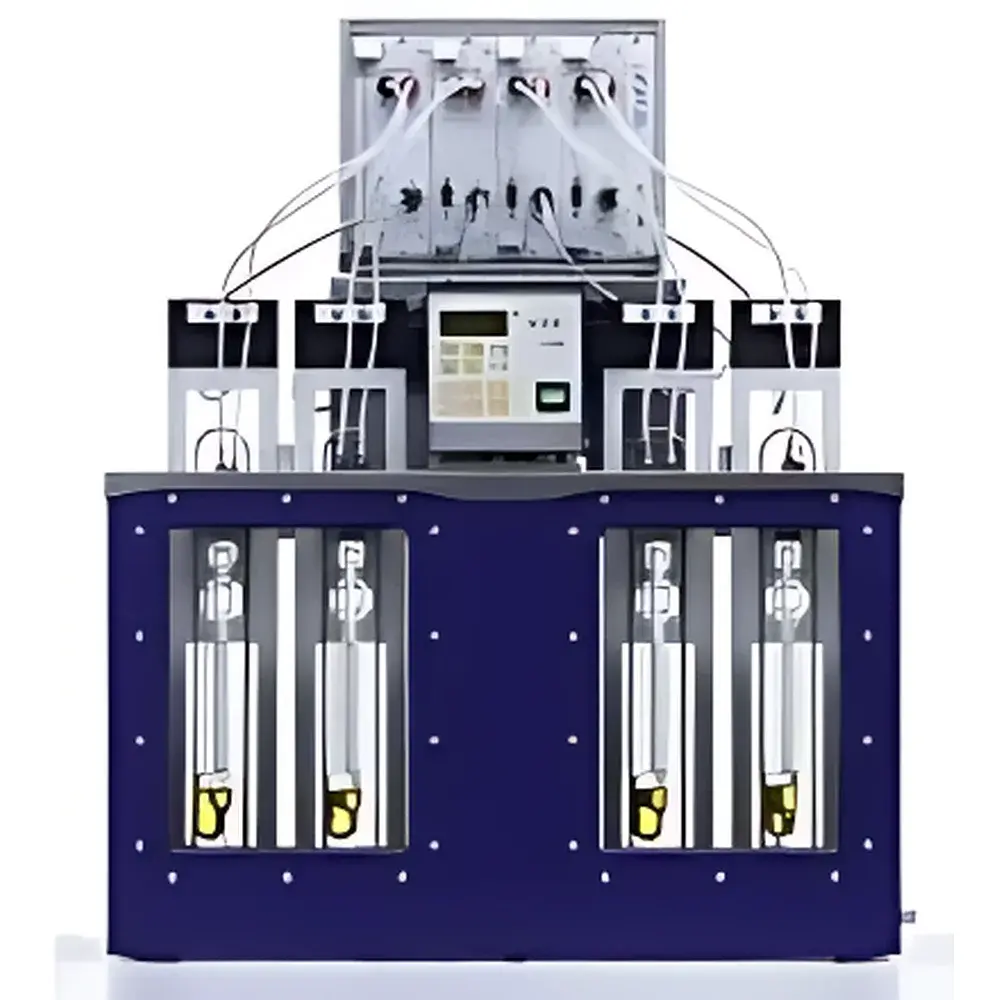
SCHOTT AVS370 Automated Capillary Viscometer
| Brand | SCHOTT |
|---|---|
| Origin | Germany |
| Model | AVS370 |
| Measurement Principle | Capillary efflux time (kinematic viscosity) via photometric and thermal-conductivity detection |
| Pressure Modes | Positive pressure & vacuum aspiration |
| Timer Resolution | 0.01 s |
| Time Range | 0.01–9999.99 s |
| Kinematic Viscosity Range | 0.35–1800 mm²/s (cSt) under positive pressure |
| Timer Accuracy | ±0.01% |
| Pump Control | Microprocessor-regulated ViscoPump II (up to 4 units per chassis) |
| Temperature Equilibration Delay | 0–20 min (user-configurable) |
| Replicates per Sample | 1–10 |
| Interface | RS-232C |
| Power | 115/230 VAC, 50/60 Hz, 30 W |
| Enclosure | Powder-coated aluminum |
| Dimensions (W×H×D) | 225 × 205 × 320 mm |
| Weight | 5.4 kg |
| Compatible Viscometers | DIN Ubbelohde, ASTM Ubbelohde, DIN Micro Ubbelohde, Micro Ostwald, Cannon-Fenske Routine, TC-Ubbelohde, TC-Micro Ubbelohde |
Overview
The SCHOTT AVS370 Automated Capillary Viscometer is a precision-engineered instrument for the determination of kinematic viscosity in accordance with internationally recognized standards—including ISO 3104, ASTM D445, DIN 51562, and IP 71. It operates on the capillary efflux principle: measuring the time required for a fixed volume of liquid to flow under gravity or controlled pressure through a calibrated capillary tube. The AVS370 uniquely integrates dual detection modalities—photometric (for transparent and translucent liquids) and thermal-conductivity (TC) sensing (for opaque, dark, or highly pigmented samples such as bitumen, heavy fuel oils, or carbon-black suspensions). This dual-sensor architecture eliminates the need for separate instrumentation across sample classes, enabling laboratories to maintain method consistency while expanding analytical scope without compromising traceability or reproducibility.
Key Features
- Dual-mode operation: Selectable positive-pressure or vacuum-driven flow control—optimized for low-viscosity solvents (e.g., hydrocarbons) and high-viscosity fluids (e.g., polymer melts, lubricants), respectively.
- Modular pump architecture: Standard configuration includes one ViscoPump II unit; expandable up to four pumps within the 19-inch rack-mount chassis—supporting parallel analysis of up to eight samples when paired with WinVisco370 software and optional multi-pump synchronization.
- High-resolution timing: Quartz-based timer with 0.01-second resolution and ±0.01% accuracy ensures compliance with stringent repeatability requirements defined in ISO 3104 Annex A (repeatability limit: ≤0.35% RSD for duplicate runs).
- Thermally stable platform: Designed for integration with SCHOTT CT-series thermostatic baths (±0.01 °C stability), supporting temperature-controlled measurements from 20 °C to 100 °C (dependent on bath specification).
- Rugged industrial design: Aluminum housing with powder coating provides electromagnetic shielding, mechanical robustness, and long-term dimensional stability in regulated laboratory environments.
Sample Compatibility & Compliance
The AVS370 accommodates a broad spectrum of Newtonian and near-Newtonian liquids—from volatile light fractions (e.g., gasoline, ethanol) to viscous industrial fluids (e.g., transformer oils, biodiesel blends, silicone oils). Its TC-sensing capability extends applicability to fully opaque media where optical detection fails, including coal tar pitch, asphaltene solutions, and pigment-loaded coatings. All supported viscometer types—including Ubbelohde, Ostwald, and Cannon-Fenske geometries—are certified to DIN/ASTM dimensional tolerances and calibrated per ISO 4787. The system supports full audit trail generation and user-access logging when operated under WinVisco370 in GLP/GMP-aligned configurations, meeting documentation requirements for FDA 21 CFR Part 11 readiness (when deployed with validated IT infrastructure and electronic signature controls).
Software & Data Management
WinVisco370 is a Windows-based control and analysis suite that enables centralized management of up to two AVS370 units and eight ViscoPump II modules simultaneously. It supports automated calculation of kinematic viscosity (ν) using the calibration constant (C) and measured efflux time (t): ν = C × t. Software features include real-time flow monitoring, automatic outlier rejection per ISO 3104 criteria, statistical reporting (mean, SD, RSD, confidence intervals), customizable report templates (PDF/CSV/XLSX), and secure data export with timestamped metadata. All measurement sessions are logged with operator ID, instrument ID, viscometer ID, bath temperature, and environmental conditions—enabling full traceability in quality-controlled workflows.
Applications
- Petroleum refining: Routine testing of crude distillates, base oils, and finished lubricants per ASTM D445 and IP 71.
- Pharmaceutical excipient characterization: Viscosity profiling of glycerol, propylene glycol, and PEG-based formulations in QC release testing.
- Paints & coatings: Evaluation of resin solutions and pigment dispersions—especially critical for black epoxy systems where TC detection ensures unambiguous endpoint recognition.
- Academic rheology labs: Teaching and research applications requiring standardized capillary methods with configurable experimental parameters (equilibration delay, replicate count, pressure mode).
- Chemical manufacturing: In-process verification of polymer solution viscosity during synthesis and dilution steps.
FAQ
Can the AVS370 measure non-Newtonian fluids?
The AVS370 is designed for kinematic viscosity determination of Newtonian or pseudo-Newtonian liquids under laminar flow conditions. For shear-dependent behavior, complementary rotational rheometry (e.g., Brookfield or Anton Paar systems) is recommended.
Is calibration traceable to national standards?
Yes—SCHOTT provides NIST-traceable calibration certificates for all supplied viscometers, and the AVS370’s timer is factory-verified against primary quartz references per ISO/IEC 17025-accredited procedures.
What maintenance is required for long-term reliability?
Routine cleaning of capillary tubes and pump manifolds with appropriate solvents is essential. ViscoPump II units undergo annual recalibration; firmware updates and software patches are distributed via SCHOTT’s authorized service network.
Does the system support LIMS integration?
WinVisco370 offers ODBC-compliant database export and configurable ASCII output formats compatible with major LIMS platforms (e.g., LabVantage, Thermo Fisher SampleManager) via middleware or custom API wrappers.
How is temperature control managed?
The AVS370 itself does not regulate temperature—it interfaces with external thermostatic baths (e.g., SCHOTT CT100, Julabo F25) via digital I/O or analog feedback signals. Bath stability and sensor placement must conform to ISO 3104 Section 6 requirements for thermal homogeneity.



