
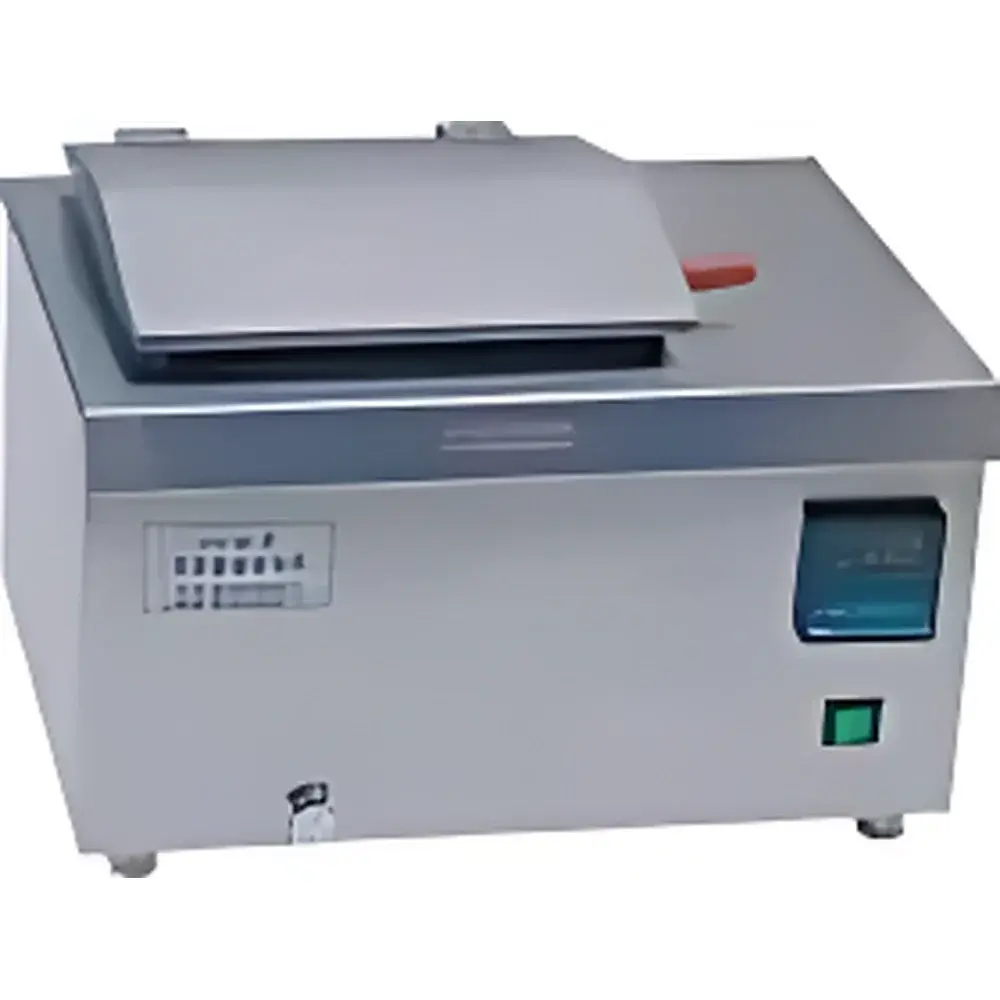
Yiheng DU-20 / DU-20G / DU-30 / DU-30G Electrically Heated Oil Bath Circulator (Non-Circulating, PID-Controlled)
| Brand | Yiheng |
|---|---|
| Origin | Shanghai, China |
| Model | DU-20, DU-20G, DU-30, DU-30G |
| Bath Volume | 12 L (DU-20/DU-20G), 20 L (DU-30/DU-30G) |
| Temperature Range | RT + 20 °C to 200 °C |
| Temperature Stability | ±0.5 °C |
| Temperature Resolution | 0.1 °C |
| Heating Power | 1000 W (DU-20/DU-20G/DU-30G), 1600 W (DU-30) |
| Power Supply | AC 220 V, 50 Hz |
| Timer Range | 0–9999 min |
| Over-Temperature Alarm Threshold | +2 °C above setpoint |
| Stirring | Magnetic stirrer integrated (DU-20G, DU-30G) |
| Construction | Stainless steel inner bath and outer casing |
| Bath Dimensions (W×D×H) | 250 × 250 × 200 mm (DU-20/DU-20G), 400 × 250 × 200 mm (DU-30/DU-30G) |
| Control System | Microprocessor-based PID temperature controller with digital display |
Overview
The Yiheng DU-series electrically heated oil baths are precision-engineered benchtop thermal platforms designed for stable, uniform, and programmable heating of samples in glassware—particularly during reactions requiring elevated temperatures beyond the boiling point of water. Unlike circulating baths, the DU series operates as a static, non-circulating immersion system, relying on conductive heat transfer through high-boiling-point oils (e.g., silicone or mineral oil) to maintain consistent thermal environments. The core architecture integrates a robust stainless steel bath vessel, a high-efficiency resistive heating element, and a microprocessor-driven PID temperature controller that delivers stable operation within ±0.5 °C across the full range of RT + 20 °C to 200 °C. This makes the DU series suitable for applications such as polymerization initiation, catalyst activation, solvent reflux, enzymatic denaturation studies, and sample preheating prior to rheological or spectroscopic analysis. The absence of mechanical circulation eliminates vibration-induced interference—critical when using sensitive analytical vessels or optical cells—and ensures compatibility with long-duration, unattended experiments governed by GLP or internal lab SOPs.
Key Features
- Microprocessor-based PID temperature controller with 0.1 °C resolution and programmable timer (0–9999 minutes), enabling precise thermal ramping and dwell protocols.
- Stainless steel inner bath and outer housing—resistant to corrosion from oils, solvents, and cleaning agents; easy to decontaminate and maintain under ISO/IEC 17025-compliant laboratory hygiene practices.
- Dual safety architecture: independent over-temperature cut-off (+2 °C deviation threshold) coupled with audible and visual alarm output, safeguarding both samples and operator integrity.
- Magnetic stirring integration (models DU-20G and DU-30G only): digitally regulated DC motor drive delivering constant rotational torque (>800 mN·m) across varying fluid viscosities—ensuring homogeneous thermal distribution without mechanical coupling or seal wear.
- Modular bath geometry: DU-20/DU-20G feature a compact 250 × 250 × 200 mm chamber (12 L capacity); DU-30/DU-30G expand to 400 × 250 × 200 mm (20 L), accommodating larger flasks or multi-vessel configurations.
- No external coolant or pump required—reducing infrastructure dependencies and maintenance overhead in shared-core facilities or mobile labs.
Sample Compatibility & Compliance
The DU-series accommodates standard laboratory glassware including round-bottom flasks (up to 5 L), graduated cylinders, beakers, and test tubes—secured via adjustable clamps or custom-fit inserts. Its open-bath design permits direct insertion of thermocouples or fiber-optic probes for independent temperature validation per ASTM E2251 or ISO 17025 clause 5.10. All models comply with IEC 61010-1:2010 safety standards for electrical equipment used in laboratory environments. While not certified for use in Class I Division 1 hazardous locations, the units meet EN 60529 IP20 ingress protection requirements. For regulated QC/QA workflows, audit-trail-capable data logging (via optional RS232/USB interface) supports alignment with FDA 21 CFR Part 11 Annex 11 principles when paired with validated third-party software.
Software & Data Management
The DU-series operates autonomously via front-panel controls but supports external monitoring and parameter logging through an optional serial (RS232) or USB interface. When connected to a host PC running compliant laboratory information management system (LIMS) or electronic lab notebook (ELN) software, real-time temperature profiles, alarm events, and timer status can be archived with time-stamped metadata. The PID algorithm’s internal error correction logs—including integral windup suppression and derivative kick mitigation—are accessible for root-cause analysis during method validation. No proprietary software is bundled; instead, the device emulates standard Modbus RTU or ASCII command sets, ensuring interoperability with LabVIEW, MATLAB Instrument Control Toolbox, or Python-based PySerial automation frameworks.
Applications
- Controlled-temperature synthesis of metal-organic frameworks (MOFs) and covalent organic frameworks (COFs) requiring extended dwell at 160–190 °C.
- Thermal aging studies of elastomers and thermoplastics per ASTM D573 and ISO 188 protocols.
- Pre-heating of calibration standards for viscometers, densitometers, and refractometers to minimize thermal drift during measurement.
- Activation of immobilized enzymes in biocatalysis workflows where shear-sensitive immobilized carriers must remain undisturbed.
- Supporting Soxhlet extraction systems by maintaining consistent condenser jacket temperatures above 100 °C.
- Calibration verification of infrared thermometers and contact probes using traceable reference oils (e.g., NIST SRM 1484).
FAQ
What is the maximum recommended operating temperature for continuous use?
The bath is rated for continuous operation up to 200 °C; however, sustained use above 180 °C requires thermal stability verification of the selected heat-transfer fluid per its manufacturer’s datasheet.
Can the DU-20G stir while maintaining temperature stability?
Yes—the magnetic stirrer and heating system operate independently; PID tuning compensates for convective heat loss during agitation, maintaining ±0.5 °C stability even at full torque output.
Is the timer function battery-backed?
No—the timer resets upon power interruption; for mission-critical timed processes, integration with an uninterruptible power supply (UPS) is recommended.
Are bath inserts or custom hole plates available?
Standard configurations include removable stainless steel perforated plates; OEM-compatible inserts for specialized vessel geometries can be fabricated upon request with dimensional specifications.
Does the unit support remote start/stop via digital I/O?
Not natively; however, the RS232 interface allows full command-line control (e.g., “START”, “STOP”, “SET TEMP=150.0”) from external logic controllers or PLCs.



