
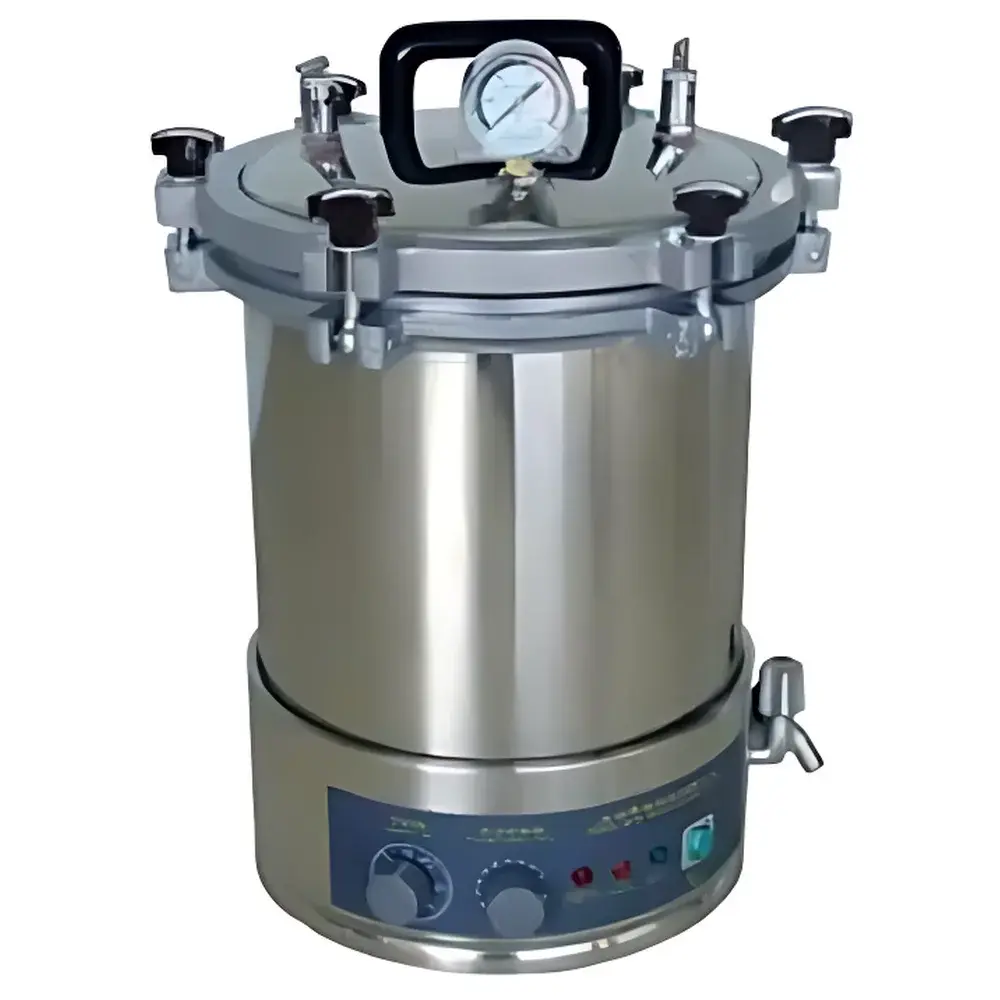
BOXUN YXQ-LS-18SI Portable Steam Autoclave
| Brand | BOXUN |
|---|---|
| Origin | Shanghai, China |
| Model | YXQ-LS-18SI / YXQ-LS-18SII |
| Sterilization Chamber Volume | 18 L |
| Maximum Operating Temperature | 126 °C |
| Maximum Operating Pressure | 0.142 MPa |
| Chamber Dimensions | Φ280 × 290 mm |
| External Dimensions | 390 mm (D) × 530 mm (H) |
| Heating Power | 2 kW |
| Voltage/Frequency | 220 V ±10%, 50 Hz ±2% |
| Temperature Control Range | 110–127 °C |
| Timer Range | 0–60 min |
| Construction Material | SUS304 stainless steel |
| Safety Features | Overpressure self-relief, low-water-level cutoff, self-sealing gasket, dual-scale Class II pressure gauge |
Overview
The BOXUN YXQ-LS-18SI is a compact, manually operated portable steam autoclave engineered for reliable saturated steam sterilization in resource-constrained or space-limited laboratory environments. It operates on the fundamental principle of moist heat sterilization—utilizing pressurized saturated steam at elevated temperatures to irreversibly denature microbial proteins and nucleic acids. With a nominal chamber volume of 18 liters and a maximum operating temperature of 126 °C at 0.142 MPa (equivalent to ~20.6 psi), the unit achieves sterility assurance levels (SAL) compliant with ISO 17665-1 for routine sterilization of heat-stable materials. Its vertical cylindrical chamber design (Φ280 × 290 mm) accommodates standard glassware, wrapped instruments, culture media bottles, and textile packs—making it suitable for teaching labs, field clinics, agricultural research stations, and small-scale QC facilities where benchtop footprint and portability are critical.
Key Features
- Robust construction using SUS304 stainless steel for both outer casing and inner chamber—ensuring long-term resistance to corrosion from repeated steam exposure, acidic reagents, and alkaline cleaning agents.
- Integrated overpressure safety relief valve that automatically vents excess steam when internal pressure exceeds 0.165 MPa (design limit), preventing mechanical failure under abnormal operating conditions.
- Dual-scale Class II pressure gauge calibrated in both MPa and psi, enabling precise real-time monitoring of chamber pressure during cycle execution and validation.
- Self-sealing silicone gasket system that expands radially under steam pressure to maintain a hermetic seal without manual torque adjustment—reducing operator dependency and improving cycle repeatability.
- Independent temperature control (110–127 °C) and timer (0–60 min), allowing users to configure cycles aligned with specific load requirements per ISO 15883-1 and EN 285 guidelines.
- Low-water-level cutoff protection: an embedded electrode sensor deactivates heating elements if water level falls below operational minimum—preventing dry-heating damage to the immersion heater.
- 2 kW electric heating element powered by standard 220 V ±10%, 50 Hz ±2% supply—enabling rapid steam generation and consistent thermal ramp rates across global electrical infrastructures meeting IEC 61000-4 EMC standards.
Sample Compatibility & Compliance
The YXQ-LS-18SI is validated for sterilizing non-porous and moderately porous loads including stainless-steel instruments, borosilicate glassware, cotton gauze, rubber stoppers, and liquid media in sealed containers (with vented caps). It conforms to national regulatory frameworks applicable to Class B autoclaves under GB 8599–2008 (Chinese standard equivalent to EN 13060:2014 for small steam sterilizers). While not certified to FDA 21 CFR Part 11 or EU MDR Annex I essential requirements as a standalone medical device, its mechanical and thermal performance supports GLP-aligned documentation practices when paired with external data loggers and cycle record templates. Users must validate cycle efficacy for each load configuration using biological indicators (e.g., Bacillus stearothermophilus spores) per ISO 11140-1 and establish routine maintenance logs per manufacturer-recommended intervals.
Software & Data Management
As a manually controlled analog unit, the YXQ-LS-18SI does not incorporate embedded digital controllers, network interfaces, or electronic data storage. All operational parameters—including setpoint temperature, exposure duration, and observed pressure—are recorded manually in bound sterilization logs. This architecture aligns with laboratories maintaining paper-based quality systems compliant with ISO/IEC 17025:2017 Clause 8.4.2 (record control) and WHO TRS 961 Annex 3 (sterilization documentation). For facilities transitioning toward digital traceability, third-party USB-connected temperature/pressure dataloggers (e.g., compliant with ASTM E2810) may be installed externally to capture time-stamped thermodynamic profiles for audit-ready cycle reports.
Applications
- Routine sterilization of reusable lab tools (forceps, scalpels, pipette tips) in academic biology and microbiology teaching laboratories.
- Preparation of agar plates, broth media, and buffer solutions in plant pathology and soil science field labs lacking centralized sterilization infrastructure.
- Decontamination of biohazardous waste bags and sharps containers prior to off-site disposal in rural health centers.
- Processing of veterinary surgical kits and animal husbandry equipment in agricultural extension units.
- Validation support for larger autoclave systems—used as a reference unit for biological indicator challenge testing under controlled ambient conditions.
FAQ
What is the difference between YXQ-LS-18SI and YXQ-LS-18SII?
The YXQ-LS-18SI features manual pressure/temperature regulation via mechanical dials and analog gauges, while the YXQ-LS-18SII integrates a digital PID controller with programmable cycle memory and automatic exhaust cooling.
Can this autoclave sterilize liquids in sealed bottles?
Yes—provided bottles are fitted with loosened caps or vented closures to prevent explosion; recommended exposure: 121 °C for 20 min at 0.1 MPa.
Is the chamber fully jacketed?
No—the YXQ-LS-18SI employs a single-wall chamber with direct immersion heating; jacketed designs (e.g., YXQ-LS-75S) offer superior temperature uniformity for regulatory-grade applications.
Does it meet international sterilization standards such as ISO 13485?
The unit itself is not ISO 13485-certified; however, its design and performance characteristics enable users to implement processes satisfying ISO 13485 clause 7.5.11 (control of production and service provision) when combined with documented procedures and validation records.
What maintenance is required to ensure long-term reliability?
Monthly descaling with food-grade citric acid solution, quarterly inspection of gasket elasticity and pressure gauge calibration, and annual verification of safety valve response pressure per GB/T 12243.



