
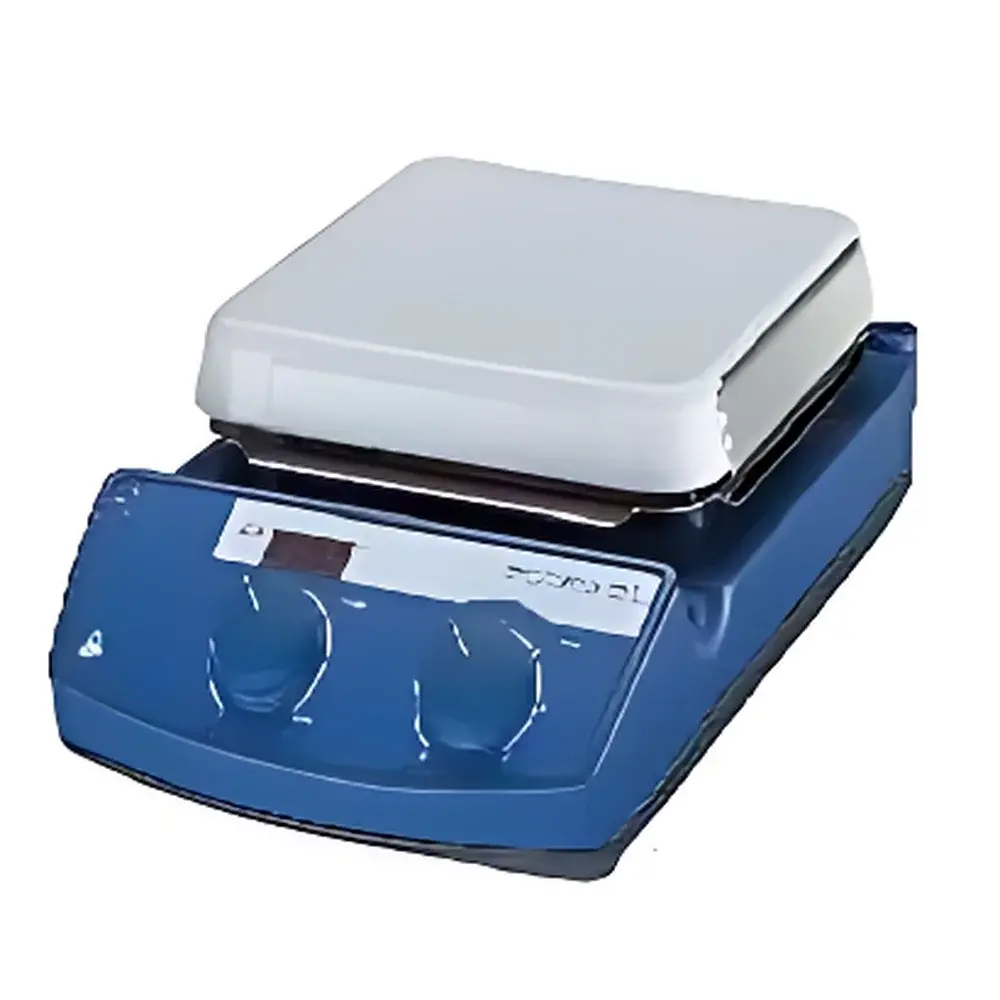
IKA C-MAG HS 7 Heating Magnetic Stirrer
| Brand | IKA |
|---|---|
| Origin | Germany |
| Model | C-MAG HS 7 |
| Maximum Stirring Volume | 10 L (H₂O) |
| Speed Range | 100–1500 rpm |
| Heating Temperature Range | 50–500 °C |
| Heating Power | 1000 W |
| Plate Material | Ceramic |
| Plate Dimensions | 180 × 180 mm |
| External Temperature Sensor Interface | ETSD5 |
| Sensor-Controlled Temperature Accuracy | ±3 K |
| Media Temperature Stability | ±3 K |
| Safety Cut-off Temperature | 550 °C |
| IP Rating | IP21 |
| Input Power | 1020 W |
Overview
The IKA C-MAG HS 7 is a high-performance heating magnetic stirrer engineered for precision, safety, and reproducibility in demanding laboratory environments. Designed and manufactured in Staufen, Germany, this instrument integrates a robust ceramic heating plate with a microprocessor-controlled DC motor to deliver consistent rotational motion and thermally stable conditions across diverse sample viscosities and volumes. Its operating principle relies on electromagnetic coupling between the internal drive magnet and an external stirring bar (stir bar), enabling contactless agitation without mechanical shaft penetration—critical for maintaining sample integrity and minimizing contamination risk. The unit supports both open-loop heating (plate temperature control) and closed-loop regulation via optional external Pt100 sensor (ETSD5), allowing users to maintain solution temperature within ±3 K of setpoint under dynamic load conditions. With a maximum stirring capacity of 10 L (water-equivalent), it serves as a core platform for synthesis, dissolution testing, buffer preparation, and thermal reaction monitoring in academic, pharmaceutical, and industrial QC laboratories.
Key Features
- High-power 1000 W ceramic heating plate with uniform thermal distribution and rapid heating rate (up to 5 K/min for 1 L water)
- Microprocessor-based feedback control system regulating both motor speed and heater output in real time
- Chemically inert, seamless ceramic plate (180 × 180 mm) resistant to acids, bases, and organic solvents
- Elevated control panel design minimizes liquid ingress risk and improves ergonomics during operation
- Dual-mode temperature control: LED-displayed plate temperature (±10 K accuracy) or sensor-regulated medium temperature (±3 K accuracy with ETSD5)
- Integrated safety circuit halts heating immediately upon exceeding 550 °C—compliant with DIN EN 60529 IP21 environmental protection requirements
- Visual thermal warning system: blinking LED indicator alerts users to elevated surface temperature during operation
- Stir bar retention optimized by high-torque magnetic field, preventing “jumping” even with viscous or dense media
Sample Compatibility & Compliance
The C-MAG HS 7 accommodates a broad range of sample types—including aqueous solutions, organic solvents, polymer melts, and suspensions—within its 10 L working volume limit. Its ceramic plate ensures compatibility with aggressive reagents commonly used in synthetic chemistry and materials science. The device conforms to IEC/EN 61010-1 for electrical safety in laboratory equipment and meets CE marking requirements for the European Economic Area. When operated with an ETSD5 temperature probe and validated protocols, it supports GLP-compliant workflows requiring traceable thermal control. While not intrinsically rated for explosive atmospheres, its IP21 enclosure provides basic protection against vertically falling drips and solid objects >12.5 mm, making it suitable for standard laboratory benchtop use under controlled ambient conditions (5–40 °C, ≤80 % RH).
Software & Data Management
The C-MAG HS 7 operates as a standalone analog-digital hybrid instrument without embedded software or network connectivity. All operational parameters—including speed (100–1500 rpm, adjustable via 0–6 scale) and temperature—are set manually and displayed on dual LED indicators. For audit-ready documentation, users may integrate the unit into validated systems using external data loggers connected to the ETSD5 sensor output. Though the device itself does not generate electronic records, its stable thermal and mechanical performance enables reliable method transfer and repeatability in regulated environments where manual parameter logging is part of SOP-defined procedures. No firmware updates or driver installation is required; the unit is ready for immediate deployment upon power-up.
Applications
- Controlled-temperature synthesis reactions requiring simultaneous heating and homogeneous mixing
- Dissolution testing per USP and Ph. Eur. 2.9.3 standards, particularly for extended-release formulations
- Preparation of calibration standards and reference solutions in analytical chemistry labs
- Cell culture media warming and component homogenization prior to sterile filtration
- Accelerated stability studies involving thermal stress exposure under constant agitation
- Viscosity-dependent process development in polymer and colloid science
FAQ
Can the C-MAG HS 7 be used with non-aqueous solvents?
Yes—the ceramic plate is chemically resistant to most common organic solvents, including acetone, ethanol, chloroform, and toluene. However, prolonged exposure to hydrofluoric acid or molten alkali metals is not recommended.
Is external temperature feedback mandatory for accurate solution temperature control?
No, but highly recommended for applications where solution temperature—not plate temperature—is the critical process parameter. Open-loop plate control has ±10 K tolerance; closed-loop with ETSD5 achieves ±3 K stability.
What is the maximum stir bar length supported?
The unit supports stir bars up to 80 mm in length, optimized for efficient torque transmission across viscous media up to 10 L volume.
Does the device support continuous operation at 500 °C?
Yes—provided adequate ventilation and absence of flammable vapors. Thermal cut-off only activates at 550 °C, offering a 50 °C safety margin.
How is calibration verified for regulatory compliance?
Users perform periodic verification using NIST-traceable PT100 probes and documented calibration logs. IKA provides factory calibration certificates; field recalibration is performed manually per user-defined SOPs.



