
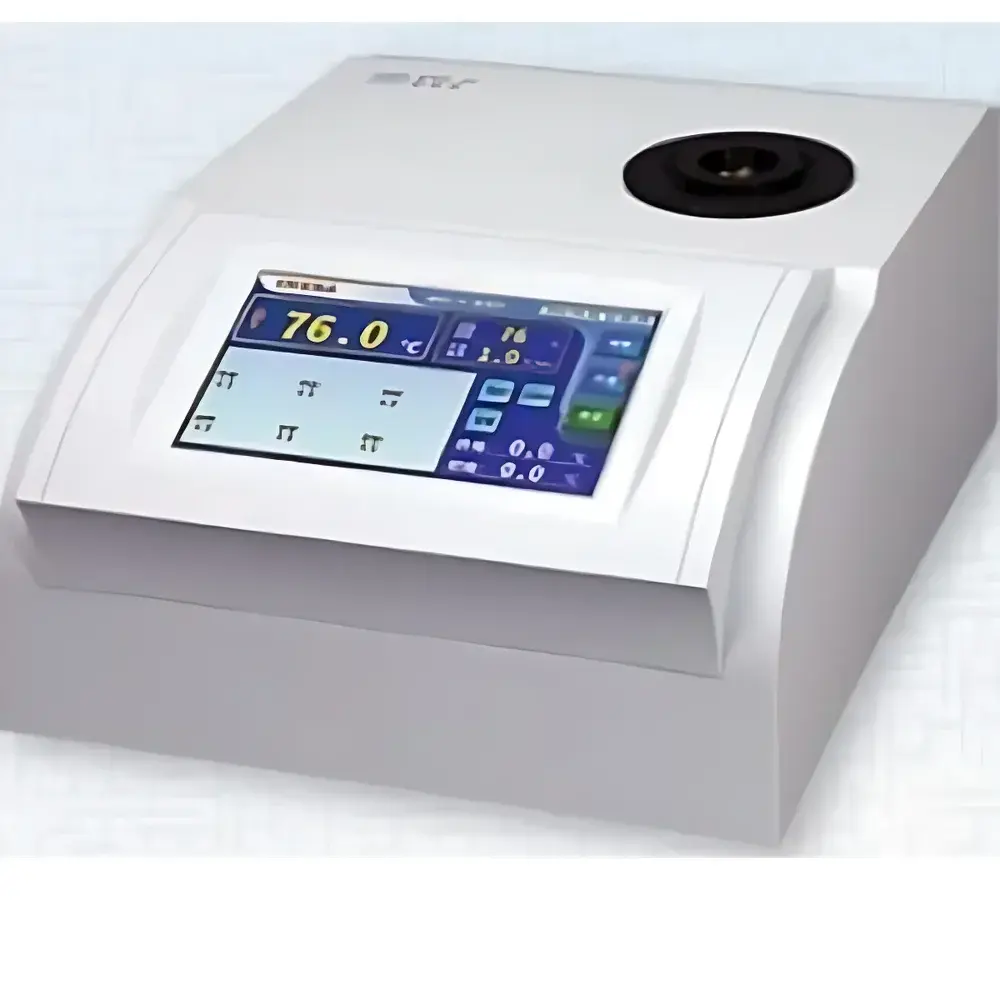
YDWG WRS-1B / WRS-1C / WRS-2 Digital Melting Point Apparatus
| Brand | YDWG |
|---|---|
| Origin | Shanghai, China |
| Model | WRS-1B, WRS-1C, WRS-2 |
| Temperature Range | Ambient to 320 °C |
| Heating Rate | 0.1–20.0 °C/min (continuously adjustable) |
| Temperature Repeatability | ±0.3 °C |
| Temperature Accuracy | ±0.4 °C |
| Capillary Dimensions | ID 1.0 mm, OD 1.4 mm, Length 90 mm |
| Sample Capacity | 3 capillaries simultaneously |
| Temperature Resolution | 0.1 °C |
| Data Storage (WRS-1C only) | Up to 1000 measurement records |
| Interface | USB and RS232 |
| Predefined Methods | 8 programmable profiles |
| Display | Color LCD touchscreen |
| Detection Principle | Photometric auto-detection of melt transition (transmittance change) |
Overview
The YDWG WRS-1B, WRS-1C, and WRS-2 Digital Melting Point Apparatus are precision thermal analysis instruments engineered for reliable, pharmacopeia-compliant determination of solid-phase transition temperatures in organic and pharmaceutical compounds. Based on the standardized capillary tube method described in USP <741>, EP 2.2.14, and ChP IV, these instruments employ photometric detection to monitor optical transmittance changes as crystalline samples undergo solid-to-liquid phase transition. A high-stability platinum resistance thermometer (Pt100) serves as the primary temperature sensor, integrated with digital PID control and PWM-based heating regulation to ensure linear, reproducible ramp profiles across the full operating range (ambient to 320 °C). The system’s architecture prioritizes traceability, thermal uniformity, and operator-independent endpoint recognition—critical requirements for QC laboratories operating under GLP or GMP frameworks.
Key Features
- Photometric auto-detection system with real-time transmittance monitoring for objective, operator-independent identification of onset (initial melt) and clear point (complete liquefaction)
- Color LCD touchscreen interface with intuitive navigation, supporting multilingual on-screen prompts (English default)
- Digital PID + PWM temperature control delivering stable heating rates from 0.1 to 20.0 °C/min in 0.1 °C/min increments
- Three-position sample holder accommodating standard pharmacopeial capillaries (1.0 mm ID, 1.4 mm OD, 90 mm length)
- Eight pre-programmable measurement methods—including rapid screening, slow-ramp validation, and multi-step protocols—for routine assay optimization
- Integrated real-time clock with timestamped data logging (WRS-1C and WRS-2 models)
- Dual communication interfaces: USB 2.0 (for direct connection to Windows/Linux PCs) and RS232 (for legacy lab network integration)
- Temperature resolution of 0.1 °C and certified accuracy of ±0.4 °C at key reference points (e.g., 100 °C, 200 °C), verified per ISO/IEC 17025 calibration procedures
Sample Compatibility & Compliance
The WRS series is validated for use with standard 1-mm internal diameter capillary tubes filled to 3–5 mm height—fully compliant with USP <741>, Ph. Eur. 2.2.14, and JP 2.60. Sample types include small-molecule APIs, excipients, polymers, natural products, and metal-organic coordination compounds. No derivatization or solvent dissolution is required. Instrument design conforms to IEC 61010-1 safety standards for laboratory electrical equipment. All models support audit-trail-ready operation when paired with compliant PC software, enabling alignment with FDA 21 CFR Part 11 requirements for electronic records and signatures (subject to validated software configuration).
Software & Data Management
The WRS-1C and WRS-2 models feature onboard non-volatile memory capable of storing up to 1000 complete measurement records—including date/time stamp, heating rate, observed onset/clear points, and raw transmittance curves. Data export is supported via USB mass storage mode (CSV format) or RS232 serial transmission using ASCII protocol. Optional PC software provides graphing tools for comparative melt curve overlay, statistical reporting (mean, SD, RSD), and batch-level summary reports suitable for regulatory submissions. All stored data includes instrument ID, user ID (if configured), and method identifier to satisfy ALCOA+ data integrity principles.
Applications
- Pharmaceutical quality control: Identity confirmation and purity assessment of active pharmaceutical ingredients (APIs) per ICH Q5 and Q6A guidelines
- Chemical synthesis validation: Monitoring reaction completion and intermediate purity during process development
- Polymorph screening: Differentiating thermally distinct crystalline forms through controlled-rate melting analysis
- Academic research: Teaching fundamental thermal behavior in undergraduate and graduate chemistry laboratories
- Regulatory filing support: Generating documented, repeatable melt data for DMF and CMC sections of ANDA/MAA dossiers
- Material science: Characterizing thermal stability thresholds of organic semiconductors and specialty polymers
FAQ
What capillary specifications are required for optimal performance?
Standard pharmacopeial capillaries with 1.0 mm inner diameter, 1.4 mm outer diameter, and 90 mm length are mandatory. Wall thickness and glass clarity directly affect optical detection sensitivity.
Does the instrument support external calibration verification?
Yes—users may perform independent calibration checks using NIST-traceable reference standards (e.g., indium, tin, zinc) following ISO 11357-3 Annex B procedures.
Can multiple users be assigned individual logins?
User authentication is managed at the PC software level; the instrument itself supports user ID tagging within exported datasets when linked to validated software.
Is GLP-compliant data archiving possible?
When used with validated software and proper SOPs, the WRS-1C/WRS-2 meet core GLP data retention requirements—including immutability, time-stamping, and method traceability—as confirmed in third-party lab assessments.
What maintenance is recommended for long-term accuracy?
Annual verification of temperature sensor linearity and photodetector response is advised. Cleaning of optical path components (lens, LED emitter, photodiode) with lint-free swabs and isopropanol is required after every 200 measurements or when ambient dust levels exceed ISO Class 8.



