
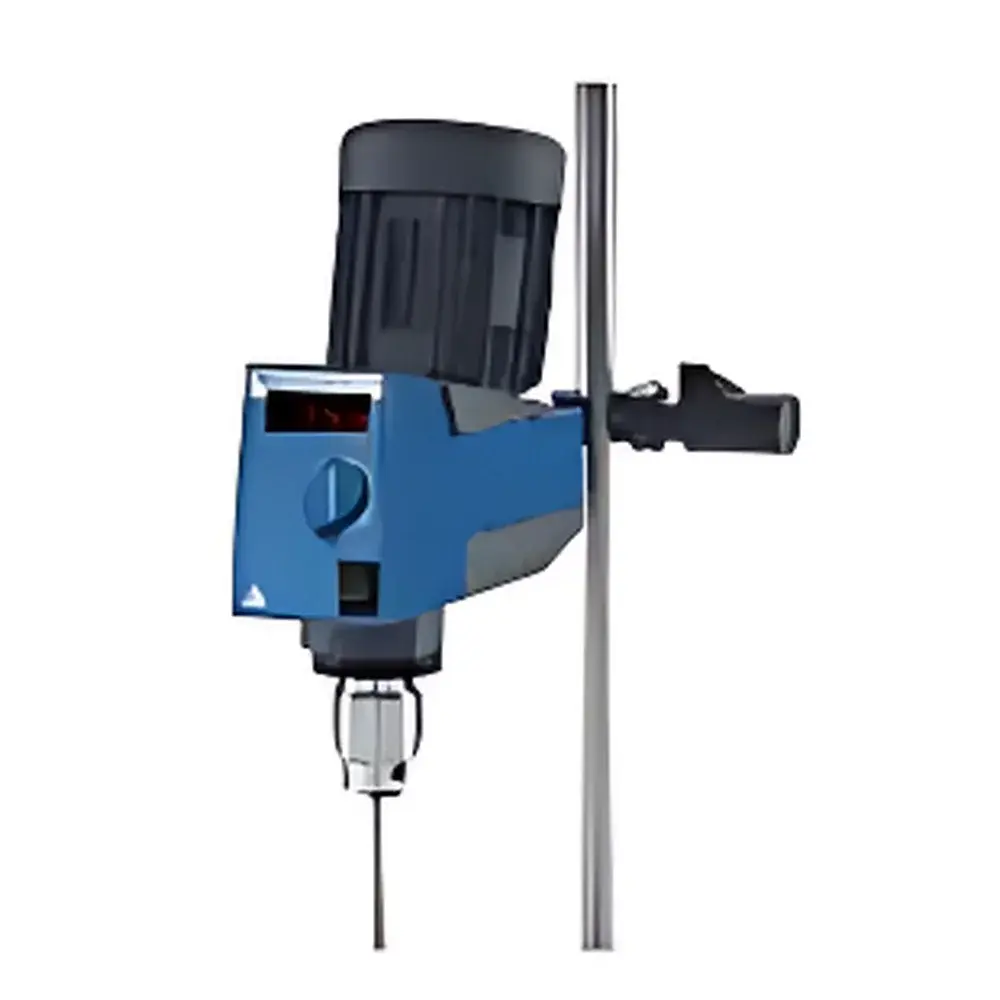
IKA RW20 Digital Overhead Stirrer
| Brand | IKA |
|---|---|
| Origin | Germany |
| Model | RW20 Digital |
| Max. Mixing Volume | 20 L |
| Speed Range | 60–2000 rpm |
| Motor Output Power | 35 W |
| Max. Torque | 150 N·cm (at 100 rpm), 300 N·cm (overload at 60 rpm) |
| Viscosity Range | up to 10,000 mPa·s |
| Chuck Capacity | 0.5–10 mm |
| Hollow Shaft ID | 10.5 mm |
| Dimensions | 88 × 294 × 212 mm |
| Weight | 3.1 kg |
| IP Rating | IP20 |
| Operating Ambient | 5–40 °C, ≤80% RH |
| Voltage/Frequency | 100–240 V, 50/60 Hz |
Overview
The IKA RW20 Digital is a high-performance overhead stirrer engineered for precision mixing and dispersion tasks in research laboratories, quality control environments, and pilot-scale development workflows. Utilizing robust electromagnetic motor technology and a rigid cantilevered drive architecture, it delivers consistent torque transmission across its full speed range — from low-shear homogenization at 60 rpm to high-intensity dispersion at 2000 rpm. Unlike magnetic stirrers or benchtop units, the RW20 Digital employs a top-mounted mechanical drive system that eliminates limitations associated with vessel depth, viscosity, or sample volume. Its design adheres to fundamental rheological principles: torque output is calibrated to maintain stable rotational energy transfer under variable load conditions, ensuring reproducible shear profiles essential for formulation development, polymer dissolution, suspension stabilization, and emulsion preparation.
Key Features
- Digitally controlled speed regulation with LED display for real-time rpm monitoring — no analog dials or estimation-based operation.
- Dual-speed-range mode (Range I: 60–500 rpm; Range II: 240–2000 rpm) optimized for both high-torque, low-speed applications and high-speed dispersing tasks.
- High-strength hollow shaft (10.5 mm internal diameter) enabling insertion of temperature probes, pH electrodes, or sampling needles during continuous operation — critical for process monitoring in GLP-compliant workflows.
- Self-centering chuck with 0.5–10 mm clamping range and integrated torque-limiting mechanism to prevent shaft slippage or motor overload under viscous loads.
- 100% duty cycle rating ensures uninterrupted operation during extended batch processing, validated under ambient conditions of 5–40 °C and ≤80% relative humidity.
- IP20-rated enclosure provides protection against solid ingress while maintaining serviceability and thermal dissipation efficiency in standard laboratory environments.
- Compact footprint (88 × 294 × 212 mm) and lightweight aluminum-magnesium housing (3.1 kg) facilitate integration into fume hoods, biosafety cabinets, or modular lab benches without structural reinforcement.
Sample Compatibility & Compliance
The RW20 Digital accommodates a broad spectrum of sample types — including Newtonian and non-Newtonian fluids, suspensions, pastes, and high-viscosity polymer melts — up to 20 L water-equivalent volume. Its maximum torque capability (150 N·cm nominal, 300 N·cm peak at startup) supports stirring of media with viscosities up to 10,000 mPa·s, making it suitable for applications referenced in ASTM D1200 (efflux viscosity), ISO 2555 (solution viscosity), and USP (drug suspension uniformity). While the unit itself does not include built-in data logging or regulatory-grade audit trails, its mechanical stability and repeatable speed control align with GMP-aligned equipment qualification protocols (IQ/OQ/PQ) when paired with external calibration standards traceable to NIST or DAkkS.
Software & Data Management
The RW20 Digital operates as a standalone instrument without embedded firmware or connectivity interfaces (no RS232, USB, or analog outputs). All operational parameters are set and monitored locally via the front-panel LED display and rotary knob. For laboratories requiring electronic recordkeeping, integration with third-party data acquisition systems is achievable using external tachometer sensors or optical RPM encoders connected to validated SCADA or LIMS platforms. Documentation packages — including factory calibration certificates, electrical safety test reports (DIN EN 61010-1), and CE declarations — are provided with each unit to support internal equipment master files and regulatory submissions.
Applications
- Preparation of homogeneous aqueous and organic-phase solutions for analytical standardization (e.g., HPLC mobile phase blending).
- Dispersion of nanoparticles, pigments, or active pharmaceutical ingredients (APIs) into liquid carriers under controlled shear history.
- Viscosity-dependent reaction initiation in polymerization and crosslinking studies where precise agitation onset timing is critical.
- Mixing of cell culture media containing heat-labile additives, leveraging the absence of magnetic field interference and minimal localized heating.
- Stirring of heterogeneous catalyst slurries in chemical synthesis workflows where mechanical robustness and contamination-free operation are mandatory.
FAQ
Does the RW20 Digital support external speed control or remote triggering?
No — it lacks analog input, digital communication ports, or programmable logic interfaces. Speed is adjusted exclusively via the front-panel control.
Can the hollow shaft accommodate thermocouples or other inline sensors during operation?
Yes — the 10.5 mm internal diameter allows insertion of standard 6 mm OD stainless steel probes, provided they are secured externally to prevent vibration-induced drift.
Is the unit compatible with glass vessels rated for vacuum or pressure applications?
The stirrer itself imposes no pressure/vacuum constraints; however, compatibility depends entirely on the vessel’s mechanical rating and the sealing integrity of the stirrer shaft feedthrough assembly.
What maintenance intervals are recommended for long-term reliability?
IKA recommends biannual inspection of chuck grip integrity, shaft runout verification (<0.1 mm), and visual assessment of motor housing ventilation channels for dust accumulation.
How is torque performance verified during equipment qualification?
Torque calibration is performed using traceable dynamometer systems per ISO 17025-accredited procedures; users should retain original factory test reports for audit readiness.



