
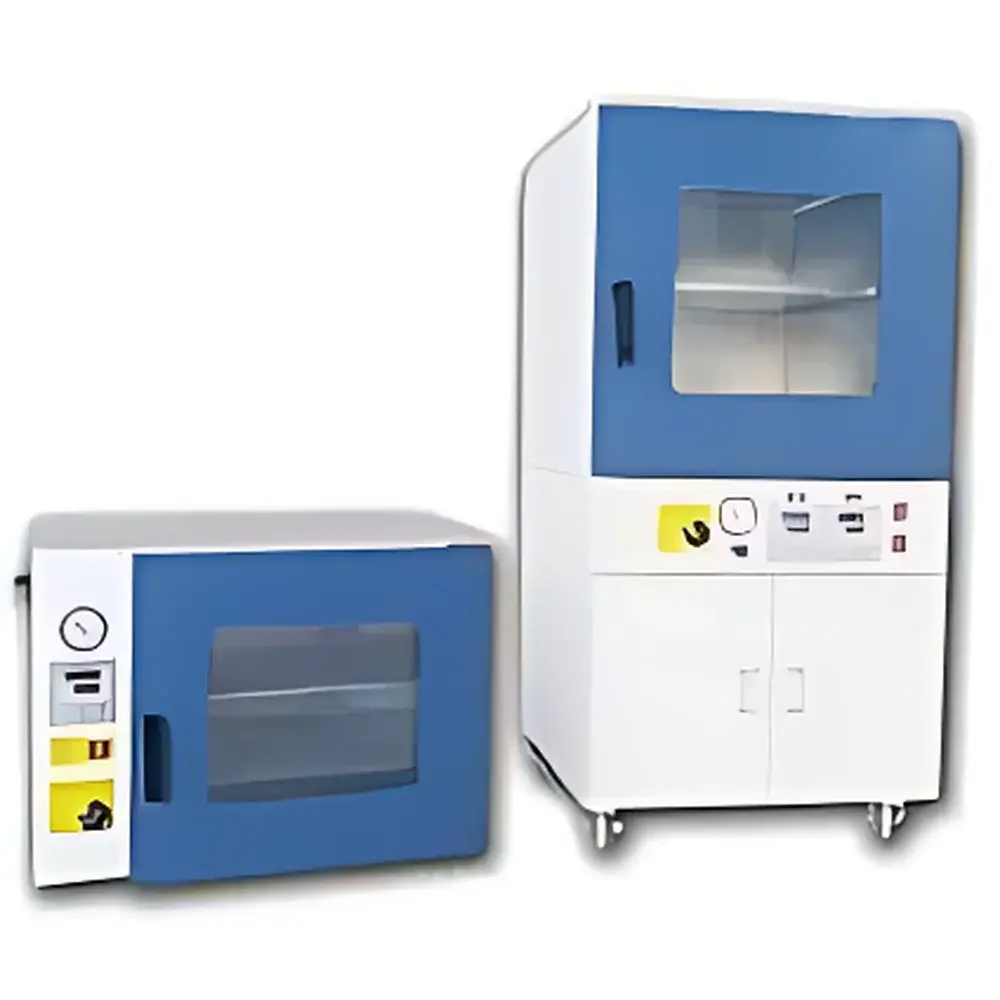
ZiQi DZF-6020 Benchtop Vacuum Drying Oven
| Brand | ZiQi |
|---|---|
| Origin | Shanghai, China |
| Manufacturer | Yes |
| Country of Origin | China |
| Model | DZF-6020 |
| Instrument Type | Vacuum Oven |
| Temperature Range | RT+10 °C to 250 °C |
| Temperature Uniformity | ±1 °C |
| Temperature Fluctuation | ±1 °C |
| Temperature Resolution | 0.1 °C |
| Vacuum Level | ≤133 Pa |
| Chamber Dimensions (W×D×H) | 300 mm × 300 mm × 275 mm |
| External Dimensions (W×D×H) | 615 mm × 470 mm × 470 mm |
| Inner Chamber Material | Stainless Steel (SUS304) |
| Heating Method | Forced-Air Convection |
| Operating Ambient Temperature | +5 °C to 40 °C |
| Power Supply | 220 V / 50 Hz |
| Heating Power | 400 W |
| Shelf Quantity | 1 |
Overview
The ZiQi DZF-6020 is a compact benchtop vacuum drying oven engineered for precise thermal processing under reduced-pressure conditions. It operates on the principle of vacuum-assisted dehydration—lowering the ambient pressure inside the chamber to reduce the boiling point of solvents and moisture, thereby enabling gentle, low-temperature drying of thermally sensitive, oxygen-sensitive, or oxidation-prone samples. Unlike conventional hot-air ovens, this system eliminates convective heat transfer limitations and suppresses oxidative degradation by removing atmospheric oxygen prior to and during heating. Its design adheres to fundamental requirements for controlled thermal environments in regulated laboratory workflows, including those aligned with ISO 17025-compliant calibration practices and GLP documentation frameworks.
Key Features
- Stainless steel (SUS304) interior chamber with seamless welding and electropolished finish—resistant to corrosion, easy to clean, and compatible with routine sterilization protocols.
- Double-layer tempered glass observation door with integrated silicone gasket seal—enables real-time visual monitoring while maintaining vacuum integrity up to ≤133 Pa.
- Adjustable door-latching mechanism ensures consistent compression force across the sealing surface, minimizing vacuum leakage over extended operational cycles.
- Microprocessor-based PID temperature controller with dual digital display—simultaneously shows setpoint and actual chamber temperature; supports auto-tuning for stable thermal regulation across the full range (RT+10 °C to 250 °C).
- Proportional heating power modulation—prevents overshoot at low setpoints and ensures uniform thermal distribution without cold spots, validated by ±1 °C temperature uniformity across the working volume.
- Benchtop form factor (615 × 470 × 470 mm external) optimized for space-constrained laboratories; includes integrated cable management and rear-mounted vacuum port compatible with standard KNF or Welch vacuum pumps (pump not included).
Sample Compatibility & Compliance
The DZF-6020 accommodates a broad spectrum of sample types—including lyophilized biological matrices, pharmaceutical excipients, polymer thin films, ceramic precursors, and analytical reference standards—without inducing thermal decomposition or surface oxidation. Its inert atmosphere capability supports applications requiring nitrogen or argon purging prior to vacuum draw-down. While not certified to UL/CSA or CE for medical device manufacturing, the unit meets baseline electrical safety (IEC 61010-1) and electromagnetic compatibility (IEC 61326-1) requirements for general laboratory use. Vacuum performance complies with ASTM E145-22 Annex A3 criteria for low-pressure thermal stability testing. Data logging via optional RS485 interface supports traceability for internal QA records, though native firmware does not provide FDA 21 CFR Part 11–compliant audit trails.
Software & Data Management
The DZF-6020 operates via embedded firmware with no proprietary PC software dependency. All configuration—including temperature setpoint, ramp rate, hold time, and vacuum delay—is managed directly through the front-panel keypad and LCD. Optional analog output (0–5 V or 4–20 mA) enables connection to external chart recorders or SCADA systems for continuous environmental logging. For laboratories requiring electronic records, third-party data acquisition modules (e.g., LabVIEW-compatible DAQ units) may be interfaced using the provided voltage signal outputs. Firmware updates are not field-upgradable; calibration parameters are stored in non-volatile memory and retain settings after power interruption.
Applications
- Drying heat-labile compounds such as enzymes, antibodies, and mRNA formulations without denaturation.
- Removing residual solvents from synthesized organic intermediates under inert gas blanket prior to crystallization.
- Conditioning hygroscopic reference materials (e.g., USP standards) in accordance with gravimetric moisture content protocols.
- Pre-treating ceramic green bodies before sintering to eliminate binder volatiles without blistering.
- Dehydrating soil and sediment samples for elemental analysis (e.g., EPA Method 3010A), minimizing chloride migration artifacts.
- Sterilizing glassware and stainless-steel tools via dry-heat exposure at ≥160 °C under vacuum—validated per ISO 17665-1 for microbial reduction equivalence.
FAQ
Is a vacuum pump included with the DZF-6020?
No—the DZF-6020 is supplied as a vacuum oven only; users must procure a compatible two-stage rotary vane pump (e.g., ultimate vacuum ≤5 Pa, pumping speed ≥2 m³/h) separately.
What is the maximum recommended load volume for optimal vacuum and temperature uniformity?
For consistent performance, total sample volume should not exceed 40% of the chamber’s internal capacity (i.e., ≤9.2 L), with adequate spacing between containers to ensure unobstructed airflow and vapor diffusion.
Can the unit operate continuously at 250 °C under full vacuum?
Yes—thermal insulation and chamber sealing are rated for sustained operation at maximum temperature and minimum specified vacuum (≤133 Pa); however, prolonged use above 200 °C may accelerate gasket aging and require more frequent maintenance.
Does the controller support programmable multi-step temperature profiles?
No—the standard controller supports single-setpoint operation only; ramp-and-soak functionality requires external programmable logic controllers or third-party automation integration.
How often should the silicone door gasket be inspected or replaced?
Inspect visually before each use for cracks or compression set; replace annually under normal usage or immediately if vacuum decay exceeds 5 Pa/min during hold tests.



