
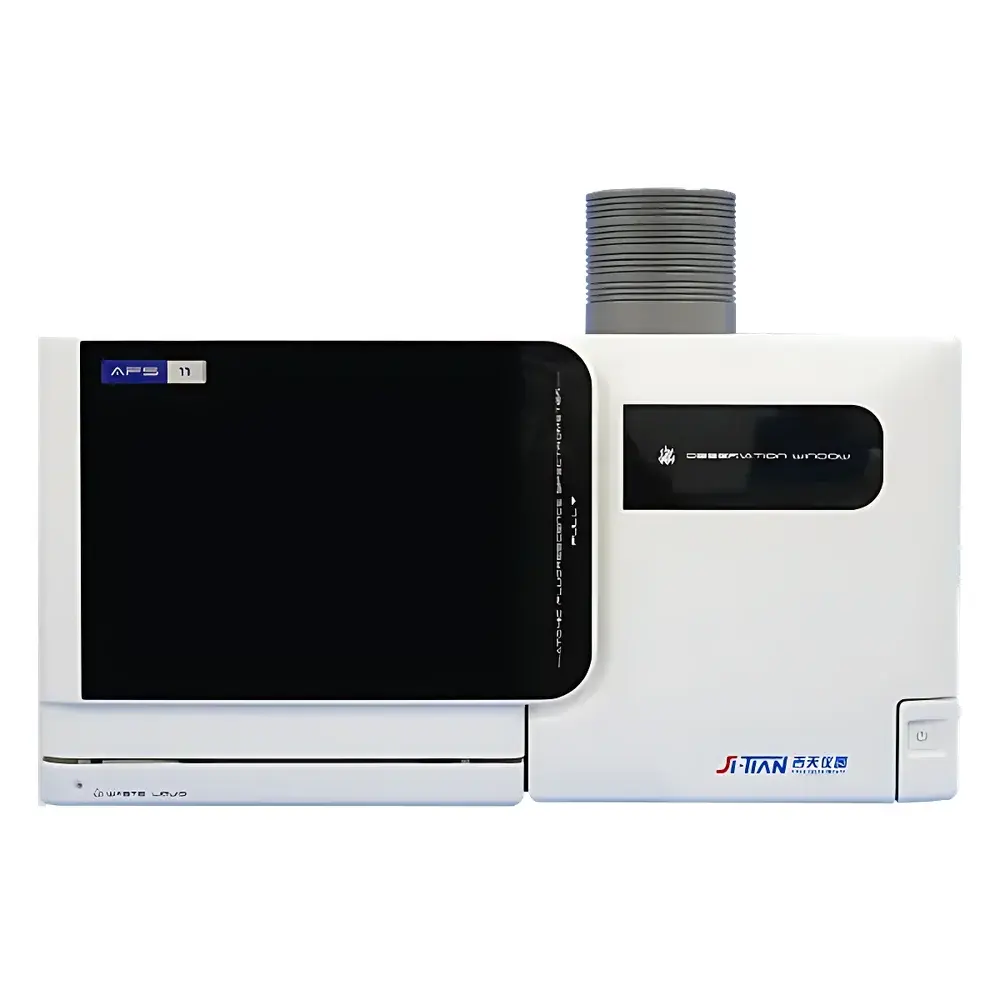
Titan Instruments AFS-11P Sequential Injection High-Precision Atomic Fluorescence Spectrometer
| Brand | Titan Instruments |
|---|---|
| Origin | Beijing, China |
| Manufacturer Type | Manufacturer |
| Instrument Type | Multi-channel Atomic Fluorescence Spectrometer |
| Sample Introduction | Dual Sequential Injection Pumps |
| Waste Disposal | Rear Exhaust Design |
| Hydride Generation Mode | Vapor Generation / Hydride Generation |
| Gas Control System | Valve Island |
| Detectable Elements | As, Sb, Bi, Sn, Se, Te, Pb, Ge, Hg, Cd, Zn |
| Relative Standard Deviation (RSD) | <0.6% |
| Linear Dynamic Range | >3 orders of magnitude |
| Detection Limits | As, Sb, Se, Bi, Te, Hg, Sn, Pb < 0.01 µg/L |
| Atomizer Temperature Control Range | Adjustable |
Overview
The Titan Instruments AFS-11P Sequential Injection High-Precision Atomic Fluorescence Spectrometer is a dedicated hydride-generation atomic fluorescence (HG-AFS) instrument engineered for trace-level quantification of hydride-forming and cold-vapor elements in environmental, food, agricultural, and geological matrices. It operates on the principle of atomic fluorescence spectroscopy: analyte elements are chemically reduced (typically via sodium borohydride in acidic medium) to volatile hydride species or elemental vapor (e.g., Hg⁰), swept into a quartz atomizer where they are atomized by flameless electrothermal heating; upon excitation by a high-intensity hollow cathode lamp (HCL) or electrodeless discharge lamp (EDL), ground-state atoms emit characteristic fluorescence photons detected at right angles to the excitation beam. This configuration delivers exceptional sensitivity and selectivity for As, Sb, Bi, Se, Te, Pb, Sn, Hg, Cd, Zn, and Ge—elements critical in regulatory compliance testing per ISO, ASTM, USP, and national standards including GB and HJ series methods.
Key Features
- Dual sequential injection pump system enabling precise, pulse-free delivery of sample, carrier solution, and reductant—minimizing cross-contamination and ensuring reproducible reaction kinetics.
- Micro-liter-level sampling accuracy with real-time volume compensation, achieving instrumental repeatability better than 0.05% RSD.
- Integrated drift correction and Quality Control Protocol (QCP) functionality supporting automated multi-point calibration curve generation and post-run stability verification—particularly critical for mercury analysis where memory effects must be rigorously controlled.
- Valve island–based pneumatic control architecture delivering stable, programmable argon flow rates essential for consistent hydride transport and atomization efficiency.
- ARM + FPGA dual-core main controller with distributed microcontroller units (MCUs) managing lamp power, atomizer temperature, gas valves, and injection timing—ensuring deterministic real-time operation and system-level fault isolation.
- Intelligent lamp management: automatic lamp identification, dual-channel lamp ignition, eccentricity-compensating lamp holder with infinite adjustment, and real-time tungsten filament current monitoring for predictive maintenance.
- Energy-aware operational modes including scheduled preheating, post-analysis sleep state, and timed wake-up—reducing standby power consumption without compromising readiness.
Sample Compatibility & Compliance
The AFS-11P supports direct analysis of aqueous digests prepared via microwave-assisted acid digestion (e.g., HNO₃/HCl/HF mixtures) or conventional hot-block digestion. It is validated for use with solid, liquid, and suspended particulate samples following standardized preparation protocols outlined in GB 5009.11-2014 (total and inorganic arsenic in food), GB 5009.17-2021 (total and organic mercury), GB/T 22105-2008 (soil Hg/As/Pb), HJ 1133-2020 (ambient air PM-bound As/Se/Bi/Sb), HJ 680-2013 (soil/sediment Hg/As/Se/Bi/Sb), HJ 694-2014 (water), and HJ 702-2014 (solid waste). The instrument architecture conforms to GLP/GMP data integrity expectations: all method parameters, calibration events, QC injections, and raw signal traces are timestamped and stored with immutable audit trails.
Software & Data Management
Titan’s proprietary AFS Control Suite provides a modular, dockable GUI supporting full workflow customization. Key capabilities include real-time multi-channel fluorescence signal visualization, guided method setup wizards, user role–based access control (administrator/operator/analyst), electronic signature support aligned with FDA 21 CFR Part 11 requirements, and customizable report templates compliant with ISO/IEC 17025 documentation mandates. Raw spectral data, peak integration logs, drift correction records, and QC flagging are stored in structured binary archives with metadata indexing—enabling retrospective data reprocessing and long-term archival integrity.
Applications
The AFS-11P is routinely deployed in accredited environmental laboratories for routine monitoring of drinking water, wastewater, soil leachates, and airborne particulates. In food safety labs, it supports compliance screening for inorganic arsenic in rice products and methylmercury in seafood. Geological survey institutions utilize its robustness for multi-element baseline mapping in sediment cores and mine tailings. Its expandable architecture accommodates future upgrades to speciation analysis—via optional serial interface connection to HPLC modules—for separation and quantification of As(III)/As(V), monomethylarsonic acid (MMA), dimethylarsinic acid (DMA), inorganic/organic Hg, and selenite/selenate species.
FAQ
What hydride-forming elements can the AFS-11P quantify with sub-part-per-trillion sensitivity?
The instrument achieves detection limits below 0.01 µg/L for As, Sb, Se, Bi, Te, Hg, Sn, and Pb under optimized hydride generation conditions.
Does the system support automated calibration and QC checks without manual intervention?
Yes—multi-point calibration curves are generated automatically; QCP routines execute bracketing standards, blank checks, and drift corrections within each analytical batch.
Can the AFS-11P be integrated into a fully automated laboratory workflow?
It features RS-232 and USB interfaces compatible with 160-position or 212-position autosamplers; method files and sample lists are importable via CSV or LIMS-compatible formats.
Is software validation documentation available for regulated environments?
Titan provides IQ/OQ documentation packages, 21 CFR Part 11 configuration reports, and audit trail validation summaries upon request.
What maintenance protocols ensure long-term atomizer stability?
The system includes real-time quartz tube temperature feedback control, programmable ramp-and-hold heating profiles, and filament current diagnostics to preemptively identify aging components.




