
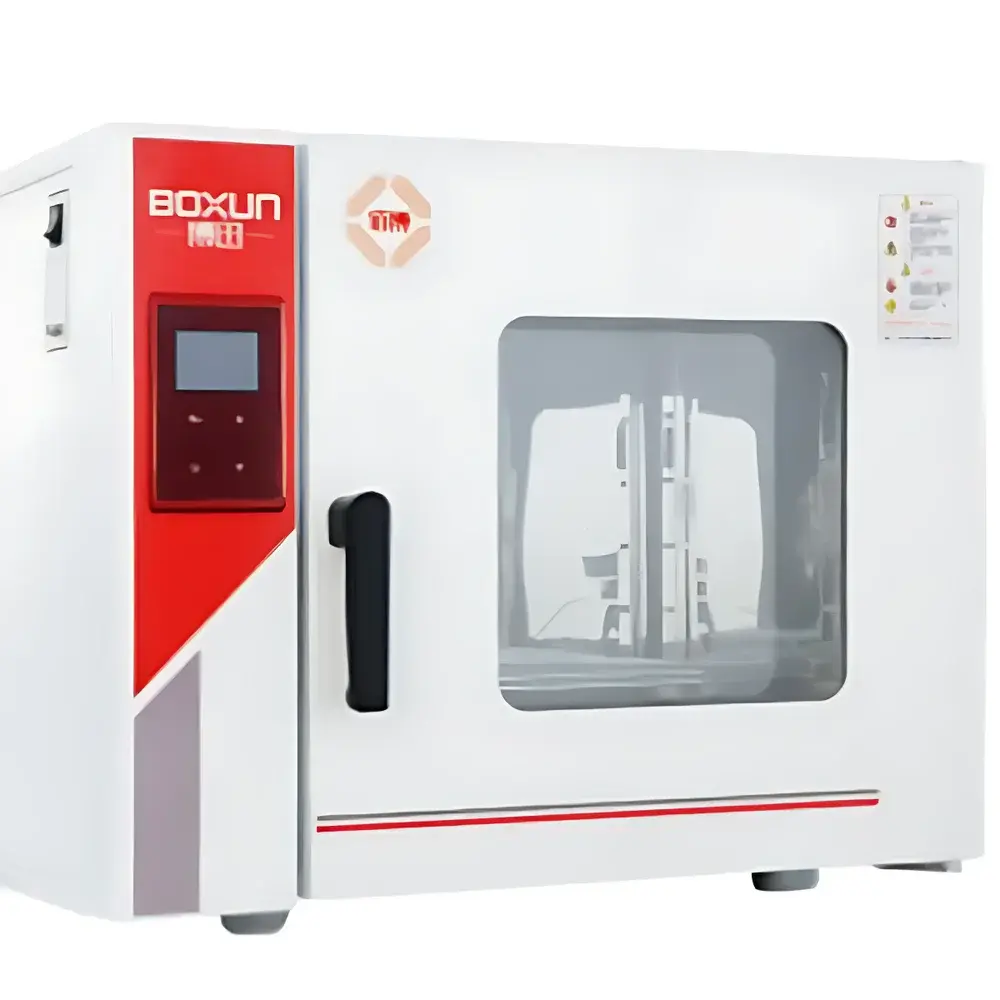
BOXUN BGZ-140 Forced-Air Drying Oven
| Brand | BOXUN |
|---|---|
| Origin | Shanghai, China |
| Model | BGZ-140 |
| Temperature Range | Ambient +5°C to 250°C |
| Temperature Uniformity | ±2% |
| Temperature Fluctuation | ±1°C (at 105°C) |
| Temperature Resolution | 0.1°C |
| Internal Chamber Dimensions (W×D×H) | 550×470×550 mm |
| External Dimensions (W×D×H) | 840×695×705 mm |
| Heating Method | Forced-air convection with adjustable fan speed (6-speed) |
| Inner Chamber Material | Mirror-finish stainless steel (SUS304) |
| Insulation | High-density mineral fiber |
| Control System | PMMA II touchscreen interface with color LCD |
| Programmable Stages | Up to 10 segments × 100 cycles |
| Timer Range | 0–9999 min/h (selectable) |
| Delayed Start | Yes |
| Power Input | AC 220V ±10%, 50Hz ±2% |
| Rated Power | 1750 W |
| Standard Compliance | GB/T 30435–2013 |
| Interface | RS-485 for PC connectivity |
| Data Integrity Features | Power-loss recovery, audit-ready operation log |
Overview
The BOXUN BGZ-140 Forced-Air Drying Oven is an ISO-compliant, laboratory-grade convection drying system engineered for precise thermal processing across research, quality control, and production environments. Operating on the principle of forced-air convection—where a variable-speed blower circulates preheated air uniformly throughout the chamber—the BGZ-140 ensures rapid heat transfer, minimal thermal stratification, and high reproducibility in drying, baking, sterilization, and pre-conditioning applications. Its working temperature range spans from ambient +5°C to 250°C, with a certified temperature fluctuation of ±1°C at 105°C and uniformity maintained within ±2% across the full internal volume. Designed to meet the functional and documentation requirements of GLP and GMP workflows, the oven integrates hardware-level safety redundancies—including overtemperature cut-off—and firmware-level data integrity safeguards aligned with FDA 21 CFR Part 11 expectations for electronic records.
Key Features
- Stainless steel interior (SUS304 mirror finish) with seamless, rounded-corner construction for ease of cleaning and contamination control
- 6-step adjustable fan speed control—enabling optimized airflow for delicate samples (e.g., powders, filters, biological matrices) while minimizing particle dispersion
- PMMA II intelligent control system featuring a full-color LCD touchscreen, real-time parameter visualization, and intuitive navigation
- Programmable thermal profiles: up to 10 segments per cycle, 100 cycles total—supporting complex ramp-hold-cool sequences for method development and validation
- Preheated air inlet design directs thermally stabilized airflow directly into the chamber, reducing warm-up time (>4°C/min at 180°C) and improving spatial temperature consistency
- Dual-stage rotary door latch with high-compression silicone gasket ensures leak-tight sealing and stable chamber pressure during extended operation
- RS-485 serial interface enables bidirectional communication with LIMS or SCADA systems for remote monitoring, data logging, and centralized calibration management
- Power-failure recovery function automatically resumes interrupted programs upon grid restoration—preserving process continuity and eliminating manual restart errors
Sample Compatibility & Compliance
The BGZ-140 accommodates standard laboratory ware including Petri dishes, weighing boats, crucibles, glassware, and polymer substrates—up to three adjustable shelves (maximum load: 15 kg per shelf). Its chamber geometry (550 × 470 × 550 mm) supports ISO/IEC 17025-compliant placement protocols for thermal mapping studies. The unit complies with GB/T 30435–2013 (General Technical Requirements for Electric Hot Air Drying Ovens), and its construction meets IEC 61010-1 safety standards for electrical equipment used in laboratory environments. Optional IQ/OQ documentation packages are available to support installation and operational qualification under pharmaceutical or medical device quality systems.
Software & Data Management
The embedded PMMA II operating system records timestamped temperature logs, program execution history, alarm events, and user actions with tamper-resistant timestamps. All entries are stored locally in non-volatile memory and exportable via RS-485 to compliant database platforms. Audit trail functionality satisfies ALCOA+ principles (Attributable, Legible, Contemporaneous, Original, Accurate, Complete, Consistent, Enduring, Available), supporting regulatory inspections under FDA, EMA, and NMPA frameworks. No proprietary software installation is required—data exchange uses standard Modbus RTU protocol for seamless integration with existing lab informatics infrastructure.
Applications
- Moisture content determination per ASTM D2231 and ISO 712 in food, feed, and pharmaceutical raw materials
- Thermal stabilization of reference standards prior to gravimetric analysis
- Post-digestion residue drying in environmental testing (EPA Method 3050B)
- Pre-sterilization conditioning of glassware and stainless steel tools in microbiology labs
- Curing of thin-film coatings and polymeric adhesives in materials R&D
- Accelerated aging studies under controlled thermal stress per ICH Q1A(R2)
FAQ
What is the maximum operating temperature and its certified stability?
The BGZ-140 achieves a maximum setpoint of 250°C, with temperature fluctuation verified at ±1°C at 105°C per GB/T 30435–2013.
Does the oven support automated data export for compliance reporting?
Yes—via RS-485 using Modbus RTU, enabling direct integration with validated LIMS or ELN platforms for 21 CFR Part 11-compliant recordkeeping.
Can the fan speed be adjusted independently of temperature control?
Yes—six discrete airflow levels are selectable manually or programmatically, allowing decoupled optimization of convective heat transfer and sample integrity.
Is the internal chamber fully traceable for calibration and mapping?
The SUS304 chamber includes standardized mounting points for PT100 probes; thermal mapping templates and sensor positioning guidelines are provided in the IQ/OQ support package.
How does the power-loss recovery feature preserve process integrity?
Upon voltage restoration, the controller reloads the last valid program state—including elapsed time, current segment, and target parameters—without requiring operator intervention or data re-entry.
Related Products



