
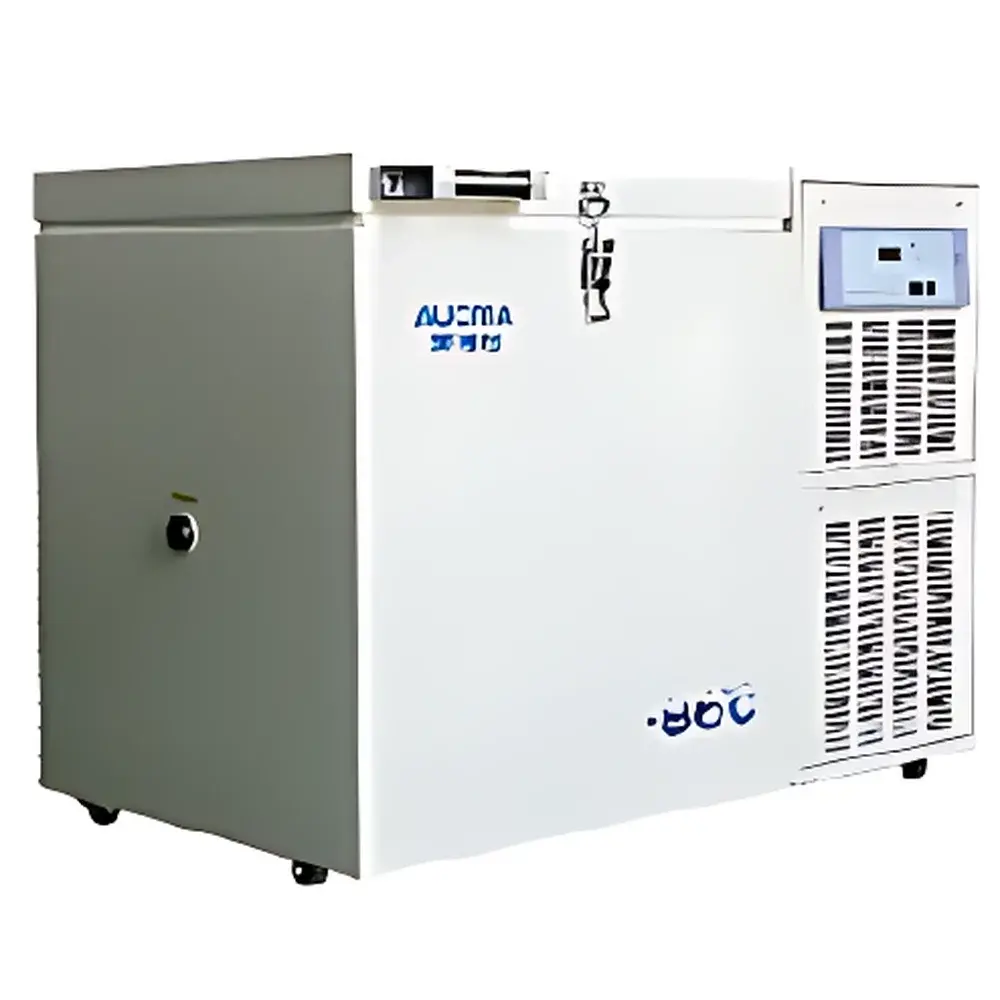
AUCMA DW-86W300 Ultra-Low Temperature Freezer
| Brand | AUCMA |
|---|---|
| Origin | Shanghai, China |
| Model | DW-86W300 |
| Capacity | 300 L |
| Internal Dimensions (mm) | 804 × 593 × 629 |
| External Dimensions (mm) | 1440 × 840 × 950 |
| Power Supply | 220 V / 50 Hz |
| Rated Power | 1000 W |
| Temperature Range | −40 °C to −86 °C |
| Configuration | Horizontal (top-opening) |
| Insulation | High-density polyurethane foam, dual-door sealing system |
| Compressor | Imported dual-stage cascade compressor |
| Refrigerant | Eco-friendly HFC blend (R404A/R23) |
| Fan Motor | Imported EBM EC motor |
| Compliance | Designed per IEC 61000-6-3 (EMC), GB/T 20154–2014 (Chinese ULT freezer standard) |
Overview
The AUCMA DW-86W300 is a horizontal ultra-low temperature (ULT) freezer engineered for long-term cryogenic storage of biologics, clinical specimens, and temperature-sensitive materials at stable operating temperatures ranging from −40 °C to −86 °C. Utilizing a proven dual-stage cascade refrigeration architecture, the unit achieves thermodynamic efficiency through optimized evaporator-condenser heat exchange and high-efficiency compressors—enabling rapid cooldown, minimal temperature fluctuation (< ±2 °C uniformity across load), and reliable operation under ambient conditions up to 32 °C. Its structural design prioritizes thermal integrity: 120 mm thick vacuum-free polyurethane insulation, dual gasketed lid seals, and pressure-equalization valve integration collectively reduce cold loss and improve door-opening ergonomics. As a CE-marked device compliant with IEC 61000-6-3 for electromagnetic compatibility and aligned with GB/T 20154–2014—the national Chinese standard for ULT freezers—the DW-86W300 meets baseline engineering and safety expectations for institutional deployment in regulated environments.
Key Features
- Microprocessor-based temperature control with digital LED display and adjustable setpoint resolution of 0.1 °C across the full −40 °C to −86 °C range.
- Multi-layer alarm system including audible/visual alerts for high/low temperature deviation, power failure, battery low (for internal backup sensor), condenser fouling, overvoltage, and sensor fault—each configurable via on-device interface.
- Dual-stage cascade refrigeration system with imported compressors and EBM EC fan motors ensures quiet operation (<52 dB[A]) and accelerated pull-down (≤7 hours from 25 °C to −80 °C, empty load).
- Eco-conscious refrigeration cycle using zero-ozone-depletion-potential (ODP) HFC refrigerants (R404A primary stage, R23 secondary stage) and CFC-free rigid polyurethane foam insulation.
- Robust mechanical design includes heavy-duty casters with locking brakes, integrated leveling feet, pressure-balanced lid mechanism, and removable drawer-style dust filter for routine maintenance.
- Security features include keypad lockout with user-defined password protection, startup delay logic, and compressor cycle protection to extend service life.
Sample Compatibility & Compliance
The DW-86W300 supports storage of diverse biospecimens—including peripheral blood mononuclear cells (PBMCs), hematopoietic stem cells, plasma, tissue sections, microbial cultures, viral isolates, semen, and cryopreserved embryos—as well as non-biological materials such as electronic components requiring thermal stress testing. Its validated temperature stability profile satisfies foundational requirements for adherence to Good Laboratory Practice (GLP) and Good Manufacturing Practice (GMP) frameworks. While not pre-certified to ISO 13485 or FDA 21 CFR Part 11 out-of-the-box, the system accommodates third-party validation protocols (IQ/OQ/PQ) and integrates with external data loggers compliant with Annex 11 and USP analytical instrument qualification guidelines. The unit’s internal temperature mapping capability (via optional calibrated probe ports) supports spatial uniformity verification per ISO/IEC 17025 clause 5.10.4.
Software & Data Management
The DW-86W300 operates autonomously via embedded firmware without proprietary software dependencies. Optional RS485 or USB interfaces enable connection to external temperature monitoring systems (e.g., DicksonOne, SensiLog, or custom SCADA platforms) for continuous data acquisition, trend analysis, and alarm forwarding via email/SMS. When paired with an external certified temperature recorder (e.g., Vaisala viewLinc or Elpro Libero®), the freezer supports audit-trail generation, electronic signature capture, and secure data export—facilitating compliance with FDA 21 CFR Part 11 when deployed within a documented quality management system. All internal alarm events are timestamped and retained in non-volatile memory for ≥30 days.
Applications
This ULT freezer serves core infrastructure needs across academic research laboratories, public health institutions (e.g., CDC-affiliated biorepositories), hospital blood banks, contract research organizations (CROs), and biopharmaceutical manufacturing sites. Typical use cases include: long-term archiving of genomic DNA/RNA libraries; cryopreservation of primary cell lines and induced pluripotent stem cells (iPSCs); stabilization of monoclonal antibody intermediates; storage of vaccine candidates during preclinical development; and environmental simulation of low-temperature material behavior in electronics and polymer R&D. Its 300 L capacity and horizontal configuration optimize accessibility for high-frequency sample retrieval while maintaining thermal recovery performance under repeated door cycling.
FAQ
What is the typical pull-down time from ambient to −80 °C?
Under no-load conditions and ambient temperature ≤25 °C, the DW-86W300 reaches −80 °C in approximately 6.5–7 hours.
Is remote monitoring supported natively?
No native cloud interface is included, but the unit provides analog voltage output (0–5 V) and RS485 Modbus RTU support for integration into facility-wide BMS or dedicated environmental monitoring platforms.
Can this freezer be validated for GxP environments?
Yes—the design permits IQ/OQ execution using industry-standard protocols; however, final validation must be performed by the end user or qualified third party per their SOPs and applicable regulatory guidance.
What maintenance intervals are recommended?
Condenser coil cleaning every 3–6 months (depending on ambient particulate load), door gasket inspection quarterly, and annual calibration verification of internal sensors using NIST-traceable references.
Does the unit include a built-in temperature logger?
No—it features two calibrated probe ports (one fixed, one optional) for integration with external validated data loggers meeting GLP/GMP traceability requirements.
Related Products





