
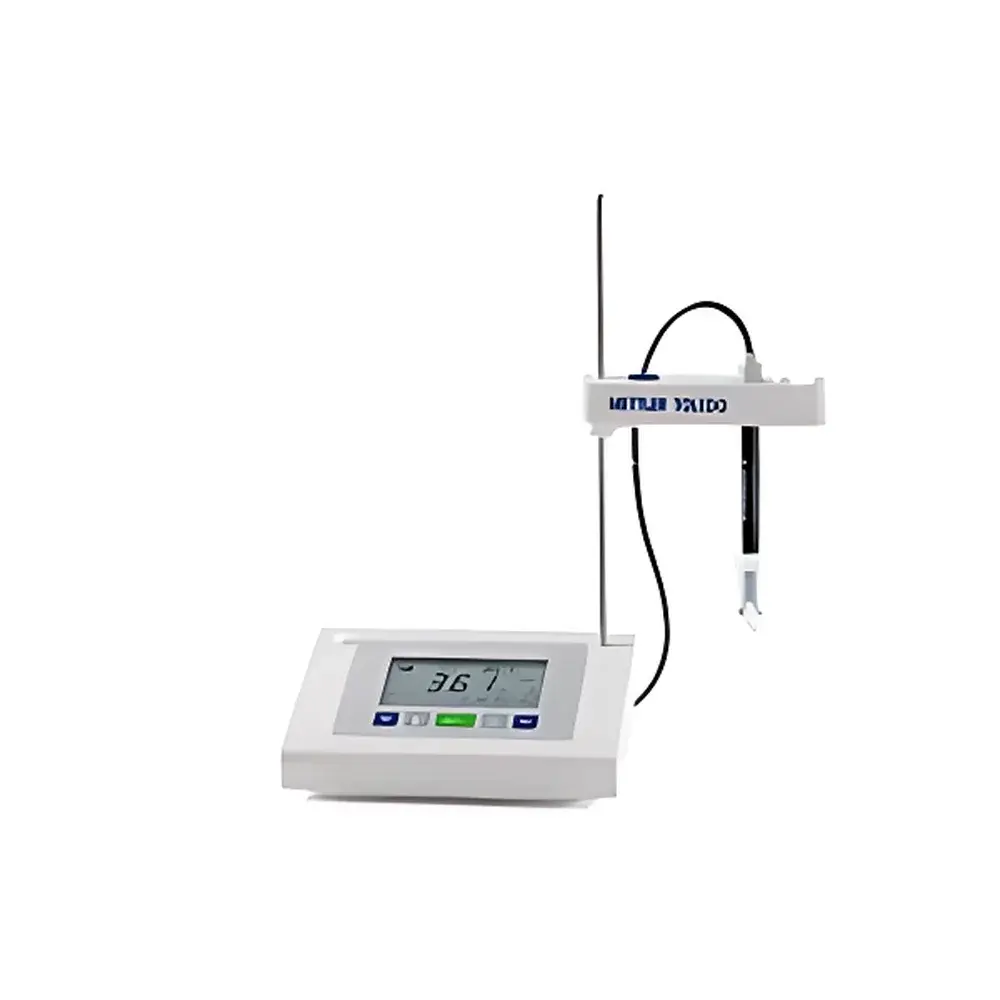
METTLER TOLEDO FiveEasy Plus FE28-Standard Benchtop pH Meter
| Brand | METTLER TOLEDO |
|---|---|
| Origin | Switzerland |
| Model | FE28-Standard |
| Instrument Type | Benchtop |
| Parameter Types | Dual (pH/mV) |
| pH Measurement Range | -2.00 to 16.00 pH |
| pH Resolution | 0.01 pH |
| pH Accuracy | ±0.01 pH |
| mV Range | -2000 to +2000 mV |
| mV Resolution | 1 mV |
| mV Accuracy | ±1 mV |
| Temperature Range | -5 °C to 105 °C |
| Temperature Resolution | 0.1 °C |
| Temperature Accuracy | ±0.3 °C |
| Temperature Compensation | Automatic (ATC) and Manual (MTC) |
| Calibration Standards | NIST-traceable buffers |
| Interface | RS232 and USB |
Overview
The METTLER TOLEDO FiveEasy Plus FE28-Standard is a benchtop pH meter engineered for precision, repeatability, and operational simplicity in routine laboratory environments. Based on potentiometric measurement principles, it determines hydrogen ion activity in aqueous solutions using a glass pH electrode and reference electrode pair, generating a millivolt signal proportional to the logarithm of H⁺ concentration. Designed as the direct successor to the FE20K platform, the FE28-Standard integrates refined electronics, improved thermal stability, and enhanced electrode interface compatibility—while retaining full backward compatibility with legacy FiveEasy sensors and accessories. Its dual-parameter capability supports simultaneous pH and redox (mV) measurements, making it suitable for quality control, academic teaching labs, environmental testing, and pharmaceutical process monitoring where regulatory traceability and procedural consistency are essential.
Key Features
- Intuitive, icon-driven user interface with large backlit LCD display and tactile membrane keys—optimized for glove-compatible operation and minimal training requirements.
- One-touch measurement initiation and auto-recognizing electrode detection reduce operator error and improve workflow efficiency.
- Compact, space-saving footprint (200 × 170 × 90 mm) with integrated removable electrode holder—designed to maximize benchtop real estate without compromising accessibility or ergonomics.
- Dual communication interfaces: RS232 port for direct thermal printer output and USB connection for data transfer to Windows-based PCs running METTLER TOLEDO LabX Lite software or generic spreadsheet applications.
- Internal memory stores up to 99 measurement results with timestamp and electrode ID—supporting basic GLP-compliant recordkeeping without external software dependency.
- Auto-buffer recognition across four pre-programmed NIST-traceable calibration sets (e.g., pH 4.01, 7.00, 10.01), reducing manual entry errors during multi-point calibration routines.
Sample Compatibility & Compliance
The FE28-Standard accommodates standard BNC-input pH electrodes—including METTLER TOLEDO’s LE438 (general-purpose), LE410 (low-ionic-strength), LE422 (bio-compatible), and LE420 (micro-volume)—enabling reliable measurements across diverse sample matrices: aqueous buffers, cell culture media, food extracts, wastewater effluents, and pharmaceutical formulations. It complies with ISO/IEC 17025 requirements for measurement uncertainty estimation and supports audit-ready documentation when used with certified reference materials traceable to NIST SRMs. While the instrument itself does not enforce 21 CFR Part 11 compliance, its data export architecture facilitates integration into validated LIMS or LabX environments where electronic signature, audit trail, and user access controls are implemented at the system level.
Software & Data Management
Data generated by the FE28-Standard can be exported in CSV format via USB or RS232 for downstream analysis in Excel, MATLAB, or statistical process control (SPC) platforms. Optional LabX Lite software provides centralized device configuration, calibration report generation, and trend visualization—particularly useful in multi-instrument laboratories requiring harmonized SOP execution. All calibration events—including date, buffer IDs, slope (%), offset (mV), and temperature—are automatically logged with timestamps. The built-in memory retains calibration history for the last three calibrations, enabling rapid verification of sensor performance drift over time.
Applications
- Routine QC testing in food & beverage production (e.g., acidity verification in dairy, juice, and fermented products).
- Environmental monitoring of surface water, wastewater, and soil leachates per ASTM D1293 and EPA Method 150.1.
- Pharmaceutical manufacturing support for buffer preparation, cleaning validation, and stability-indicating assays.
- Academic instruction in general chemistry, analytical chemistry, and biotechnology curricula—where robustness, ease of use, and pedagogical clarity are prioritized.
- Industrial process control in electroplating, chemical synthesis, and water treatment facilities requiring stable mV monitoring alongside pH.
FAQ
Does the FE28-Standard support automatic temperature compensation (ATC)?
Yes—it accepts signals from integrated Pt1000 or NTC temperature probes (e.g., LE438-T, InLab® Routine Pro) and applies real-time Nernstian correction across the full -5 °C to 105 °C range.
Can I perform calibration with non-NIST buffers?
Manual calibration with custom buffer values is supported; however, only pre-defined NIST-traceable sets enable auto-recognition and slope validation reporting.
Is the FE28-Standard compatible with GLP/GMP documentation workflows?
While the standalone unit lacks electronic signatures or role-based access, its timestamped calibration logs and CSV export capability align with foundational GLP documentation practices when paired with controlled procedures.
What is the expected service life of the internal battery backup?
The FE28-Standard uses capacitor-based memory retention—not a replaceable battery—ensuring calibration and setup parameters persist for >10 years without power.
How frequently should the pH electrode be recalibrated?
Calibration frequency depends on application stringency; daily calibration is recommended for regulated QC work, while less critical applications may follow a verified interval protocol based on historical performance data.
Related Products






