
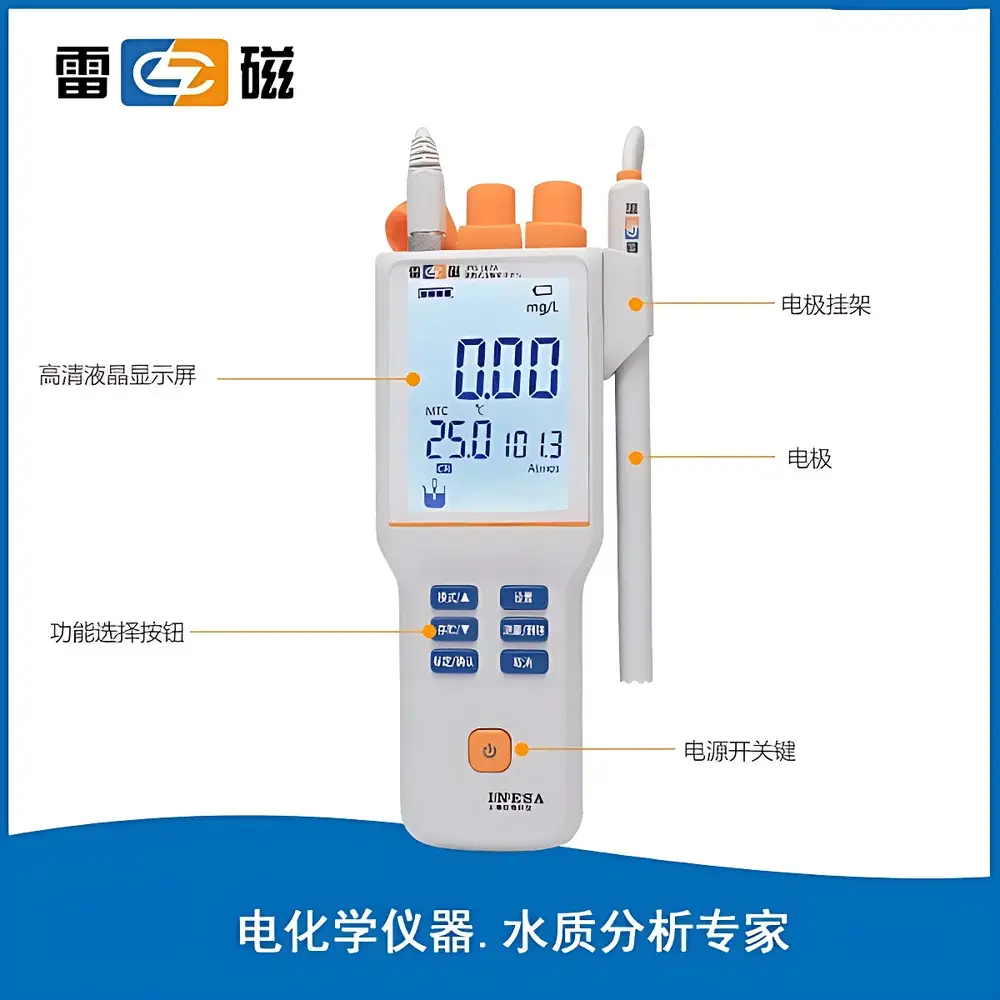
Leici JPB-607A Portable Dissolved Oxygen Meter
| Brand | Leici |
|---|---|
| Origin | Shanghai, China |
| Model | JPB-607A |
| Instrument Type | Portable |
| Measurement Principle | Polarographic Electrochemical Probe |
| Measurement Range | 0.00–20.00 mg/L |
| Accuracy | ±0.30 mg/L |
| Repeatability | ±0.1 mg/L |
| Temperature Range | −5.0–110.0 °C |
| Temperature Compensation | Automatic (0.0–40.0 °C) |
| DO Resolution | 0.1 mg/L |
| Temp Resolution | 0.1 °C |
| Basic Temp Error | ±0.5 °C |
| Power | Rechargeable Li-ion Battery & DC5V Adapter |
| Dimensions | 80 × 225 × 35 mm |
| Weight | 0.4 kg |
| Standard Electrode | DO-957 Polarographic Dissolved Oxygen Electrode |
Overview
The Leici JPB-607A Portable Dissolved Oxygen Meter is an engineered field-deployable instrument designed for reliable, on-site measurement of dissolved oxygen (DO) concentration in aqueous environments using the polarographic electrochemical probe principle. Based on Clark-type amperometric detection, the system applies a fixed polarizing voltage across a gas-permeable membrane–enclosed cathode and anode, generating a diffusion-limited current proportional to the partial pressure of molecular oxygen dissolved in the sample. This fundamental electrochemical transduction ensures stable baseline response and high reproducibility under variable environmental conditions. The JPB-607A is calibrated per ISO 5814:2012 (Water quality — Determination of dissolved oxygen — Electrochemical probe method) and supports compliance with ASTM D888 and EPA Method 360.5 for routine water quality assessment in rivers, lakes, wastewater treatment plants, aquaculture systems, and groundwater monitoring campaigns.
Key Features
- High-contrast LCD display with backlight for low-light field operation
- Dual reading modes: continuous real-time monitoring and equilibrium-based stable reading acquisition
- Integrated automatic temperature compensation (0.0–40.0 °C), eliminating manual correction steps and minimizing thermal drift
- Comprehensive calibration suite: zero-oxygen (sodium sulfite) and full-scale (air-saturated water or Winkler-standardized solution) calibration routines with user-guided prompts
- Barometric pressure and salinity compensation algorithms to correct for local atmospheric conditions and ionic strength effects on oxygen solubility
- Compact, rugged housing (80 × 225 × 35 mm; 0.4 kg) with IP67-rated enclosure for dust and immersion resistance during transport and outdoor use
- Long-life rechargeable lithium-ion battery (up to 100 hours of continuous operation) with optional AC/DC adapter (input: 100–240 VAC; output: 5 VDC)
Sample Compatibility & Compliance
The JPB-607A is validated for use with freshwater, seawater, brackish water, activated sludge, and process effluents. Its DO-957 polarographic electrode features a Teflon membrane with optimized thickness and diffusion barrier geometry to ensure rapid response time (<90 s to 95% step change) and minimal stirring dependence—critical for low-flow or stagnant sampling scenarios. The instrument meets essential regulatory expectations for field instrumentation under GLP-aligned workflows and supports audit-ready documentation when paired with external logging software. While not certified for FDA 21 CFR Part 11 compliance out-of-the-box, its data export functionality (via USB) enables traceable integration into validated LIMS or ELN platforms compliant with ISO/IEC 17025 and USP .
Software & Data Management
Data acquisition and configuration are managed directly via the onboard interface; no proprietary PC software is required for basic operation. All measurements include embedded metadata: date/time stamp, temperature, atmospheric pressure (if entered manually), salinity value, and calibration status flags. Measurement records (up to 500 entries) are stored internally with timestamp and can be exported in CSV format via micro-USB connection. Firmware updates are delivered as signed binary files through Leici’s official technical support portal, ensuring version control and integrity verification. For laboratory integration, raw serial output (ASCII protocol) is available for custom scripting or SCADA interfacing.
Applications
- Environmental field surveys: surface water DO profiling, hypolimnetic oxygen depletion tracking, and seasonal stratification studies
- Wastewater treatment plant (WWTP) process control: aeration basin optimization, return activated sludge (RAS) monitoring, and final effluent compliance verification
- Aquaculture and fisheries management: pond and raceway DO surveillance to prevent hypoxia-induced mortality
- Drinking water distribution system integrity assessment: detecting biofilm-related oxygen demand anomalies
- Educational laboratories: hands-on instruction in aquatic chemistry, sensor fundamentals, and environmental metrology principles
FAQ
What electrochemical method does the JPB-607A employ?
It uses the polarographic (Clark-type) amperometric method with a gold cathode and silver/silver chloride reference anode enclosed behind a gas-permeable Teflon membrane.
Is temperature compensation fully automatic?
Yes—the built-in thermistor provides continuous temperature sensing from −5.0 to 110.0 °C, and compensation is applied automatically within the 0.0–40.0 °C operational range specified for DO measurement accuracy.
Can the instrument compensate for salinity and barometric pressure?
Yes—users may manually input local salinity (0–50 g/kg) and atmospheric pressure (60–110 kPa) values to correct oxygen saturation calculations per the Benson-Krause equation.
What is the expected service life of the DO-957 electrode?
With proper maintenance—including regular membrane replacement (recommended every 3–6 months depending on usage frequency and sample matrix), electrolyte replenishment, and storage in humidified KCl solution—the electrode typically delivers >12 months of stable performance.
Does the JPB-607A meet international standards for field DO measurement?
It conforms to the functional and performance requirements outlined in ISO 5814:2012 and ASTM D888-19, supporting comparability with reference methods such as iodometric (Winkler) titration in routine monitoring applications.







