
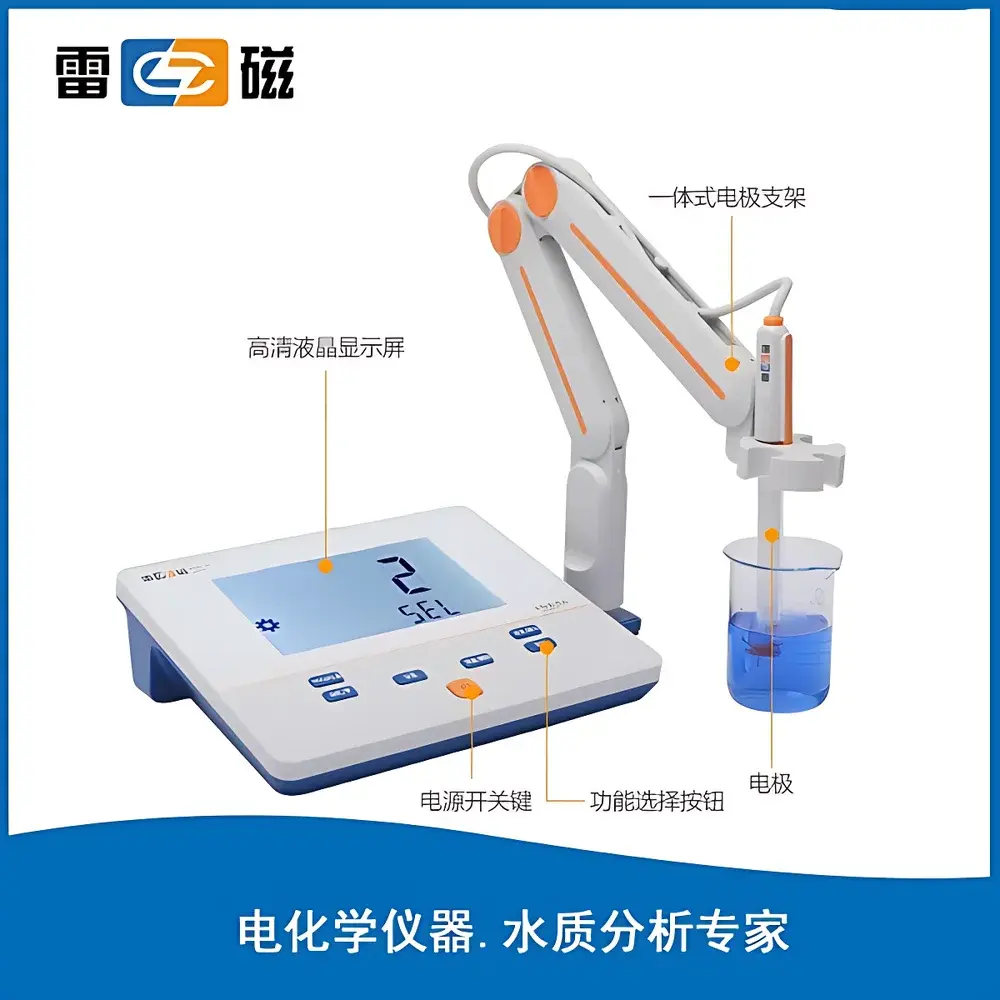
LeiCi PHS-3C Benchtop pH Meter
| Brand | LeiCi |
|---|---|
| Origin | Shanghai, China |
| Model | PHS-3C |
| pH Measurement Range | -2.00 to 18.00 pH |
| Resolution | 0.01 pH |
| Accuracy | ±0.01 pH |
| mV Range | -1999 to +1999 mV |
| mV Resolution | 1 mV |
| mV Accuracy | ±0.1% FS |
| Input Impedance | ≥1 × 10¹² Ω |
| Stability | ±0.01 pH ±1 digit / 3 h |
| Temperature Compensation | Manual, 0.0–60.0 °C |
| Power Supply | AC 220 V ±10%, 50 Hz |
| Dimensions (W×D×H) | 242 × 195 × 68 mm |
| Weight | 0.9 kg |
| Compliance | Meets GB/T 11165–2022 (Chinese national standard for laboratory pH meters) |
Overview
The LeiCi PHS-3C Benchtop pH Meter is a precision electrochemical instrument engineered for reliable, repeatable pH and millivolt measurements in routine laboratory environments. Based on potentiometric measurement principles, it determines hydrogen ion activity via a high-impedance voltage differential between a pH-sensitive glass electrode and a stable reference electrode—typically the E-201-C Q9 combination electrode supplied with the system. Designed to meet Class 0.01 accuracy requirements per GB/T 11165–2022, the PHS-3C delivers traceable, GLP-aligned performance without integrated data logging or automated compliance reporting. Its analog-digital hybrid architecture prioritizes operational robustness over software complexity, making it suitable for QC labs, educational institutions, and industrial process support where manual calibration protocols and long-term stability are valued over connectivity features.
Key Features
- High-contrast LCD display with intuitive key-based navigation for rapid parameter access and mode selection
- Dual-parameter measurement capability: simultaneous pH and mV (with auto-polarity detection)
- Up to three-point pH calibration using NIST-traceable buffer standards (pH 4.01, 7.00, 10.01); supports automatic recognition of common Chinese standard buffers
- Manual temperature compensation (0.0–60.0 °C) to correct for thermal drift in electrode response
- Internal memory stores up to 50 measurement records, each including pH/mV value, temperature, date/time stamp, and calibration status
- Input impedance ≥1 × 10¹² Ω ensures minimal loading error when measuring high-resistance samples (e.g., low-conductivity aqueous solutions)
- Stability specification of ±0.01 pH ±1 digit over 3 hours confirms suitability for extended batch monitoring under controlled ambient conditions
Sample Compatibility & Compliance
The PHS-3C is validated for use with standard aqueous electrolyte solutions, buffer preparations, and routine industrial process streams (e.g., wastewater effluent, fermentation broths, cleaning validation rinsates). It is not designed for non-aqueous solvents, highly viscous media, or sterilized closed-system applications. While not certified to ISO/IEC 17025 or FDA 21 CFR Part 11 out-of-the-box, its documented calibration traceability, defined stability window, and adherence to GB/T 11165–2022 support integration into laboratories operating under GLP or internal QA frameworks. Users must implement procedural controls—including documented calibration logs, electrode maintenance schedules, and environmental monitoring—to satisfy audit requirements for regulated environments.
Software & Data Management
The PHS-3C operates as a standalone instrument with no embedded firmware-based data export, cloud connectivity, or PC synchronization. All stored measurements (max. 50 entries) are accessible via front-panel review, deletion, or recall functions. No proprietary software is required or provided; data extraction necessitates manual transcription. This design minimizes cybersecurity exposure and eliminates dependency on driver installation or OS compatibility—advantageous in legacy IT environments or facilities with strict software approval policies. For labs requiring electronic record retention, external documentation systems (e.g., LIMS-integrated manual entry or camera-based audit trail capture) are recommended per ALCOA+ principles.
Applications
- Quality control testing of raw materials and finished products in food, beverage, and pharmaceutical manufacturing
- pH verification during chemical synthesis, titration endpoint confirmation, and reagent preparation
- Environmental monitoring of surface water, groundwater, and treated effluent per local regulatory guidelines
- Academic teaching labs for fundamental electrochemistry experiments and electrode characterization
- Calibration verification of field-deployable pH sensors and portable meters using standardized buffer checks
FAQ
What buffer solutions are compatible with automatic recognition on the PHS-3C?
The instrument recognizes three standard Chinese national buffer solutions: pH 4.01 (potassium hydrogen phthalate), pH 6.86 (phosphate), and pH 9.18 (borax) at 25 °C. Custom buffers require manual entry of nominal pH values.
Can the PHS-3C measure pH in non-aqueous or low-ionic-strength samples?
It is not optimized for such matrices. Measurements below 100 µS/cm conductivity may exhibit slow response, drift, or unstable readings due to insufficient junction potential stabilization. Use of specialized low-conductivity electrodes and guarded calibration protocols is advised.
Is temperature compensation mandatory for accurate pH results?
Yes—pH is temperature-dependent. The PHS-3C requires manual input of sample temperature prior to measurement to apply the Nernst equation correction. Omitting this step introduces systematic error exceeding ±0.03 pH per 10 °C deviation from calibration temperature.
Does the unit include a built-in printer or RS-232 interface?
No. The PHS-3C lacks serial communication ports or direct printing capability. Data transfer relies on manual recording or third-party imaging solutions.
What is the recommended recalibration frequency for routine use?
Per GB/T 11165–2022, recalibration is required before each analytical session, after electrode replacement, following prolonged storage (>24 h), or when measurement drift exceeds ±0.02 pH versus control standards.






