
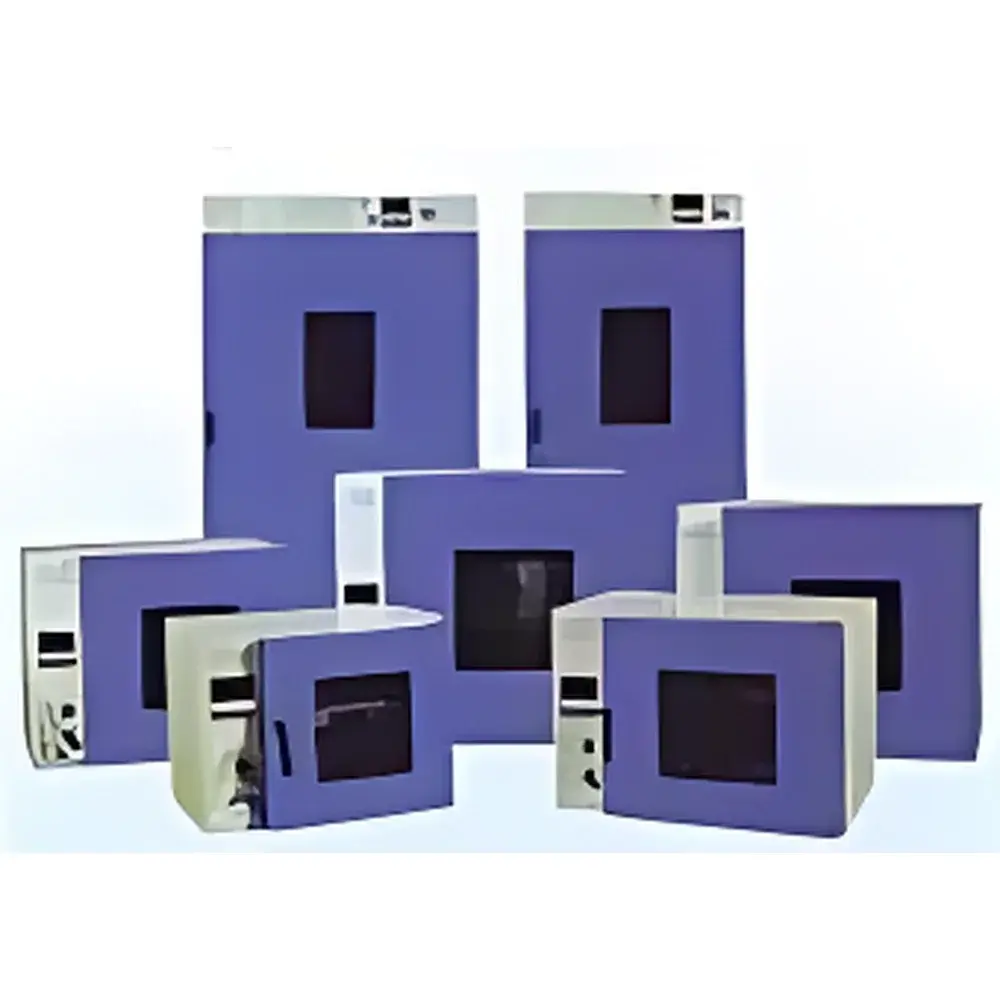
Yiheng DHG-9140A Forced-Air Drying Oven
| Brand | Yiheng |
|---|---|
| Model | DHG-9140A |
| Origin | Shanghai, China |
| Temperature Range | RT+10 °C to 200 °C / RT+10 °C to 250 °C |
| Temperature Uniformity | ±3% at 100 °C |
| Temperature Fluctuation | ±1.0 °C |
| Temperature Resolution | 0.1 °C |
| Chamber Dimensions (W×D×H) | 550 × 450 × 550 mm |
| External Dimensions (W×D×H) | 840 × 580 × 730 mm |
| Interior Material | Mirror-Finish Stainless Steel |
| Heating Method | Forced-Air Convection |
| Power Supply | AC 220 V, 50 Hz |
| Rated Power | 2050 W |
| Operating Ambient Temperature | +5 °C to +40 °C |
| Standard Shelving | 4 Adjustable Stainless Steel Trays |
| Optional Accessories | Multi-Stage Programmable Controller, RS485 Interface, Embedded Thermal Printer, Independent Over-Temperature Cut-Off System |
Overview
The Yiheng DHG-9140A Forced-Air Drying Oven is an engineered laboratory drying system designed for precise thermal processing of samples in research, quality control, and production environments. Based on the principle of forced convection heating—where a high-temperature-stable centrifugal blower circulates heated air uniformly across the chamber—the DHG-9140A ensures consistent heat transfer and minimizes thermal gradients. Its mirror-finish stainless steel interior (grade 304) resists oxidation and corrosion during repeated exposure to elevated temperatures up to 250 °C, supporting long-term reliability in routine drying, sterilization, moisture determination, preheating, and aging applications. The oven complies with general safety and performance expectations for Class II laboratory ovens per IEC 61010-1:2010 and meets structural and electrical requirements for non-explosive environments under EN 60529 (IP20). It is not intended for use with flammable, volatile, or hazardous substances unless explicitly validated and modified under institutional risk assessment protocols.
Key Features
- Mirror-polished 304 stainless steel inner chamber—welded via TIG process for seamless integrity, ease of cleaning, and resistance to acidic/alkaline residue buildup.
- Microprocessor-based P.I.D. temperature controller with digital LED display, offering setpoint resolution of 0.1 °C and real-time deviation monitoring with auto-tuning capability.
- Independent over-temperature protection circuit (optional)—mechanically isolated from the main controller, triggering immediate power cutoff if chamber temperature exceeds user-defined threshold.
- Adjustable air inlet and exhaust dampers—enabling fine control of internal airflow dynamics to optimize drying kinetics for hygroscopic, porous, or layered samples.
- High-efficiency axial fan rated for continuous operation at ≥250 °C, integrated into a symmetrical duct system that directs laminar airflow from rear wall upward and downward toward sample zones.
- Energy-efficient insulation using 100 mm thick mineral fiber (thermal conductivity ≤0.04 W/m·K), minimizing surface temperature rise and reducing standby power consumption.
Sample Compatibility & Compliance
The DHG-9140A accommodates standard laboratory ware including porcelain crucibles, glass Petri dishes, aluminum weighing pans, stainless steel trays, and polymer-coated substrates—provided materials are thermally stable within the operating range. It supports gravimetric moisture analysis per ASTM D2231, ISO 293, and USP <731>, as well as residual solvent removal in pharmaceutical intermediates per ICH Q5C guidelines. While not certified to GLP or GMP out-of-the-box, the unit may be qualified (IQ/OQ/PQ) for regulated workflows when paired with validated accessories: a calibrated NIST-traceable thermometer, multi-point temperature mapping probe set, and audit-ready data logging via RS485-to-USB interface with timestamped CSV export. All optional printer outputs comply with FDA 21 CFR Part 11 requirements when deployed with electronic signature-enabled software and secure user access controls.
Software & Data Management
When equipped with the optional RS485 communication module and companion PC software (Yiheng LabLink v3.2), the DHG-9140A enables remote parameter configuration, real-time temperature graphing, and automated report generation—including min/max/mean values, dwell time verification, and deviation alerts. Data logs retain full traceability: operator ID, session start/stop timestamps, setpoint history, and ambient condition metadata. The embedded thermal printer (optional) produces hard-copy records with header fields for batch number, analyst initials, and instrument ID—supporting paper-based SOP adherence in non-digitalized labs. Firmware updates are delivered via USB flash drive and include checksum validation to ensure integrity during installation.
Applications
- Moisture content determination in food, soil, polymers, and pharmaceutical raw materials.
- Drying of filter papers, chromatography media, and microbiological culture plates prior to weighing or incubation.
- Curing of coatings, adhesives, and composite prepregs under controlled thermal profiles.
- Pre-conditioning of reference standards and calibration artifacts per ISO/IEC 17025 Clause 6.4.10.
- Aging studies of electronic components and packaging materials per JEDEC JESD22-A108 and MIL-STD-883 Method 1008.
- Residual solvent evaporation in API synthesis and formulation development.
FAQ
What is the maximum allowable load volume inside the DHG-9140A chamber?
The usable chamber volume is 136 L (550 × 450 × 550 mm), but optimal airflow uniformity requires maintaining ≥25% free space above and between loaded trays. Maximum recommended gross load is 12 kg of dry mass.
Does the DHG-9140A support ramp-and-soak temperature programming?
Standard configuration includes single-setpoint control with timer. Multi-stage programmable controller (optional accessory) enables up to 30 segments with independent ramp rates, soak durations, and cycle repeats.
Can this oven be used for sterilization of glassware?
It is suitable for dry-heat depyrogenation of glass and metal items at ≥160 °C for ≥2 hours per USP <1211>, though biological indicator validation is required for sterility claims.
Is the RS485 interface compatible with LabVIEW or MATLAB?
Yes—Modbus RTU protocol implementation allows native integration with LabVIEW (using VISA or Modbus I/O libraries) and MATLAB (via Instrument Control Toolbox and serial port configuration).
How often should the temperature sensor be recalibrated?
Annual calibration against a NIST-traceable reference thermometer is recommended; more frequent verification (e.g., quarterly) is advised in GLP/GMP environments or after mechanical impact or extended high-temperature operation.



