
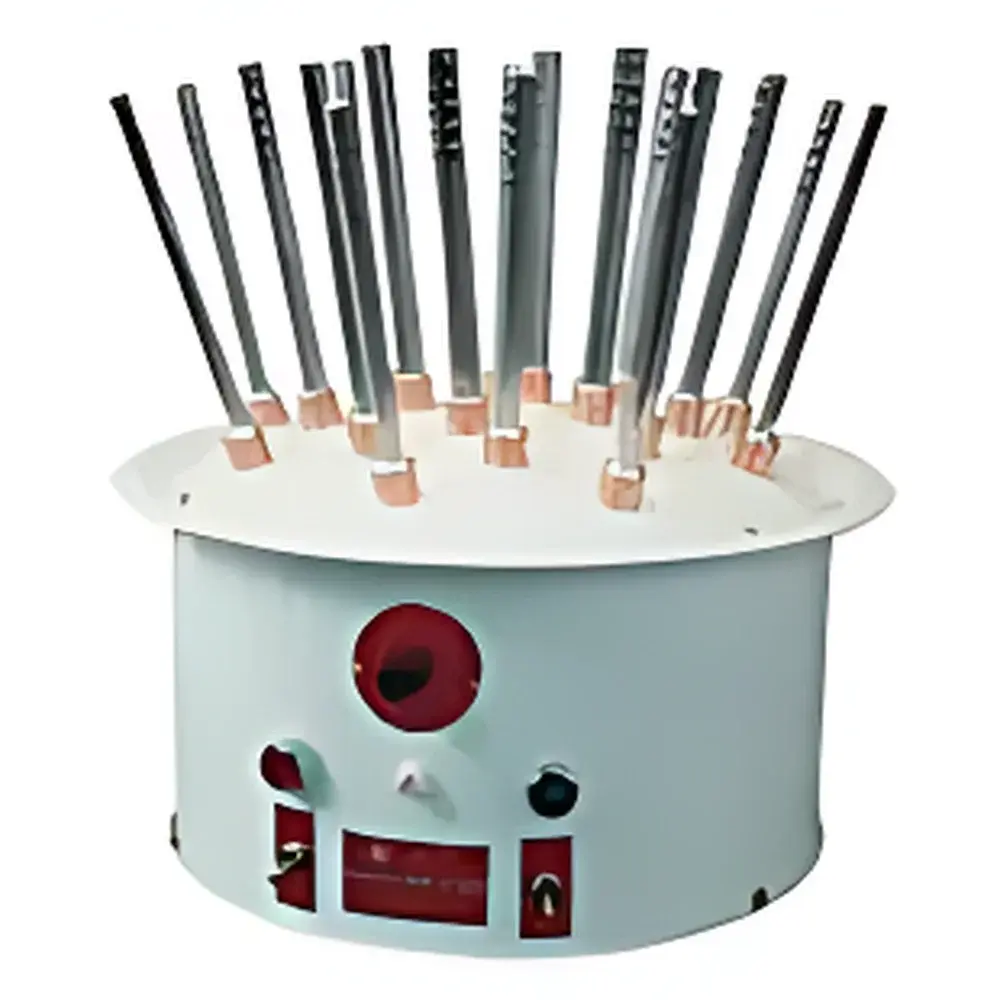
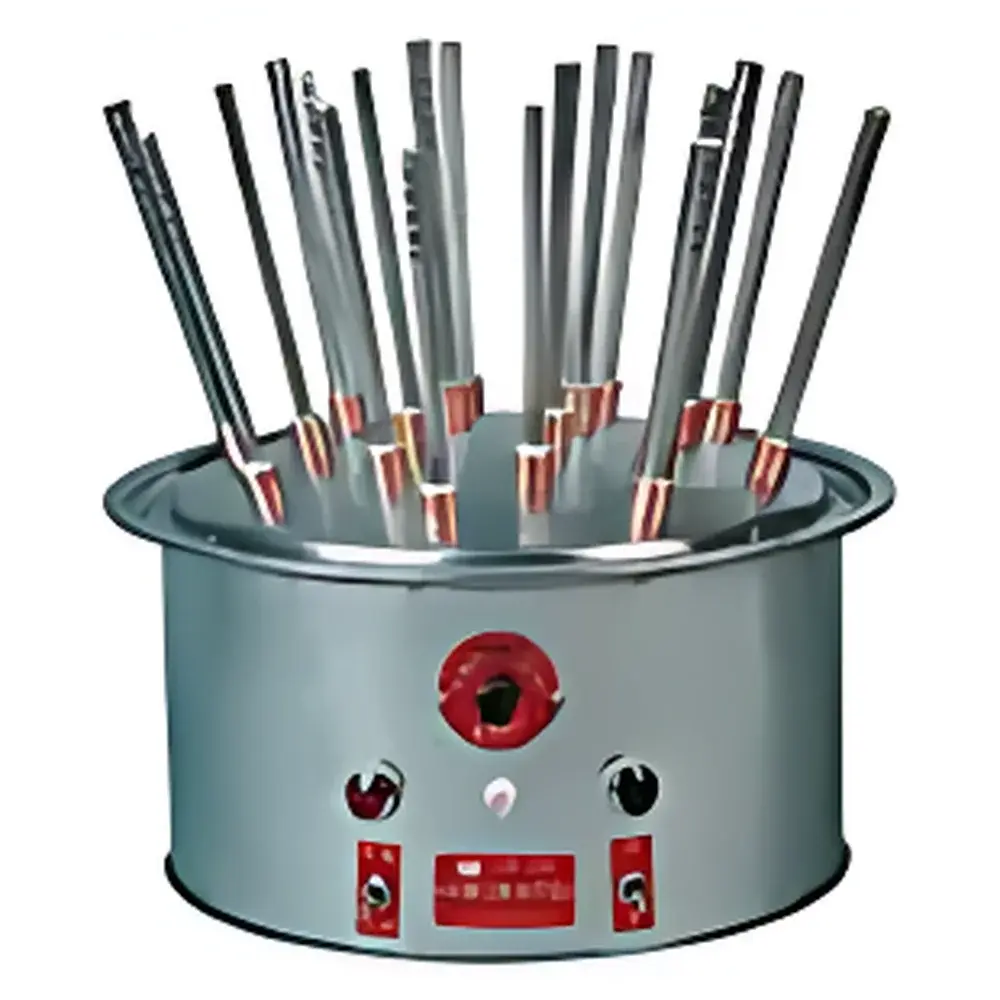
Ziqi Glassware Air-Drying Oven Series B12/B20/B30/C12/C20/C30
| Brand | Ziqi |
|---|---|
| Origin | Shanghai, China |
| Manufacturer Type | Direct Manufacturer |
| Product Origin | Domestic (China) |
| Models | B12, B20, B30, C12, C20, C30 |
| Power Rating | 800 W (B/C series) |
| Input Voltage/Frequency | 220 V / 50 Hz |
| Temperature Range | 40–120 °C |
| Temperature Accuracy | ±5 °C |
| Air Tube Length | 170 mm / 200 mm |
| Air Tube Diameters | 9 mm, 12 mm, 17 mm |
| Number of Drying Ports | 12, 20, or 30 |
| Dimensions (Ø × H) | Φ400 × 400 mm |
| Weight | 7–8 kg |
| Housing Material | B-series — Powder-Coated Steel |
Overview
The Ziqi Glassware Air-Drying Oven Series (B12/B20/B30 and C12/C20/C30) is a laboratory-grade convective drying system engineered for rapid, residue-free dehydration of glassware following rinsing, washing, or solvent displacement. Unlike passive air-drying racks or heat-only ovens, this instrument employs directed, temperature-controlled airflow through calibrated nozzles to accelerate evaporation while minimizing thermal stress on delicate borosilicate or soda-lime glassware. The system operates on the principle of forced convection: ambient air is drawn in, heated to a user-selectable setpoint (40–120 °C), and delivered via rigid, diameter-graded air tubes (9 mm, 12 mm, and 17 mm ID) to individual ports—ensuring uniform thermal energy distribution across all mounted items. Designed for routine use in analytical, quality control, clinical, and teaching laboratories, it supports compliance with standard laboratory drying protocols referenced in ISO 17025-accredited workflows and GLP environments where trace moisture interference must be eliminated prior to gravimetric analysis, titration, or sample preparation.
Key Features
- Two distinct housing architectures: B-series features durable powder-coated mild steel construction for cost-effective general-purpose use; C-series utilizes full AISI 304 stainless steel for enhanced corrosion resistance in high-humidity or acidic rinse environments.
- Precise thermostatic control with ±5 °C accuracy across the full 40–120 °C operating range, enabling method-specific drying profiles—for example, low-temperature drying (40–60 °C) for volumetric flasks and burettes, or elevated settings (80–120 °C) for rapid solvent removal from reaction vessels.
- Modular port configuration: 12-, 20-, and 30-position variants accommodate diverse lab throughput requirements without sacrificing footprint efficiency (compact Φ400 × 400 mm base).
- Interchangeable air tubes with three standardized inner diameters (9 mm, 12 mm, 17 mm) allow optimal airflow matching to tube/neck geometry—critical for drying narrow-bore pipettes, culture tubes, or wide-mouth Erlenmeyer flasks without turbulence-induced splashing or condensation re-deposition.
- Energy-efficient 800 W heating element with automatic cut-off upon reaching set temperature, reducing standby power consumption and extending component service life.
- Robust mechanical design with integrated ventilation grilles and overheat protection circuitry compliant with IEC 61010-1 safety standards for laboratory electrical equipment.
Sample Compatibility & Compliance
The Ziqi Air-Drying Oven accommodates standard laboratory glassware including but not limited to: test tubes (10–25 mm OD), centrifuge tubes, volumetric flasks (10–1000 mL), graduated cylinders, Petri dishes, watch glasses, and NMR tubes. Its non-contact drying mechanism eliminates physical abrasion, making it suitable for calibration-grade Class A glassware. All models meet CE marking requirements for electromagnetic compatibility (EMC Directive 2014/30/EU) and low-voltage safety (LVD Directive 2014/35/EU). While not certified to FDA 21 CFR Part 11, the absence of software-based controls renders it inherently audit-trail compatible for GMP-aligned documentation when paired with manual logbooks referencing batch-specific drying parameters (temperature, duration, vessel type). The stainless-steel C-series complies with ASTM F824-22 recommendations for materials used in repeated contact with aqueous cleaning agents.
Software & Data Management
This is a hardware-only, analog-controlled instrument with no embedded microprocessor, touchscreen interface, or digital data logging capability. Temperature selection is performed via a calibrated rotary dial with visual indicator; operational status is confirmed by LED power and heater indicators. As such, it requires no firmware updates, network connectivity, or cybersecurity validation—making it ideal for air-gapped labs, regulated environments requiring deterministic behavior, or facilities prioritizing long-term maintenance simplicity. All operating parameters are manually recorded per SOP, supporting traceability under ISO/IEC 17025 Clause 7.7 (Ensuring Validity of Results) when integrated into documented drying protocols.
Applications
- Routine post-wash drying of glassware in QC/QA laboratories performing USP , EP 2.2.44, or JP 2.07 moisture-sensitive assays.
- Preparation of dry, particle-free containers for HPLC vial filling, Karl Fischer titration, or residual solvent analysis (ICH Q3C).
- Dehydration of microbiological culture tubes and petri dishes in clinical and pharmaceutical microbiology labs.
- Removal of ethanol, acetone, or isopropanol residues from glass reaction vessels in synthetic chemistry workflows.
- Standardized drying step in ASTM D129, D92, or D93 flash point testing procedures where residual moisture affects ignition behavior.
- Teaching lab implementation for demonstrating principles of convective heat transfer and phase-change kinetics in undergraduate physical chemistry courses.
FAQ
What is the maximum recommended continuous operating time?
Continuous operation is permissible up to 8 hours per cycle; extended use beyond this duration is discouraged without periodic cooling intervals to maintain thermal stability of internal components.
Can the air tubes be sterilized in an autoclave?
Stainless-steel air tubes (C-series only) are autoclavable at 121 °C, 15 psi for 20 minutes; powder-coated B-series tubes are not autoclave-rated and must be cleaned with 70% ethanol or mild detergent solutions.
Is external exhaust ducting required?
No—unit is designed for ambient recirculation and does not require venting to fume hoods or external ductwork; however, adequate room ventilation is advised when drying volatile organic solvents.
How is temperature calibration verified?
Users may validate setpoint accuracy using a NIST-traceable digital thermometer probe inserted into a representative air tube during steady-state operation; deviation exceeding ±5 °C warrants service inspection.
Are replacement air tubes available as spare parts?
Yes—Ziqi supplies OEM-compatible air tubes in all three diameters (9 mm, 12 mm, 17 mm) and lengths (170 mm and 200 mm), sold individually or in multi-pack kits for scheduled maintenance programs.



