
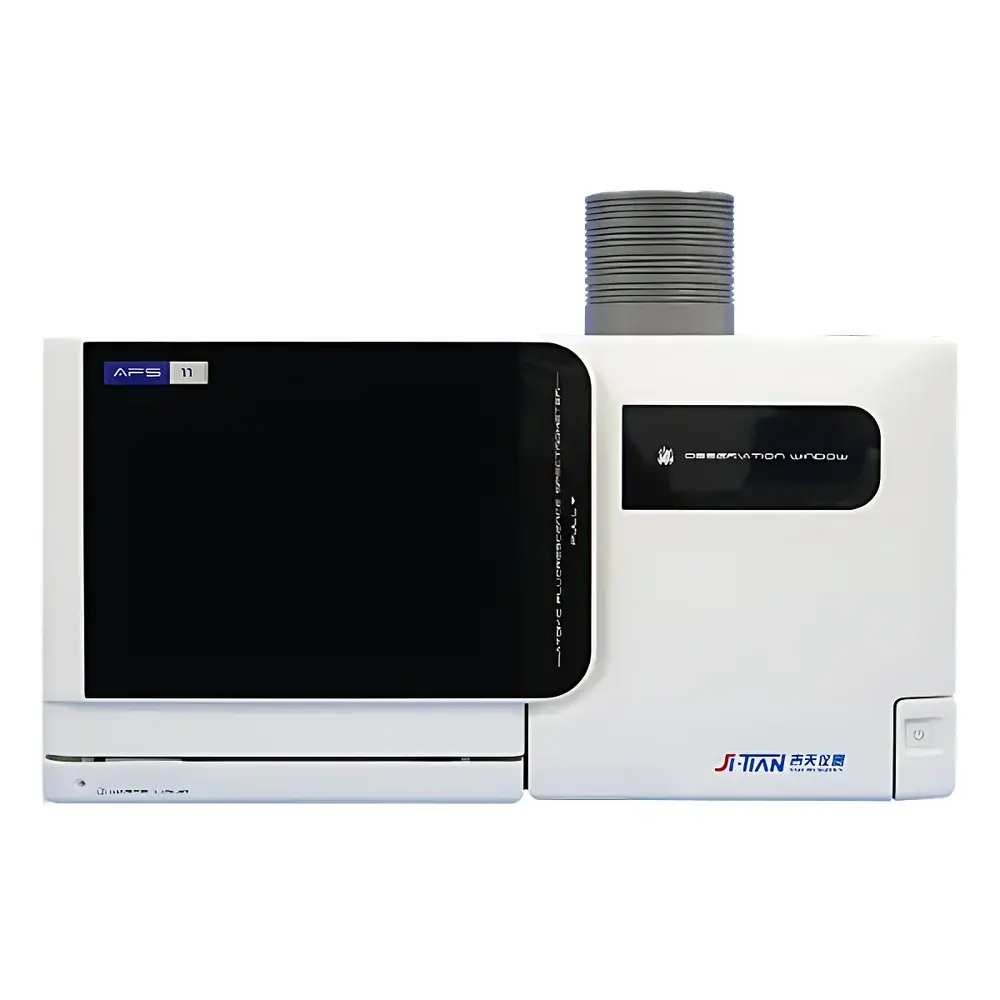
Titan Instruments AFS-11C Sequential Injection High-Precision Atomic Fluorescence Spectrometer
| Brand | Titan Instruments |
|---|---|
| Origin | Beijing, China |
| Manufacturer Type | Manufacturer |
| Instrument Type | Multi-channel Atomic Fluorescence Spectrometer |
| Sample Introduction | Dual Sequential Injection Pumps |
| Waste Disposal | Rear-mounted Waste Drainage |
| Hydride Generation Mode | Vapor Generation / Hydride Generation |
| Gas Flow Control | Valve Island System |
| Detectable Elements | As, Sb, Bi, Sn, Se, Te, Pb, Ge, Hg, Cd, Zn |
| Relative Standard Deviation (RSD) | <0.6% |
| Linear Dynamic Range | >3 orders of magnitude |
| Detection Limits | As, Sb, Se, Bi, Te, Hg, Sn, Pb < 0.01 µg/L |
Overview
The Titan Instruments AFS-11C Sequential Injection High-Precision Atomic Fluorescence Spectrometer is a dedicated hydride-generation atomic fluorescence (HG-AFS) instrument engineered for trace-level quantification of hydride-forming and cold-vapor elements in environmental, food, agricultural, geological, and clinical matrices. It operates on the principle of atomic fluorescence spectroscopy: analyte elements are chemically reduced to volatile hydride species (e.g., AsH3, SbH3, H2Se) or elemental vapor (e.g., Hg0) in solution, swept into a quartz atomizer by argon carrier gas, atomized in a flameless quartz cell (typically heated by tungsten or quartz-tube furnace), and excited by high-intensity hollow cathode lamp (HCL) radiation. The resulting element-specific fluorescence emission is collected at right angles to the excitation beam and measured with a low-noise photomultiplier tube (PMT). This configuration delivers exceptional sensitivity, selectivity, and minimal spectral interference—particularly advantageous for arsenic, mercury, selenium, antimony, and lead analysis at sub-ppt levels.
Key Features
- Dual sequential injection pump system enabling precise, pulse-free delivery of sample, carrier solution, and reducing reagent—ensuring highly reproducible on-line hydride generation and minimizing memory effects.
- Micro-liter-level sampling accuracy with real-time volumetric compensation, achieving instrumental repeatability better than 0.05% RSD (injection-to-injection).
- Integrated drift calibration functionality with multi-point standard curve auto-generation, significantly enhancing long-term measurement stability—especially critical for mercury analysis where signal drift is common.
- ARM + FPGA dual-core architecture with distributed MCU control: four independent processing units manage fluidics, optics, temperature regulation, and data acquisition, ensuring deterministic timing and robust system synchronization.
- Intelligent lamp management including automatic HCL ignition, dual-channel lamp activation, eccentricity-compensating lamp holder with infinite adjustment, and real-time filament current monitoring for predictive maintenance.
- True walk-away automation: auto-dilution of high-concentration samples, overnight operation with scheduled preheating and sleep/wake cycles, and optional integration with 160- or 212-position autosamplers.
Sample Compatibility & Compliance
The AFS-11C supports aqueous digests and extracts prepared via microwave-assisted acid digestion (e.g., HNO3/H2O2), alkaline leaching, or direct dilution—compatible with regulatory workflows for soils (HJ 680-2013), water (HJ 694-2014), air particulates (HJ 1133-2020), solid waste (HJ 702-2014), and foodstuffs (GB 5009.11-2014, GB 5009.17-2021). Its rear-mounted waste drainage design facilitates unobstructed benchtop integration and simplifies lab layout. The valve island–controlled gas circuit ensures stable, programmable carrier gas flow and purge timing—critical for meeting ISO/IEC 17025 method validation requirements. All operational parameters—including lamp current, furnace temperature, reaction delay, and PMT gain—are fully logged and timestamped to support GLP/GMP compliance and audit readiness.
Software & Data Management
The proprietary Titan AFS Control Suite provides a modular, dockable GUI supporting real-time multi-channel fluorescence signal visualization, full workflow monitoring, and customizable reporting templates. It implements role-based user access control (administrator, analyst, reviewer), complete electronic audit trail per FDA 21 CFR Part 11 requirements (including operator ID, action timestamp, parameter changes, and result modifications), and seamless import/export of sample metadata via CSV or LIMS-compatible formats. Calibration curves may be generated manually or via guided wizard; all raw spectra and processed results are stored in encrypted binary format with checksum verification. Software updates preserve historical method files and calibration records without migration overhead.
Applications
The AFS-11C is routinely deployed in accredited testing laboratories for routine monitoring of regulated elements across multiple matrices: total inorganic arsenic in rice flour and infant cereals; methylmercury screening in fish tissue digests; speciation-ready quantification of total Se in fortified beverages; and multi-element screening (As, Sb, Bi, Te, Pb) in airborne particulate filters per EPA-aligned protocols. Its linear dynamic range exceeding three orders of magnitude enables direct analysis of both ultratrace environmental samples and higher-level industrial effluents without manual dilution. Optional morphology expansion—via reserved serial interface—allows future upgrade to As(III)/As(V), Hg(II)/MeHg, or Se(IV)/Se(VI) speciation when coupled with HPLC separation modules.
FAQ
What hydride-forming elements can the AFS-11C quantify with certified detection limits?
The instrument achieves sub-10 ng/L detection limits for As, Sb, Se, Bi, Te, Hg, Sn, and Pb under standard HG-AFS conditions using KBH4 reduction and quartz furnace atomization.
Is the system compliant with international quality standards for regulated testing?
Yes—it supports full traceability, electronic signatures, audit logs, and method validation documentation required by ISO/IEC 17025, USP , and FDA 21 CFR Part 11 for contract and regulatory laboratories.
Can the AFS-11C be integrated into an existing laboratory information management system (LIMS)?
It exports structured analytical data (CSV, XML) and accepts sample lists via file drop or TCP/IP socket, enabling bidirectional LIMS integration without proprietary middleware.
What maintenance routines are recommended for sustained performance?
Daily: rinse lines with deionized water post-analysis; weekly: inspect quartz atomizer integrity and clean gas filter; quarterly: verify lamp alignment and recalibrate PMT gain using certified reference materials.
Does the instrument support remote diagnostics or firmware updates?
Yes—secure SSH-enabled remote access allows authorized service engineers to monitor subsystem health, retrieve diagnostic logs, and deploy validated firmware patches over encrypted network connections.





