
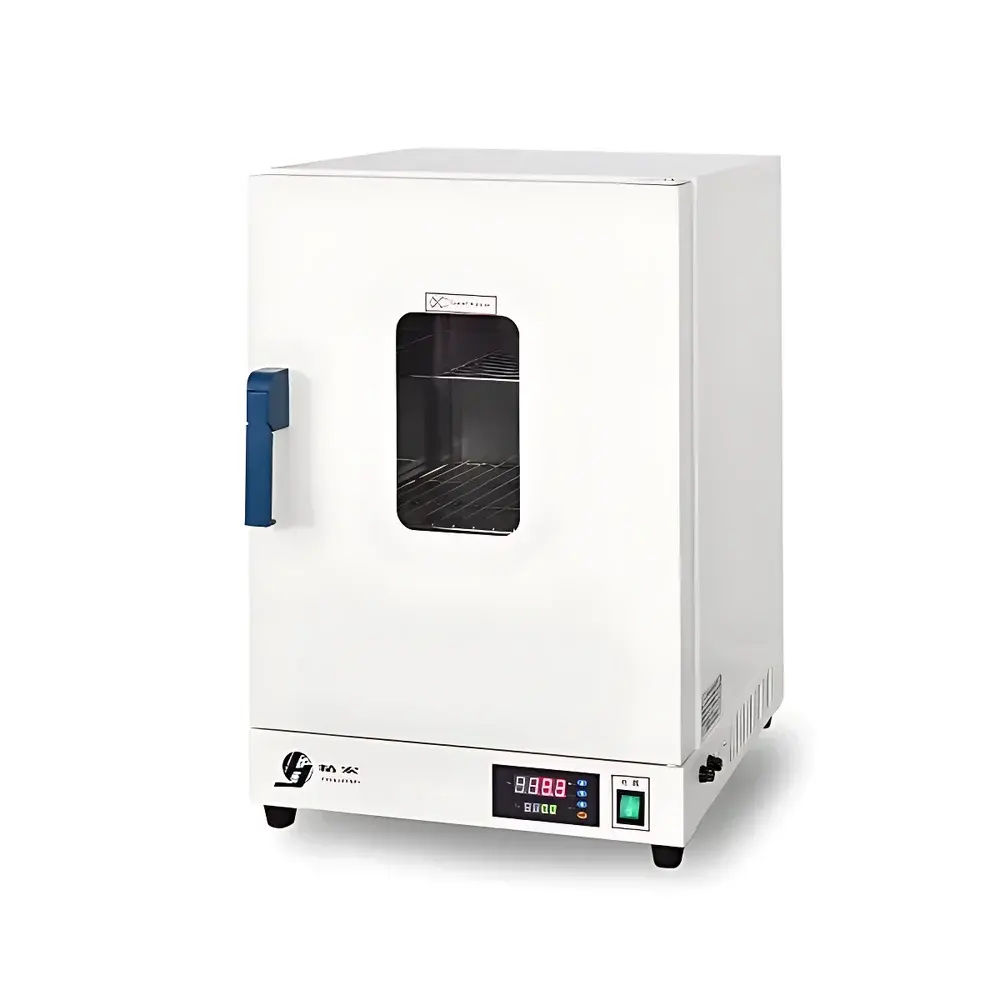
JingHong DHG-9030A & DHG-9030Y Forced-Air Drying Oven
| Brand | JingHong |
|---|---|
| Origin | Shanghai, China |
| Model | DHG-9030A, DHG-9030Y |
| Temperature Range | RT+10°C to 200°C |
| Temperature Uniformity | ±1°C |
| Temperature Resolution | 0.1°C |
| Chamber Dimensions (W×D×H) | 300×300×350 mm |
| External Dimensions (W×D×H) | 440×495×620 mm |
| Chamber Material | Stainless Steel |
| Heating Method | Forced-Air Circulation |
| Operating Ambient Temperature | 5–40°C |
| Instrument Type | General-Purpose Laboratory Drying Oven |
Overview
The JingHong DHG-9030A and DHG-9030Y are precision-engineered forced-air drying ovens designed for consistent thermal processing in laboratory, industrial QA/QC, and research environments. These units operate on the principle of convective heat transfer enhanced by a regulated internal air circulation system—ensuring uniform temperature distribution across the entire working chamber. Unlike natural-convection ovens, the integrated low-noise centrifugal blower actively circulates heated air through calibrated ducts, minimizing thermal gradients and reducing drying or conditioning time variability. The ovens are rated for continuous operation within a controlled ambient range of 5–40°C and support applications requiring stable thermal exposure from ambient +10°C up to 200°C—making them suitable for moisture removal, pre-weighing sample conditioning, polymer curing verification, and residual solvent evaporation per ASTM D1654 and ISO 527-2 protocols.
Key Features
- Stainless steel interior chamber (300 × 300 × 350 mm) resistant to corrosion, oxidation, and repeated thermal cycling—ensuring long-term dimensional stability and ease of cleaning.
- Microprocessor-based PID temperature controller with dual digital display: one channel for setpoint, another for real-time chamber temperature—enabling precise monitoring and traceable process control.
- Auto-tuning function for optimal PID parameter adaptation to load conditions, improving thermal response stability during chamber door openings or mass-loading events.
- Adjustable power suppression mode to mitigate overshoot during ramp-to-setpoint phases—critical for thermally sensitive samples such as pharmaceutical excipients or hygroscopic powders.
- Forced-air circulation architecture delivers ≤±1°C temperature uniformity (measured per IEC 60068-3-5 at nine standardized chamber locations), validated under no-load and half-load conditions.
- Front-access viewing window with double-layer tempered glass provides visual process monitoring without compromising thermal integrity or operator safety.
Sample Compatibility & Compliance
The DHG-9030A/Y accommodates standard laboratory ware including porcelain crucibles, aluminum weighing dishes, glass Petri dishes, and stainless steel trays—compatible with common gravimetric moisture analysis workflows (e.g., AOAC 950.46, USP <731>). Chamber volume (31.5 L) supports batch processing of multiple samples while maintaining regulatory-grade repeatability. Units comply with GB/T 5170.2–2017 (Chinese national standard for temperature testing equipment) and meet essential safety requirements per IEC 61010-1:2010 for electrical equipment used in laboratory environments. Though not FDA 21 CFR Part 11–certified out-of-the-box, audit-ready operation is achievable when paired with external electronic lab notebook (ELN) systems supporting ALCOA+ data integrity principles.
Software & Data Management
These ovens operate as standalone instruments with embedded firmware—no proprietary software required. All operational parameters (setpoint, dwell time, ramp rate) are configured via front-panel keypad and retained in non-volatile memory during power loss. Optional RS-485 interface (available upon request) enables integration into centralized facility monitoring systems using Modbus RTU protocol for remote status polling and event logging. For GLP/GMP-aligned labs, users may deploy third-party data acquisition platforms (e.g., LabVIEW, Ignition SCADA) to capture timestamped temperature logs with electronic signature capability—supporting 21 CFR Part 11 compliance when configured with appropriate access controls and audit trail modules.
Applications
- Moisture content determination in food, feed, soil, and pharmaceutical raw materials (per gravimetric drying standards).
- Baking and pre-drying of filter papers, pipette tips, and glassware prior to sterility validation.
- Thermal stabilization of reference standards before calibration or inter-laboratory comparison studies.
- Accelerated aging tests for packaging materials and adhesives under controlled isothermal conditions.
- Pre-heating of metal coupons for corrosion testing (ASTM G1, ISO 9223) and salt-spray chamber preconditioning.
- Low-temperature sterilization of non-heat-sensitive tools where steam autoclaving is impractical.
FAQ
What is the difference between the DHG-9030A and DHG-9030Y models?
The DHG-9030A features a standard microprocessor controller with timer and auto-shutdown; the DHG-9030Y includes an upgraded controller with programmable multi-step ramp-soak profiles and enhanced data hold functionality.
Can this oven be used for sterilization of medical devices?
It is not validated for microbial kill efficacy per ISO 17665 or AAMI ST38; it supports only dry-heat depyrogenation of glassware and metal instruments at ≥160°C for ≥2 hours, per USP <1211> guidance.
Is the temperature sensor calibrated and traceable to NIST standards?
The unit ships with a factory-calibrated PT100 sensor; full NIST-traceable calibration certificates are available as an optional add-on service.
Does the oven support external data logging without modification?
Yes—via optional RS-485 output with Modbus RTU, enabling direct connection to PLCs, SCADA systems, or PC-based DAQ hardware.
What maintenance is recommended for long-term reliability?
Biannual inspection of fan bearings and air filter (if equipped), quarterly verification of door gasket compression, and annual validation of temperature uniformity and controller accuracy per ISO/IEC 17025 Annex A.4 guidelines.



