
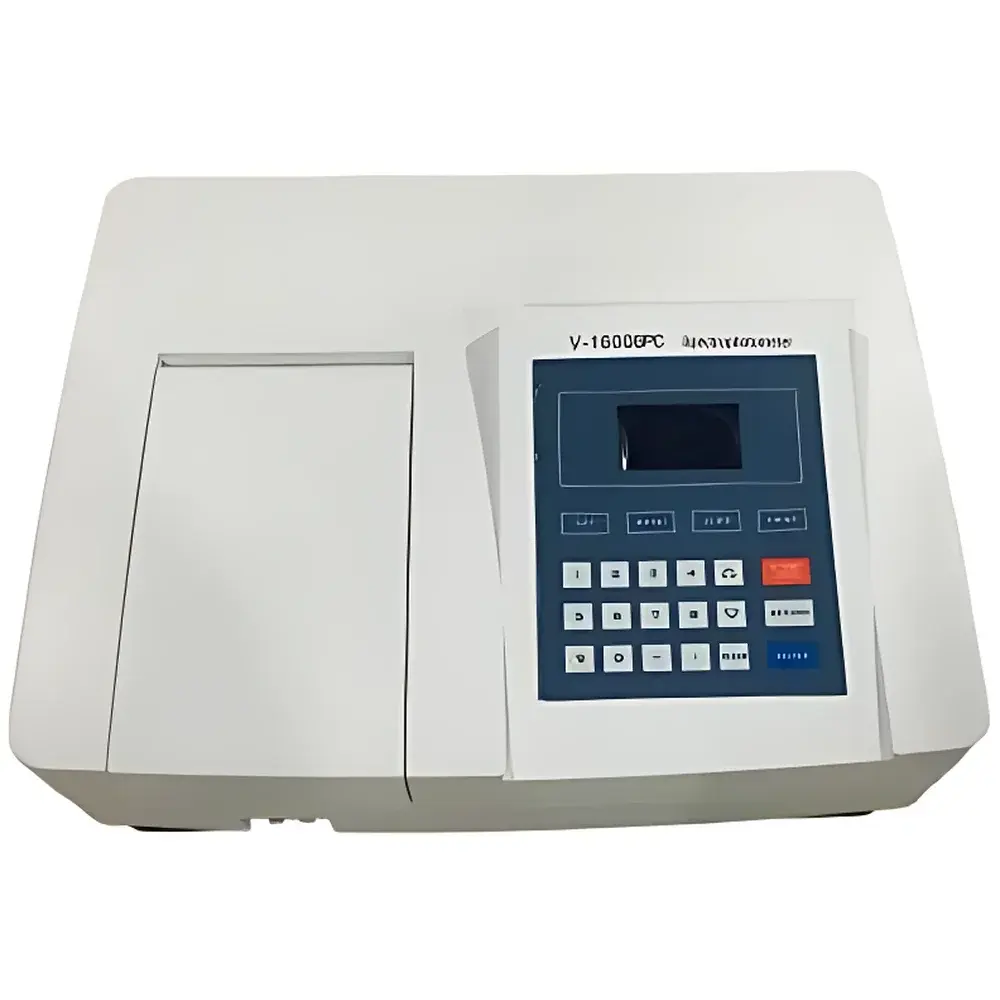
MAPADA UV-1600B and UV-1600BPC Single-Beam Ultraviolet-Visible Spectrophotometers
| Brand | MAPADA |
|---|---|
| Origin | Shanghai, China |
| Model | UV-1600B, UV-1600BPC |
| Optical System | Single-beam |
| Detector | Imported silicon photodiode array |
| Wavelength Range | 190–1100 nm |
| Spectral Bandwidth | 4 nm |
| Wavelength Accuracy | ±0.5 nm |
| Wavelength Repeatability | ≤0.2 nm |
| Stray Light | ≤0.05% T @ 220 nm and 360 nm |
| Photometric Accuracy | 0.3% T (0–100% T), ±0.002 A (0–0.5 A), ±0.004 A (0.5–1 A) |
| Photometric Repeatability | ≤0.15% T (0–100% T), ±0.001 A (0–0.5 A), ±0.002 A (0.5–1 A) |
| Baseline Flatness | ±0.002 A (200–1000 nm) |
| Drift | ±0.001 A/h @ 500 nm |
| Noise | ±0.0005 A |
| Display | 128 × 64 dot-matrix LCD |
| Data Interface | USB port |
| Power Supply | AC 220 V/50 Hz or AC 110 V/60 Hz |
| Dimensions | 490 × 360 × 240 mm |
| Weight | 14 kg |
Overview
The MAPADA UV-1600B and UV-1600BPC are single-beam ultraviolet-visible (UV-Vis) spectrophotometers engineered for routine quantitative and qualitative analysis in academic laboratories, quality control environments, and industrial R&D settings. Based on Beer-Lambert law principles, these instruments measure absorbance, transmittance, and energy across a broad spectral range (190–1100 nm), enabling reliable characterization of organic compounds, transition metal complexes, biomolecules, and colored solutions. The optical architecture employs a high-efficiency 1200 lines/mm holographic grating and an imported silicon photodiode array detector, ensuring consistent signal-to-noise performance and long-term photometric stability. Designed with regulatory-aware workflows in mind, the UV-1600B series supports traceable wavelength calibration, lamp usage monitoring, and automated source switching—features aligned with GLP-compliant documentation practices and foundational requirements for ISO/IEC 17025-accredited testing labs.
Key Features
- Single-beam optical design optimized for cost-effective, high-reproducibility absorbance measurements in standardized protocols.
- Integrated 128 × 64 dot-matrix LCD display supporting real-time visualization of kinetic curves, calibration plots (with linear regression equations), and up to 200 stored measurement records.
- Onboard storage capacity for up to 100 user-defined calibration curves—enabling rapid method recall without external software dependency.
- Automated wavelength calibration and lamp management: intelligent control of deuterium and tungsten lamp activation, runtime logging, and seamless source switching at optimal cutoff points (~350 nm).
- Modular lamp housing with plug-in configuration—eliminates optical realignment during replacement, reducing downtime and technician dependency.
- Wide sample compartment accommodating cuvettes from 5 mm to 100 mm pathlength, compatible with standard quartz, glass, and plastic cells.
- USB interface compliant with USB 2.0 specifications, facilitating direct data export to Windows-based systems and interoperability with third-party spreadsheet or LIMS platforms.
Sample Compatibility & Compliance
The UV-1600B series accommodates standard 10 mm rectangular cuvettes as well as variable-pathlength cells (5–100 mm), supporting both dilute and highly concentrated samples via manual gain adjustment or pre-dilution protocols. Instrument performance meets key international benchmarks for routine UV-Vis instrumentation: stray light ≤0.05% T at 220 nm and 360 nm satisfies ASTM E387 and ISO 9001 verification criteria; wavelength accuracy (±0.5 nm) and repeatability (≤0.2 nm) conform to manufacturer specifications referenced in USP for spectrophotometer qualification. While not inherently 21 CFR Part 11 compliant in standalone mode, the system supports audit-trail-capable data handling when integrated with validated MAPADA acquisition software under controlled IT governance.
Software & Data Management
The UV-1600BPC variant includes enhanced PC connectivity via USB, enabling bidirectional communication with optional MAPADA SpectraSoft™ data acquisition software. This application provides extended functionality including time-scan kinetics, multi-wavelength quantitation, spectral overlay, and customizable report generation. All raw absorbance/time or absorbance/wavelength datasets are exported in CSV format—ensuring compatibility with MATLAB, Python (NumPy/Pandas), or laboratory information management systems (LIMS). Internal memory retains calibration parameters and measurement history with timestamping, supporting basic traceability requirements for internal QA audits.
Applications
- Quantitative determination of nucleic acids and proteins using established extinction coefficients (e.g., A260/A280 ratios).
- Pharmaceutical assay validation per USP monographs requiring fixed-wavelength or scanning-mode measurements.
- Environmental water analysis for nitrate, phosphate, and COD-related chromophores within EPA-approved methods.
- Food and beverage quality control, including color index evaluation and preservative concentration monitoring.
- Academic teaching labs for fundamental spectroscopy experiments, including Beer’s law verification and equilibrium constant determination.
FAQ
What is the difference between the UV-1600B and UV-1600BPC models?
The UV-1600BPC adds full USB host capability and bundled PC software support, whereas the UV-1600B operates in standalone mode with local display and internal memory only.
Is this instrument suitable for GMP-regulated environments?
It supports essential operational qualification (OQ) parameters but requires supplementary procedural controls—including documented calibration logs, user access restrictions, and electronic record retention—to meet full GMP or 21 CFR Part 11 expectations.
Can the instrument perform scanning measurements across the full 190–1100 nm range?
Yes—both models execute continuous wavelength scans with programmable start/stop points, step resolution (1 nm default), and scan speed optimization for signal averaging.
Does the system include wavelength verification standards?
No certified holmium oxide or didymium filters are included by default; users must procure NIST-traceable reference materials separately for periodic verification.
What maintenance is required for long-term photometric stability?
Routine cleaning of the sample compartment and optical window, annual lamp replacement (typical deuterium lamp life: ~1000 h), and biannual wavelength calibration using reference standards are recommended.
Related Products






