
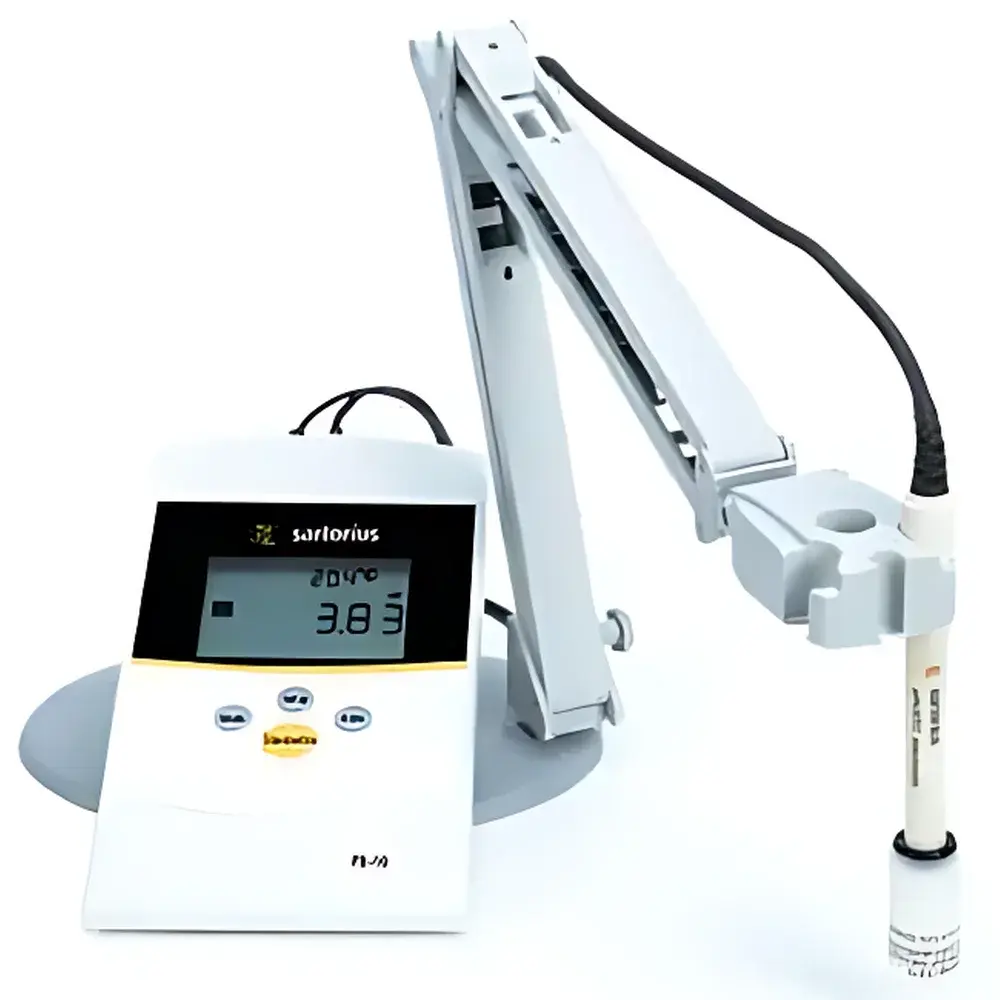
Sartorius PB-10 Benchtop pH Meter
| Brand | Sartorius |
|---|---|
| Origin | Germany |
| Model | PB-10 |
| Instrument Type | Benchtop |
| Parameter Types | pH, mV, Temperature |
| pH Range | 0.00–14.00 |
| pH Resolution | 0.01 |
| pH Accuracy | ±0.01 |
| mV Range | ±1500 mV |
| mV Resolution | 0.1 mV |
| mV Accuracy | ±0.4 mV |
| Temperature Range | −5.0 to 105.0 °C |
| Temperature Resolution | 0.1 °C |
| Temperature Accuracy | ±0.2 °C |
| Calibration Points | Up to 3-point |
| Buffer Recognition | Auto-detection of up to 16 NIST-traceable standard buffers |
| ATC (Automatic Temperature Compensation) | Yes |
| Electrode Slope Monitoring | Yes |
| Display | LCD with simultaneous pH/mV/°C/buffer ID |
| Input Interface | BNC |
| Power Supply | AC adapter |
| Dimensions (L×W×H) | 230 × 120 × 80 mm |
Overview
The Sartorius PB-10 Benchtop pH Meter is a precision electrochemical instrument engineered for reliable, repeatable pH and redox (mV) measurements in routine laboratory environments. Based on potentiometric measurement principles—where the potential difference between a pH-sensitive glass electrode and a stable reference electrode is converted into a logarithmic pH value—the PB-10 delivers high reproducibility across aqueous and mildly buffered samples. Its design adheres to fundamental metrological requirements defined in ISO 7027 and ASTM D1293 for pH determination, ensuring traceability to NIST-certified buffer standards. As a benchtop system, it prioritizes operational stability over portability, featuring a rigid chassis, low-drift analog circuitry, and electromagnetic interference (EMI)-resistant signal conditioning to minimize noise in shared lab environments.
Key Features
- Three-point calibration with automatic recognition of up to 16 NIST-traceable pH buffer solutions (including pH 4.01, 7.00, and 10.01), eliminating manual buffer selection errors
- Integrated Automatic Temperature Compensation (ATC) using a built-in or external Pt1000 sensor, applying the theoretical Nernst slope correction across −5.0 to 105.0 °C
- Real-time electrode diagnostics: displays slope (%), offset (mV), and status indicator to verify electrode health prior to measurement
- Stability-assisted reading: “Hold” icon activates only when signal drift falls below 0.01 pH/min for ≥3 seconds—ensuring thermodynamic equilibrium is reached
- Simultaneous display of pH (or mV), temperature, and active buffer identity on a high-contrast LCD—reducing transcription errors during QC documentation
- One-touch calibration initiation and auto-storage of up to three calibration profiles with timestamps (non-volatile memory)
- BNC input compatibility with industry-standard combination electrodes—including the supplied tri-functional pH/ATC/REF electrode—supporting rapid probe interchange without recalibration
Sample Compatibility & Compliance
The PB-10 is validated for use with aqueous solutions, buffer standards, cell culture media, pharmaceutical formulations, and food extracts where ionic strength remains within 0.1–1.0 mol/kg. It is not intended for non-aqueous solvents, highly viscous slurries, or samples containing sulfides, proteins, or heavy metals that may poison the reference junction. The instrument complies with IEC 61010-1 for electrical safety and meets EMC directive 2014/30/EU. While the PB-10 itself does not provide audit trails or user access control, its calibration records and measurement outputs support GLP-compliant workflows when documented manually or integrated via RS232 output into validated LIMS platforms.
Software & Data Management
The PB-10 operates as a standalone instrument with no embedded firmware-based data logging. However, its RS232 serial interface (optional cable required) enables direct transmission of real-time pH/mV/°C values to PC-based applications such as Excel, LabChart, or custom Python scripts using standard ASCII protocols. All transmitted data include timestamp (derived from host system), measurement mode identifier, and unit annotation—facilitating alignment with 21 CFR Part 11–aligned systems when paired with appropriate electronic signature and audit trail software. Calibration history is retained in device memory but requires manual export; no cloud connectivity or proprietary software installation is involved.
Applications
- Quality control of purified water (PW) and water-for-injection (WFI) per USP and EP 2.2.40
- pH verification of calibration standards in metrology labs accredited to ISO/IEC 17025
- Batch release testing of topical pharmaceuticals, oral suspensions, and ophthalmic solutions
- Monitoring fermentation broth pH in bioprocess development
- Educational laboratories requiring robust, entry-level instrumentation with clear electrode diagnostics
- Environmental testing of surface water, wastewater effluents, and soil leachates per EPA Method 150.1
FAQ
Does the PB-10 support GLP-compliant record keeping?
No—GLP compliance requires electronic signatures, audit trails, and user authentication, which the PB-10 does not provide natively. However, its RS232 output allows integration into validated third-party data acquisition systems that meet these requirements.
Can I use non-Sartorius electrodes with the PB-10?
Yes—any BNC-compatible combination electrode with a single-junction or double-junction reference system will function, though slope accuracy and lifetime may vary depending on junction design and filling solution compatibility.
Is the PB-10 suitable for measuring pH in organic solvent mixtures?
Not recommended. The glass electrode’s asymmetric potential and liquid junction potential become unstable in non-aqueous media; dedicated non-aqueous pH electrodes and specialized calibration protocols are required.
How often should I calibrate the instrument?
Calibration frequency depends on application criticality: daily for regulated QC, before each analytical session for research use, and immediately after electrode replacement or extended storage.
What does a slope value below 90% indicate?
A slope < 90% suggests reduced electrode sensitivity—common causes include dried-out hydration layer, clogged reference junction, or aging glass membrane—and warrants cleaning, rehydration, or replacement per Sartorius Technical Note TN-PH-002.
Related Products







