
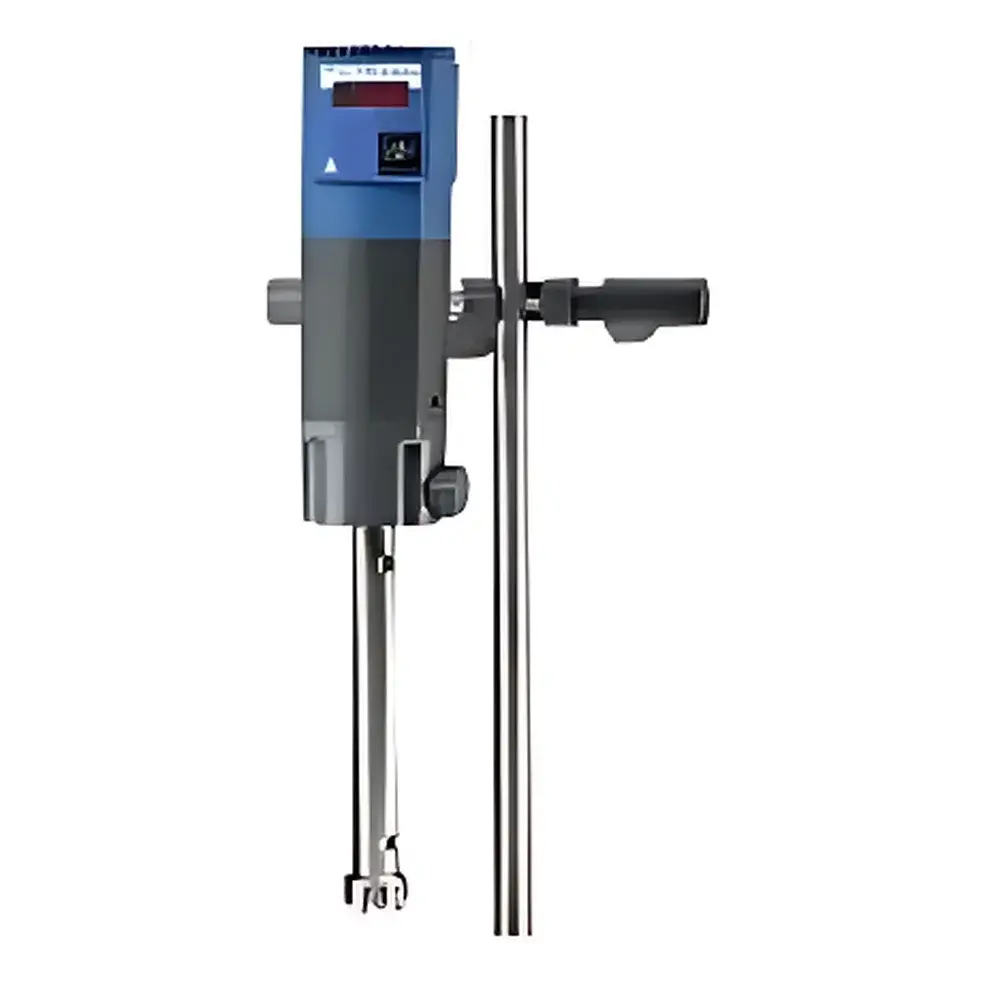
IKA T25 Digital High-Speed Dispersion Homogenizer
| Brand | IKA |
|---|---|
| Origin | Germany |
| Model | T25 Digital |
| Instrument Type | Probe-type Rotor-Stator Homogenizer |
| Dimensions (W×D×H) | 87 × 271 × 106 mm |
| Processing Volume Range | 1–2000 mL |
| Motor Input Power | 500 W |
| Motor Output Power | 300 W |
| Speed Range | 3400–24,000 rpm |
| Speed Accuracy | ±1% |
| Max. Viscosity | 5000 mPa·s |
| Display | LED Digital |
| Protection Class | IP20 |
| Operating Temperature | 5–40 °C |
| Relative Humidity | ≤80% |
| Voltage | 220–240 V / 100–120 V |
| Frequency | 50/60 Hz |
| Noise Level (no probe) | 73 dB(A) |
| Shaft Diameter | 13 mm |
| Shaft Length | 175 mm |
| Compliance | DIN EN 60529 |
Overview
The IKA T25 Digital is a high-performance, probe-type rotor-stator homogenizer engineered for precision dispersion, emulsification, and cell disruption in research and quality control laboratories. Utilizing the proven ULTRA-TURRAX® principle—where high-shear forces are generated by the relative motion between a rapidly rotating rotor and a stationary stator—the instrument delivers reproducible particle size reduction and homogeneous sample preparation across a broad viscosity range (up to 5000 mPa·s). Designed for batch processing of volumes from 1 mL to 2000 mL (water-equivalent), the T25 Digital integrates robust mechanical architecture with digital speed control and real-time LED feedback, enabling consistent operation under variable load conditions including vacuum or pressurized reactor environments. Its compact footprint (87 × 271 × 106 mm) and lightweight construction (1.6 kg) support flexible benchtop integration without compromising torque stability or thermal management.
Key Features
- Digitally controlled speed regulation (3400–24,000 rpm) with ±1% accuracy and continuous LED display for precise method replication
- Three-point precision bearing system ensuring long-term rotational stability and minimal runout—even during extended high-load cycles
- Rotor-stator geometry optimized for rapid energy transfer and uniform shear distribution, validated for applications ranging from diagnostic specimen homogenization to nanoparticle dispersion
- Interchangeable stainless-steel probes (e.g., S25N–10G, S25N–19G) compatible with standard IKA ULTRA-TURRAX® accessories; all probes feature quick-lock mechanism and 30-year functional warranty
- Thermally stable 500 W input / 300 W output motor with integrated electronic overload protection and automatic thermal cut-off
- IP20-rated housing compliant with DIN EN 60529, suitable for standard laboratory ambient conditions (5–40 °C, ≤80% RH)
- No RS232 or analog output interfaces—designed as a standalone, operator-controlled instrument meeting core GLP documentation requirements via manual log entry
Sample Compatibility & Compliance
The T25 Digital accommodates aqueous, organic, and semi-viscous samples—including biological tissues, polymer suspensions, pharmaceutical slurries, and environmental wastewater matrices. Its rotor-stator configuration enables effective processing of heterogeneous systems where particle deagglomeration, phase stabilization, or cellular lysis is required. While not certified for intrinsically safe (ATEX) or cleanroom (ISO 14644) environments, the unit conforms to general electrical safety standards per DIN EN 60529 (IP20) and operates within voltage/frequency tolerances specified for global laboratory infrastructure (100–240 V, 50/60 Hz). It supports routine QC workflows aligned with ASTM D3764 (emulsion stability), ISO 13320 (laser diffraction sample prep), and USP (liposome size distribution protocols), provided procedural validation is performed per lab-specific SOPs.
Software & Data Management
The T25 Digital operates as a stand-alone instrument with no embedded firmware-based data logging or network connectivity. All operational parameters—including set speed, runtime, and probe type—are recorded manually by the user in laboratory notebooks or LIMS-integrated electronic records. The absence of digital communication ports (RS232, USB, Ethernet) eliminates cybersecurity concerns and simplifies 21 CFR Part 11 compliance when used in regulated environments: audit trails are maintained externally through documented procedures, signature logs, and version-controlled SOPs. For labs requiring automated traceability, external tachometer integration (via optional speed sensor port on select legacy bases) permits third-party acquisition of RPM signals into validated SCADA or LabVIEW platforms—subject to site-specific IQ/OQ validation.
Applications
- Pre-analytical sample homogenization for clinical diagnostics (e.g., blood plasma fractionation, tissue lysate preparation)
- Emulsion and suspension formulation development in pharmaceutical and cosmetic R&D
- Environmental sample digestion and particulate dispersion prior to ICP-MS or gravimetric analysis
- Cell disruption for protein extraction and subcellular fractionation (bacterial, yeast, mammalian)
- High-shear mixing of nanocomposite precursors and conductive ink formulations
- In-reactor inline dispersion during small-scale catalytic or polymerization studies under controlled atmosphere
FAQ
What is the minimum and maximum recommended sample volume for the T25 Digital?
The validated working range is 1–2000 mL using water-equivalent media; optimal dispersion efficiency occurs between 10–500 mL depending on probe geometry and viscosity.
Can the T25 Digital be used under vacuum or pressure?
Yes—its sealed motor housing and rigid probe mount allow safe operation in vacuum chambers or pressurized reactors up to 2 bar gauge pressure, provided appropriate feedthrough and cooling provisions are implemented.
Is the T25 Digital compatible with FDA-regulated GMP manufacturing environments?
It may be deployed in GMP settings as a non-product-contact auxiliary device; however, full qualification (IQ/OQ/PQ) must be performed per site-specific protocols, and its lack of electronic audit trail requires complementary procedural controls.
Does IKA provide calibration certificates for speed accuracy?
Factory calibration is performed per internal metrology standards; NIST-traceable speed verification reports are available upon request at time of purchase or during scheduled service intervals.
How does the three-bearing design improve long-term performance?
The tri-radial bearing assembly minimizes axial and radial play over >10,000 hours of operation, reducing vibration-induced probe wear and maintaining consistent tip speed—critical for inter-laboratory reproducibility in multi-site studies.



