
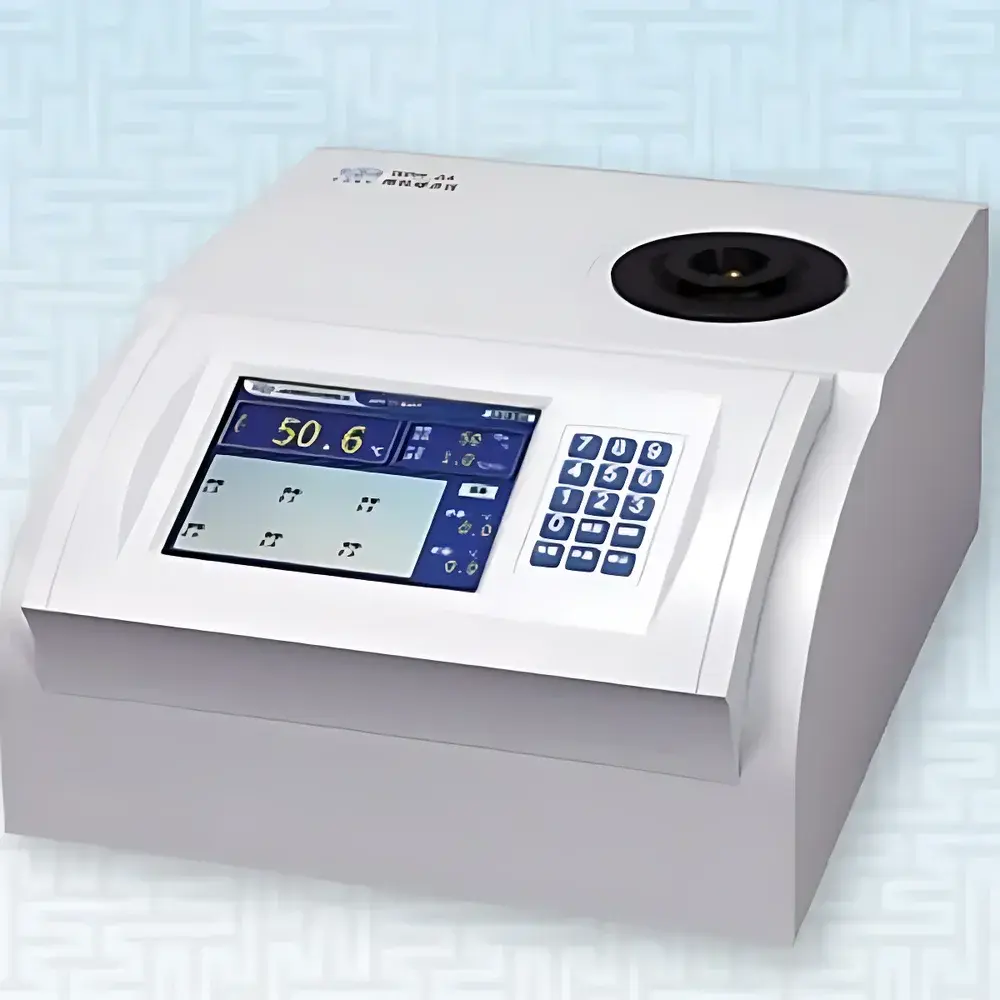
Shanghai Physical Optics WRS-2A Digital Automatic Melting Point Apparatus
| Brand | YDWG (Shanghai Physical Optics) |
|---|---|
| Origin | Shanghai, China |
| Model | WRS-2A |
| Temperature Range | Ambient to 300 °C |
| Heating Rates | 0.2, 0.5, 1.0, 1.5, 2.0, 3.0, 4.0, 5.0 °C/min (8 selectable steps) |
| Temperature Repeatability | ±0.3 °C |
| Temperature Accuracy | ±0.4 °C ≤200 °C |
| Temperature Resolution | 0.1 °C |
| Capillary Dimensions | OD 1.4 mm, ID 1.0 mm, Length 90 mm |
| Sample Capacity | 3 capillaries per run |
| Display | Dot-matrix LCD with keypad input |
| Calibration | Multi-point PT100-based calibration |
| Interface | RS232 and USB |
| Power Supply | 220 V ±10%, 50 Hz ±1 Hz |
| Dimensions (W×D×H) | 360 × 290 × 170 mm |
| Net Weight | 9 kg |
Overview
The Shanghai Physical Optics WRS-2A Digital Automatic Melting Point Apparatus is a precision thermal analysis instrument engineered for reliable, operator-independent determination of melting point ranges in solid organic compounds, pharmaceutical intermediates, polymers, and reference standards. It operates on the principle of optical detection of phase transition—specifically, the onset and completion of solid-to-liquid transformation—as observed through a calibrated capillary tube under controlled linear heating. The system employs a high-linearity PT100 platinum resistance thermometer as its primary temperature sensor, coupled with PID-based thermal regulation to ensure stable, reproducible ramp profiles across its full operating range (ambient to 300 °C). Unlike manual or analog units, the WRS-2A integrates real-time photodetection circuitry that continuously monitors light transmission through the sample column, automatically identifying initial melt (onset) and clear point (endpoint) based on abrupt changes in optical transmittance. This eliminates subjective visual interpretation and significantly reduces inter-operator variability—critical for compliance-driven environments such as pharmaceutical QC laboratories operating under GLP or ISO/IEC 17025 frameworks.
Key Features
- Automated dual-point detection: Simultaneous identification and digital recording of both initial melt (Tonset) and final melt (Tclear) with automatic calculation of melting range width.
- Eight programmable heating rates (0.2–5.0 °C/min), enabling method optimization per pharmacopoeial requirements (e.g., USP <741>, EP 2.2.17) and material-specific thermal response profiling.
- High-fidelity temperature control: PID-regulated heating block with ±0.3 °C repeatability at 1.0 °C/min and certified accuracy traceable to NIST-calibrated references (±0.4 °C ≤200 °C; ±0.7 °C >200 °C).
- Dedicated capillary holder accommodating three standard 1.4 mm OD × 1.0 mm ID × 90 mm tubes—designed for consistent sample geometry and minimal thermal lag.
- Dot-matrix LCD interface with numeric keypad entry, supporting direct parameter input, real-time curve visualization, and on-device statistical evaluation (mean, SD, min/max) across up to three sequential measurements.
- Multi-point calibration capability using certified reference standards (e.g., caffeine, acetanilide, indomethacin), ensuring long-term measurement integrity and audit readiness.
Sample Compatibility & Compliance
The WRS-2A is validated for use with crystalline and semi-crystalline organic solids requiring precise thermal characterization—including active pharmaceutical ingredients (APIs), excipients, fine chemicals, and polymer additives. Sample preparation follows standardized protocols: 3–5 mm packed height in sealed capillaries, dried and homogenized prior to loading. Instrument design conforms to general safety and electromagnetic compatibility (EMC) requirements per IEC 61010-1. While not pre-certified to FDA 21 CFR Part 11, the device supports data export via RS232/USB to compliant LIMS or ELN platforms where electronic signatures, audit trails, and user access controls can be implemented externally. Its performance specifications align with key international standards including ASTM E324 (Standard Test Methods for Softening Point of Solid Materials by Ring-and-Ball Apparatus—comparative validation basis), ISO 6383-1 (Plastics—Determination of Vicat Softening Temperature), and pharmacopoeial monographs referenced in USP <741>, JP 2.60, and Ph. Eur. 2.2.17.
Software & Data Management
The WRS-2A operates as a standalone analytical unit with embedded firmware handling all acquisition, processing, and display functions. Raw thermal profiles and discrete melt values are stored internally and exportable in ASCII format via RS232 or USB to external PCs running third-party spreadsheet or laboratory informatics software. No proprietary driver or closed-format database is required—data files contain timestamped Tonset, Tclear, ramp rate, and operator ID fields (user-entered). For regulated environments, integration with validated chromatography data systems (CDS) or electronic lab notebooks (ELN) enables full traceability, version-controlled method storage, and automated report generation meeting ALCOA+ principles (Attributable, Legible, Contemporaneous, Original, Accurate, Complete, Consistent, Enduring, Available).
Applications
- Pharmaceutical quality control: Identity verification and purity assessment of APIs and drug substances per ICH Q5 and Q6 guidelines.
- Chemical synthesis monitoring: Endpoint confirmation in multi-step organic reactions and crystallization process development.
- Materials science: Thermal stability screening of specialty polymers, liquid crystals, and metal-organic frameworks (MOFs).
- Educational laboratories: Teaching fundamental concepts of phase transitions, eutectic behavior, and thermal analysis methodology.
- Regulatory submissions: Generation of GMP-compliant melting point data packages for DMF filings and ANDA dossiers.
FAQ
What capillary dimensions are supported?
The WRS-2A is configured for standard capillaries with outer diameter 1.4 mm, inner diameter 1.0 mm, and length 90 mm.
Can the instrument store calibration data after power-off?
Yes—calibration coefficients and user-defined method parameters are retained in non-volatile memory without battery backup.
Is external software required for data analysis?
No. All statistical calculations (mean, standard deviation, range) are performed onboard and displayed in real time.
Does the device support GLP-compliant audit trails?
The hardware itself does not generate electronic audit trails; however, exported data files include timestamps and operator identifiers, enabling downstream implementation in validated informatics systems.
What maintenance is recommended for long-term accuracy?
Annual recalibration using NIST-traceable reference standards and periodic cleaning of the optical path and heating block surface are advised per manufacturer guidelines.



